
Switch
SWITCH — *same letters, different word. shake the bag.*
Listen along — Switch
Loading audio…
Press play to listen along. The line being read lights up as you go.
Show full transcript
Loading transcript…
Chapter 3 — Switch and the Bag of Letters
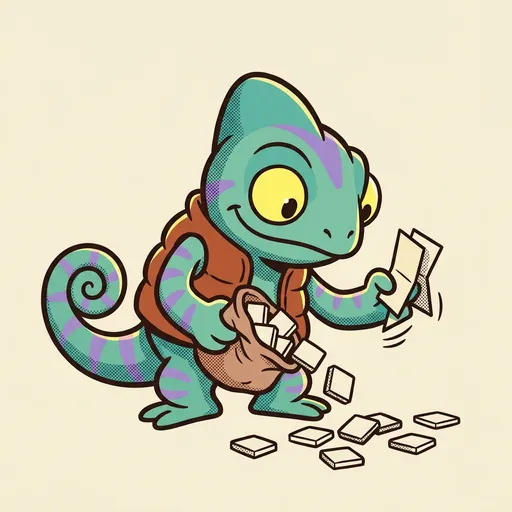
Switch was a kid who moved like a chameleon. One minute, they were there. The next, they’d shifted. They wore a chunky cartoon vest. A small bag of letter tiles hung from their belt. Switch always carried a special card too. It was for mixing up letters.
Switch was small and very curious. Their skin was a cool jade green. Soft violet stripes ran across it. They loved to shuffle letters around. Switch paid close attention to every single letter. They often said, “Same letters, different word. Shake the bag!”
This was Switch’s special trick. Switch taught everyone about anagrams. That’s the fun way to rearrange letters. It’s like a puzzle, but with words.
Think about “listen” and “silent.” They use the exact same letters. Mix them up, and one becomes the other. It’s pretty cool. The meaning even changes. “Astronomer” can turn into “moon starer.” “The eyes” can become “they see.” Anagrams show us something important. Words are just bags of letters. The same letters can make totally different words.
Switch’s special skill is teaching kids to SHAKE THE BAG. It means seeing a word as a bunch of letters. Those letters can rearrange into something new. Most times, shaking the letters makes nonsense. That’s okay! The important part is the practice. Finding a real word is the fun reward.
Switch teaches us about letters. They show that “a word is a bag of letters.” It’s not just a fixed shape. Switch also teaches a rule. “Most shakes make nonsense,” they say. “That’s part of the practice. But one in twenty shakes makes gold!” This skill helps with other things. It helps with QuillSpell, which is about knowing letters. It helps with GrammarForge, which is about how words are built. And it helps with RiddleRealm, which has word puzzles.
Switch would say, “I am Switch. My special skill is anagrams. My move is ‘same letters, different word. Shake the bag!’”
They would also say, “Shake the bag. Most shakes are nonsense. That’s part of the practice.”
One day, Switch and their friends came to a Laughtonia bridge. This bridge was bouncy and made of huge, colorful letters. A grumpy Letter-Sprite guarded it. The Sprite had a big, square head and arms like pencils. It blocked their path.
“Hold it right there, you word-wanderers!” the Letter-Sprite boomed. Its voice sounded like chalk on a blackboard. “To cross this bridge, you must pass my test.”
Quirk gulped. Knot looked worried. The Letter-Sprite held out a small pouch. It tipped the pouch over. Seven letter tiles clattered onto the bridge. They spelled out E, A, R, T, H, S, T.
“Give me a word made from THESE letters!” the Sprite demanded. It pointed a long, bony finger at the tiles.
Quirk froze. Seven letters felt like a lot. Their mind went blank. Knot started to pair letters up. “E-A… R-T…” they mumbled. But nothing clicked.
Switch just smiled. They reached for their own small, imaginary bag. They made a shaking motion with their hands. “Hmm, let’s see,” Switch muttered. They looked closely at the letters. E, A, R, T, H, S, T.
Switch started to try combinations out loud. “H… A… S… T… E… R… T. Hastert? No, we only have one T. And one H.” Switch shook their imaginary bag again. “Okay, what about STREET? No, we need two Es and two Ts for that. We only have one E and two Ts.”
The Letter-Sprite tapped its foot impatiently. Quirk and Knot watched, holding their breath. Switch kept their eyes on the tiles. They kept shaking their imaginary bag. They tried a few more nonsense words. Each time, they checked the letters carefully.
Then, Switch’s eyes lit up. “Wait a minute!” they said. “I’ve got it! THREATS!”
Switch carefully spelled it out with their finger. “T-H-R-E-A-T-S. Yes! Seven letters all used. Every single one!”
The Letter-Sprite’s grumpy face softened a bit. It gave a slow, approving nod. Then it stepped aside. “Well done, word-shaker,” it grumbled. The bouncy bridge suddenly felt much safer.
Switch turned to Quirk and Knot. “See?” they said, holding up their imaginary bag. “The trick isn’t being super smart. It’s just shaking the bag again and again. Most of the words I tried were nonsense. Like ‘HATTERS’ without an A, or ‘STREET’ with the wrong letter counts.”
Switch tapped the bag. “But the shaking made ‘THREATS’ appear. It’s about how many times you try. Not how clever you are on the first try.”
This was a really important lesson. Switch NEVER said that solving anagrams meant you were smart. The skill was in the PRACTICE of shaking. It wasn’t about being fast. The friends NEVER ranked each other. No one was a “good anagrammer” or a “bad anagrammer.” Every kid could shake the bag. Some had just practiced more. That was all. This idea of patience was like what Knot taught.
Switch’s whole skill was about practice. Anagrams have NO special talent. They need NO special insight. They only need you to SHAKE THE BAG. You just keep trying until something appears. The friends understood this. They knew that “word skill is anagram skill is shaking the bag. It’s about practice volume. Not a gift. Just practice.”
Switch’s lessons were connected to other skills. They echoed QuillSpell’s letter knowledge. It was the same skill, just seen in a different way. It connected to GrammarForge, which taught that words’ letters can rearrange. They are separate parts, not stuck together. It also linked to RiddleRealm’s letter puzzles. And even to MathForge, which teaches how many ways things can be arranged.
The WitQuest ensemble
Switch is part of WitQuest's distributed-narrative cast. Each character embodies a different curricular primitive; together they teach the full subject.
-

Quirk
Puns and double-meanings
-
Knot
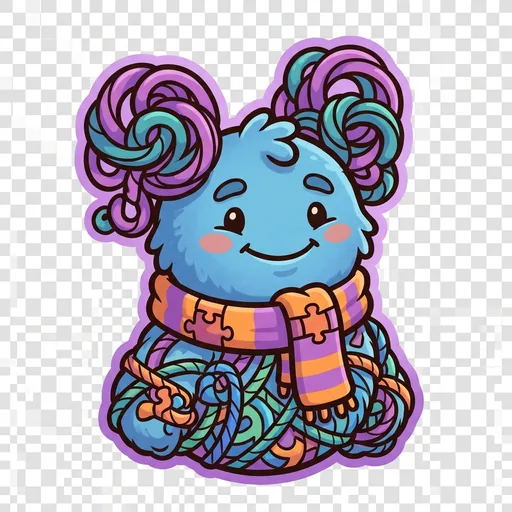
Riddles (compressed-info puzzles where you decode the answer from constrained clues)
-

Lilt
Idioms and figurative language (phrases whose literal meaning ≠ their actual meaning — "raining cats and dogs")
-

Hop
Lateral thinking (finding a non-obvious angle on a problem; sidestepping the assumed framing)
-
Trip
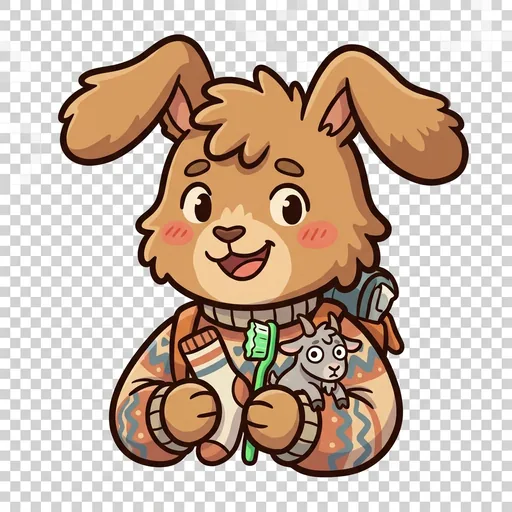
The rule of three (two beats set a pattern; the third breaks it — the break is the laugh)
-
Dry
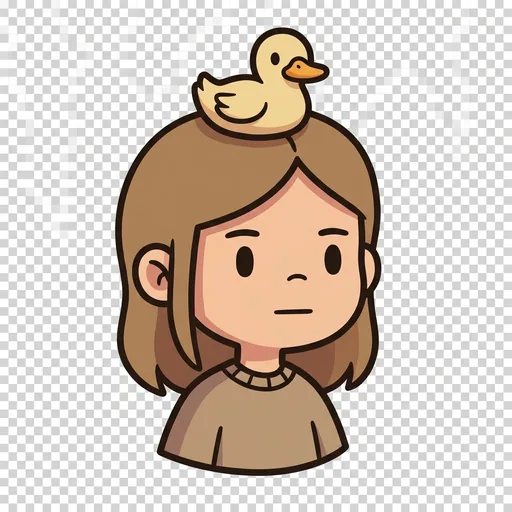
Deadpan delivery (saying something ridiculous with a calm, serious face — the flat delivery is the joke)
-
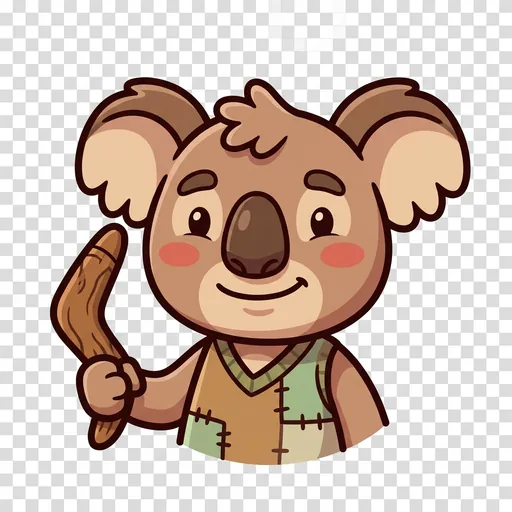
Boomerang
The callback (bringing back an earlier joke later, when it's half-forgotten — funnier the second time)
-
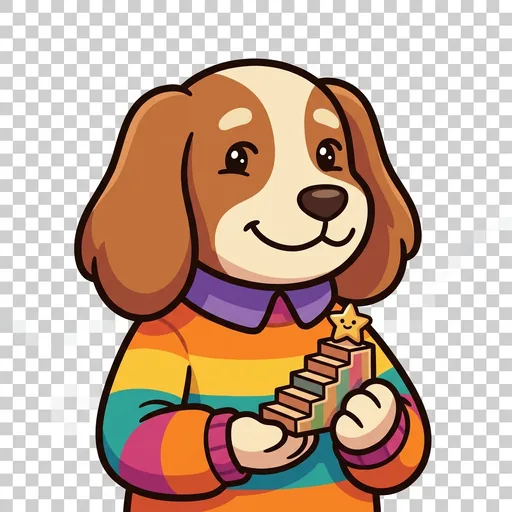
Topper
The topper / escalation (capping a joke with an even bigger one, raising the stakes each time)
-

Straight
The straight man / the setup (reacting normally so the absurdity stands out — comedy needs someone to be normal)