Lilt
LILT — *the literal isn't the meaning. follow the picture, not the words.*
Listen along — Lilt
Loading audio…
Press play to listen along. The line being read lights up as you go.
Show full transcript
Loading transcript…
Chapter 4 — Lilt and the Picture Behind the Words
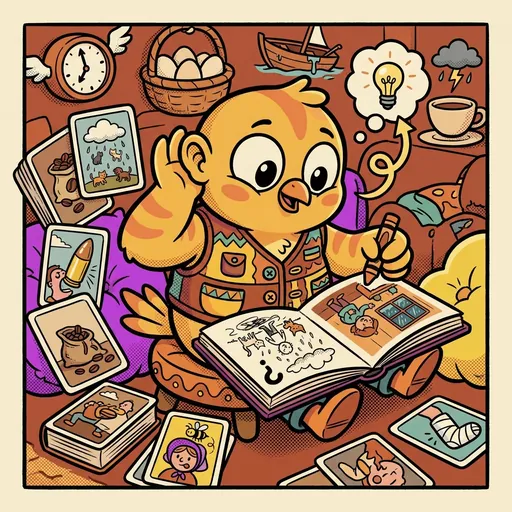
Lilt was small, even for a tween. She often stood with her head tilted, a listening pose that made her seem like a bright canary, ready to catch every sound. Her vest, a cheerful mix of saffron yellow and soft tangerine stripes, was patched with tiny, embroidered pictures: a cat holding an umbrella, a dog wearing rain boots. She called it her comedy-vest. Tucked into one pocket was her idiom-deck, a stack of cards she’d collected from all over Laughtonia. In the other, a slim picture-tracker, ready for new drawings.
Lilt was deeply attentive to the picture a phrase paints. Not just the words themselves, but the image they created in your mind. “The literal isn’t the meaning,” she often said. “Follow the picture, not the words.” She loved to show off her idiom-deck. Each card had a common phrase on one side, like “raining cats and dogs.” On the back, she’d drawn two pictures. One showed actual cats and dogs falling from the sky, looking quite confused. The other showed a sky dark with heavy rain, puddles splashing everywhere. Two very different pictures for the same words.
This was Lilt’s craft. She understood that language lived in pictures, and sometimes those pictures wandered far from the literal words. For kids learning English as a second language, or those who thought more literally, like some on the autism spectrum, these phrases could be truly confusing. Lilt’s job was to explain them carefully, never as a test, but always as shared cultural pictures. She wanted everyone to see the humor and the meaning.
She believed that being picture-fluent was more important than being literal-fluent in English.
Lilt stood before the cast, her usual gentle smile in place. “I am Lilt,” she announced, her voice soft but clear. “The primitive I teach is idioms and figurative language. The move is: the literal isn’t the meaning. Follow the picture, not the words.”
Just then, a traveler from a far province stepped forward, looking genuinely puzzled. He was new to Laughtonia, his clothes still smelling faintly of distant pine forests. “The innkeeper said ‘break a leg’ before my speech tonight,” he said, his brow furrowed. “Why does the innkeeper want me injured?”
A ripple of gentle laughter went through the cast. No one mocked him. They knew better. Lilt stepped forward, her smile warm. “Oh! That’s an idiom,” she explained, pulling a card from her deck. On one side, “Break a leg.” “It actually means ‘good luck’ in a performance.”
The traveler stared at the card. “But… the words say ‘break a leg.’ The picture behind the words is opposite the literal meaning.”
Lilt nodded, her expression understanding. “You’re right,” she agreed. “It doesn’t make sense if you only think about the literal words. Most idioms don’t. They only make sense as pictures that a culture has agreed on. We just know what they mean.” She held up the card, pointing to her drawing of a person on a stage, giving a thumbs-up. “This is the picture we see.”
The traveler still looked unconvinced. “In my home province,” he said slowly, “we say ‘the mountain swallows the sun’ when evening is coming.”
Lilt’s eyes lit up. “See?” she said, her voice full of delight. “That’s a beautiful picture! The mountain doesn’t actually swallow the sun, of course. The sun just goes behind it. But the image, that idea of the mountain taking the sun, is fluent in your culture. ‘Break a leg’ is fluent in mine. We just need to share the picture-fluency.” She tapped her idiom-deck. “Every culture’s idioms paint pictures the literal words don’t. If a phrase confuses you, always ask yourself: ‘What picture is this trying to paint?’”
Lilt knew that idioms were more than just funny phrases. They were like historical fossils, bits of older language or traditions preserved in everyday speech. “Bite the bullet,” for example, didn’t mean chewing ammunition. It came from a time when soldiers on battlefields might literally bite a bullet to endure pain during surgery. Understanding these pictures, Lilt believed, was like stepping into the past, or into someone else’s culture, and truly understanding them. It was a way to make sure no one felt left out just because a phrase sounded strange.
The WitQuest ensemble
Lilt is part of WitQuest's distributed-narrative cast. Each character embodies a different curricular primitive; together they teach the full subject.
-

Quirk
Puns and double-meanings
-

Knot
Riddles (compressed-info puzzles where you decode the answer from constrained clues)
-

Switch
Anagrams (rearranging letters to form a different word — "listen" → "silent")
-

Hop
Lateral thinking (finding a non-obvious angle on a problem; sidestepping the assumed framing)
-
Trip
The rule of three (two beats set a pattern; the third breaks it — the break is the laugh)
-
Dry
Deadpan delivery (saying something ridiculous with a calm, serious face — the flat delivery is the joke)
-
Boomerang
The callback (bringing back an earlier joke later, when it's half-forgotten — funnier the second time)
-

Topper
The topper / escalation (capping a joke with an even bigger one, raising the stakes each time)
-

Straight
The straight man / the setup (reacting normally so the absurdity stands out — comedy needs someone to be normal)