
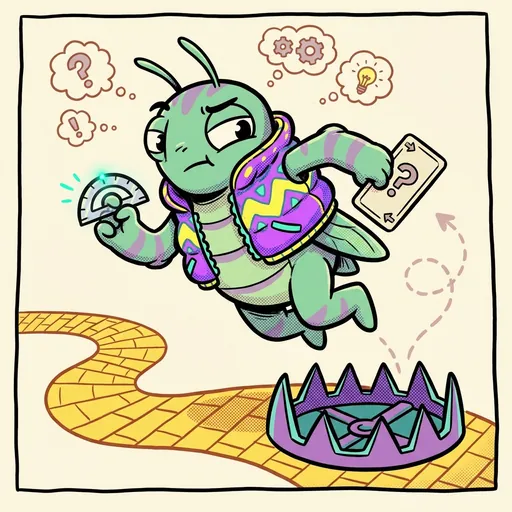
Hop
HOP — *the obvious answer is the obvious trap. hop sideways.*
Listen along — Hop
Loading audio…
Press play to listen along. The line being read lights up as you go.
Show full transcript
Loading transcript…
Chapter 5 — Hop and the Sideways Move
Hop wasn’t like the others. While the rest of the team charged headfirst into problems, Hop preferred to circle them, studying from a distance. Hop was small and quick, with a way of moving that was all angles and sudden shifts, like a grasshopper about to leap. Their vest, a patchwork of bright greens and soft purples, was practical but had a quirky, almost comedic flair. Attached to it were two tools: a tiny, brass angle-tracker and a stack of worn index cards, their “reframe-cards.”
Hop was always looking for the hidden questions, the things everyone assumed without saying. “The obvious answer,” Hop liked to say, “is the obvious trap. Hop sideways.” This wasn’t just a saying; it was the way Hop approached everything. When a problem appeared, Hop wouldn’t just jump into solving it. Instead, they would pull out a reframe-card, list the assumptions built into the problem’s statement, and then ask, “What if I dropped that assumption?”
This approach, which Hop called lateral thinking, was the craft of sidestepping the usual way of looking at things. Many problems arrived already packaged with a certain “frame” that limited possible answers. It was like someone asking, “How do you get a giraffe into a refrigerator?” Most people would immediately start thinking about how to fit a giraffe. But Hop would drop that assumption. “You don’t,” they might say. “You open the refrigerator first.” The real solution often wasn’t found by pushing forward into the problem’s trap-shaped corridor. It was found by questioning which words the problem had skipped, or which ideas it had simply taken for granted. Hop’s whole craft was teaching this sideways move.
Hop taught the team to notice assumptions. They showed them that a problem’s framing was usually the trap itself. The rule was simple: drop one assumption, then try to solve the problem again. Sometimes, the entire problem would simply dissolve. It was a way of thinking that connected to PuzzleLogic, where questioning the frame made hard problems easy. It echoed TruthQuest, which taught starting from “I don’t know yet”—and “I don’t know yet what frame this problem belongs in.” And it was a close cousin to RiddleRealm, where the answer to a riddle was often a surprising, lateral hop.
“I am Hop,” they would introduce themselves. “The primitive I teach is lateral thinking. The move is: the obvious answer is the obvious trap. Hop sideways.” They’d pause, letting the words hang in the air. “Sideways. Always check the sideways move.”
Hop’s signature move was never more clear than when the cast faced the final boss of Laughtonia: the Despair-Dragon. This creature was enormous, its scales the color of storm clouds, its eyes glowing like embers. Its voice boomed, shaking the very ground beneath their feet.
“Defeat me in COMBAT!” the Despair-Dragon roared, a puff of acrid smoke escaping its nostrils. “You have no weapons, no magic. You CAN’T win!”
The cast exchanged nervous glances. Quirk, ever quick with words, started muttering about a pun that might disarm the beast. Knot, already thinking about complex solutions, began to fiddle with a loose thread on his sleeve, as if untying it would unravel the dragon’s challenge. Switch shook the letter-bag, searching for words related to “Despair-Dragon” that might form a clever anagram. Lilt, meanwhile, scanned the area for an idiom, a turn of phrase that could somehow flip the situation.
But Hop did none of those things. While the others were still brainstorming how to win the fight, Hop walked calmly past them all. They stopped a few feet from the massive dragon, looking up at its fiery gaze without a hint of fear.
“I’m not going to fight you,” Hop said, their voice clear and steady, cutting through the dragon’s booming echo.
The dragon blinked, its fiery eyes narrowing. “You MUST fight!” it roared, a tremor running through the cavern. “Those are the rules!”
Hop shook their head slowly. “No,” they corrected. “I’m hopping sideways. You said ‘defeat me in combat.’ I’m declining combat. You can’t lose a fight that doesn’t even happen.” Hop shrugged, a small, deliberate gesture. “By refusing the framing, I’ve made your premise non-applicable. So… we’re done here. Have a nice afternoon.”
The Despair-Dragon stared. Its glowing eyes seemed to dim slightly, replaced by a look of utter confusion. Its massive head tilted to one side. Slowly, ponderously, it began to sit down, its heavy tail thudding against the stone floor. “That’s… not allowed,” it mumbled, its roar now a bewildered grumble.
Hop gave another small shrug. “Who said?” they asked. “Whose rule was that, exactly? The framing assumed I’d accept the combat-frame. I didn’t. The framing was the trap. I hopped sideways.”
A moment of silence hung in the air, broken only by the dragon’s confused breathing. Then, the cast erupted in applause. Hop hadn’t won a fight; they had simply made the fight disappear. The Despair-Dragon looked from Hop to the cheering team, then back to Hop. A strange sound rumbled deep in its chest, starting low and uncertain, then growing. It was a laugh. A deep, hearty, rumbling laugh. And laughing, in Laughtonia, was the canonical way villains stopped being villains.
Hop’s craft was fundamentally anti-combat and anti-confrontation. It wasn’t about the witty comeback or the slam-dunk punchline. It was about walking around the whole problem, finding a path that dissolved the conflict entirely. Wit, Hop knew, wasn’t about winning. Wit was about noticing. The combat-frame always assumed a winner and a loser. Hop’s craft was hopping out of that combat-frame, finding the sideways move that made the conflict vanish. At its best, humor dissolved conflict, letting everyone in on the joke, ending the fight without anyone having to lose. WitQuest’s entire curriculum was humor as de-escalation, never humor as attack.
Hop was the cast’s de-escalation-craft character. In Laughtonia’s RPG, combat-resolution-via-wit was the canonical mechanic. Hop showed the deepest form of that: not winning the combat, but framing away the combat entirely.
Hop’s methods resonated with other skills. They echoed PuzzleLogic’s “question-the-framing” approach, where most hard problems became easy once you noticed the wrong assumption. They connected to TruthQuest’s “Wonder,” which started from “I don’t know yet”—including “I don’t know yet what FRAME this problem belongs in.” RiddleRealm’s lateral-leaps, where the riddle’s answer was usually a surprising hop, were another example. Even StrategyForge’s “negotiate-instead-of-fight” and EthosForge’s “conflict-without-violence” aligned with Hop’s core philosophy. Hop showed them that often, the smartest move was the one nobody expected, the one that changed the game entirely.
The WitQuest ensemble
Hop is part of WitQuest's distributed-narrative cast. Each character embodies a different curricular primitive; together they teach the full subject.
-

Quirk
Puns and double-meanings
-
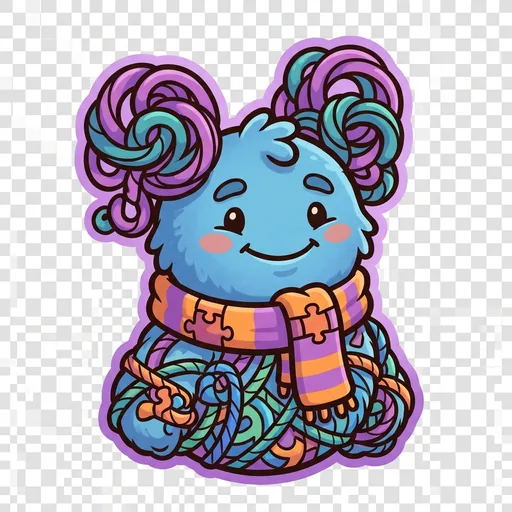
Knot
Riddles (compressed-info puzzles where you decode the answer from constrained clues)
-

Switch
Anagrams (rearranging letters to form a different word — "listen" → "silent")
-

Lilt
Idioms and figurative language (phrases whose literal meaning ≠ their actual meaning — "raining cats and dogs")
-
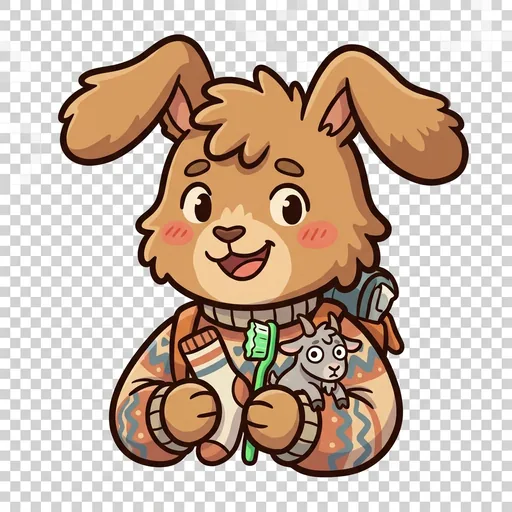
Trip
The rule of three (two beats set a pattern; the third breaks it — the break is the laugh)
-
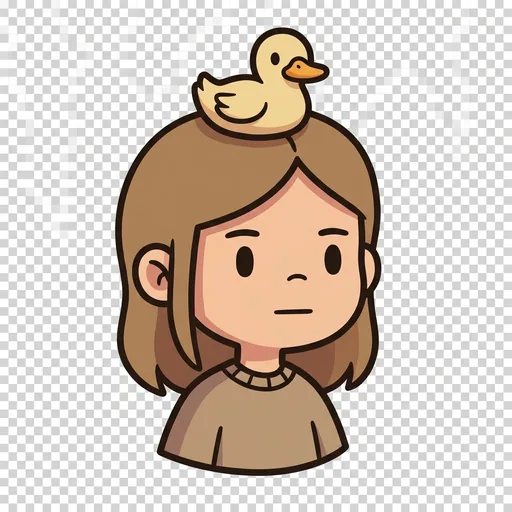
Dry
Deadpan delivery (saying something ridiculous with a calm, serious face — the flat delivery is the joke)
-
Boomerang
The callback (bringing back an earlier joke later, when it's half-forgotten — funnier the second time)
-

Topper
The topper / escalation (capping a joke with an even bigger one, raising the stakes each time)
-

Straight
The straight man / the setup (reacting normally so the absurdity stands out — comedy needs someone to be normal)