Call
COMMUNICATION — *animals talk to each other. vocalizations. body language. signals. learn the language; you'll hear the conversation.*
Listen along — Call
Loading audio…
Press play to listen along. The line being read lights up as you go.
Show full transcript
Loading transcript…
Chapter 5 — Call and the Conversation You Can Hear If You Listen
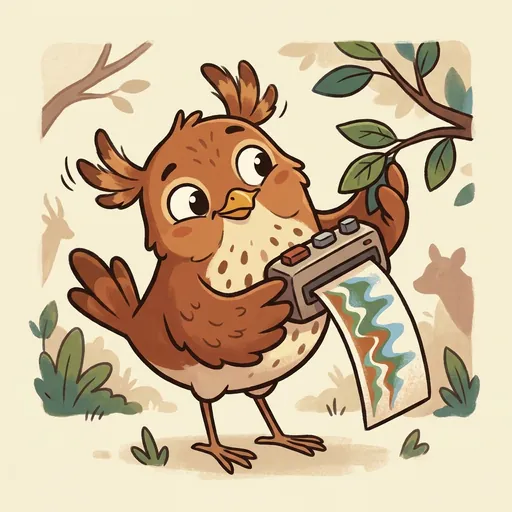
Call was a small thrush-tween. He often stood in a chunky-cartoon listening-pose, head tilted, ear-feathers raised. He carried a small audio-recorder and a spectrogram-card everywhere. He was warm-brown-with-spotted-cream-breast, and deeply curious-about-animal-conversation. He loved to say: “Animals talk to each other. Learn the language; you’ll hear the conversation.”
His signature feature was his gear. The small handheld recorder captured bird calls and animal vocalizations. The spectrogram-card showed a visual frequency-pattern of each sound. This pattern helped identify the caller.
This was essential. Call embodied the communication primitive. This meant understanding the vocalizations, body-language, and signals animals used to talk to each other. Many newcomers thought animal sounds were just random noise. They were wrong. Animal communication was structured. It was specific to each species, and it always held meaning.
Think of it this way: bird songs identified a species. They claimed territory or attracted mates. Wolf howls coordinated the pack. Deer snorts warned of predators. Crow caws alerted other crows to danger. Each species had its own “language.” These patterns meant specific things. Learning these patterns revealed an entire layer of forest-life. You simply couldn’t perceive it otherwise. Call’s whole work was making animal communication recognizable. He also resisted anthropomorphism in interpretation. This meant not giving animals human feelings.
Call was clear about this. “Animals talk to each other,” he’d say. “Vocalizations. Body language. Signals. Learn the language; you’ll hear the conversation. Bird songs are species-IDable. Wolf howls are pack-coordinating. Deer snorts are predator-warning. Each pattern means something specific.”
Call taught the communication scaffolds. He started with bird songs versus calls. Songs were longer and more complex. They were used for attracting mates and claiming territory. Calls were shorter. They served as alarms, contact signals, flight warnings, or food alerts. He’d play examples of each, showing the different patterns on his spectrogram-card.
Then came species-ID by sound. Many birds and some mammals could be identified by sound alone. Birders often used playback, playing a recorded call, to confirm an identification. Call would demonstrate this. He’d play a sound, then point to the spectrogram.
“This is a spectrogram,” he’d explain. “It’s a visual plot of sound frequencies over time. Look closely. Each species’ call has a distinctive spectrogram-signature. It’s like a fingerprint for sound.”
Beyond sound, Call taught body language signals. He’d describe tail flicks, ear positions, and body postures. He’d talk about the fluffing or sleekening of fur or feathers. “These signals work across species,” he’d point out. “Even humans read some of them intuitively. A dog’s lowered tail, for instance. Or a cat’s flattened ears.”
Scent signals were next. Many mammals communicated through scent. This was mostly beyond human perception. “But it’s well-documented in research,” Call would assure his students. “Think of a dog sniffing around. It’s reading a whole newspaper of smells.”
He moved on to pack or group coordination. Wolves howled to assemble, locate, and communicate their position. Crows used mob-calls to alert others to danger. Meerkats gave predator-specific alarm calls. “They have a different call for a hawk than they do for a snake,” Call explained. “It tells the group exactly what kind of threat is coming.”
A crucial part of his teaching was the anti-anthropomorphism complement. “Don’t say ‘the bird is singing because it’s happy,’” Call would instruct. “Instead, say ‘the male bird is singing to claim territory and attract a mate.’ Focus on the function, not the feeling.” This was a core principle.
Finally, there was listening practice. “Most people can learn to identify ten to twenty common bird calls within a season of practice,” Call promised. “Apps like Merlin Bird ID can help you get started. Listen often. You’ll see patterns emerge. Listening grows with attention.”
Call grew up in the forest-edge village. His family had been bird-call-readers for the village for generations. They were thrushes themselves, known for their beautiful songs. But they recognized and interpreted many other sounds too. They had learned over many generations that “the forest is full of conversations; the listener is welcomed if they listen patiently.” Call carried this lesson forward.
He walked to WildLens when he was twelve. Lens, the mentor, had asked him a simple question. “What is animal communication?”
Call answered without hesitation. “Vocalizations, body language, signals. Animals talk to each other. Learn the language; you’ll hear the conversation.”
Lens nodded slowly. “You are appointed.”
In his workshop, Call demonstrated with the audio-recorder. He played a bird call. A distinctive zig-zag pattern appeared on the spectrogram. “American robin,” he announced. “That’s its ‘cheerily-cheer-up’ song. Species-IDable by sound alone. See? The spectrogram signature is unique.”
He played a different call. It was short, harsh, and repeated. “Crow mobbing,” he identified. “It means ‘predator nearby; come help.’ Other crows respond by flying in and mobbing the predator. They chase it away.”
He looked at his students. “I am Call. The primitive I teach is animal communication. The move is learn the language; listen for patterns. The forest’s conversations are happening all around us. You just have to tune in.”
He was gentle. “Don’t be embarrassed when you can’t identify a bird sound at first,” he advised. “Bird-song-ID takes practice. Apps like Merlin Bird ID can help. Listen often. Patterns emerge. Within a season, you’ll know ten to twenty.”
“Listen patiently,” Call concluded. “The forest will speak to you in its own languages.”
The WildLens ensemble
Call is part of WildLens's distributed-narrative cast. Each character embodies a different curricular primitive; together they teach the full subject.