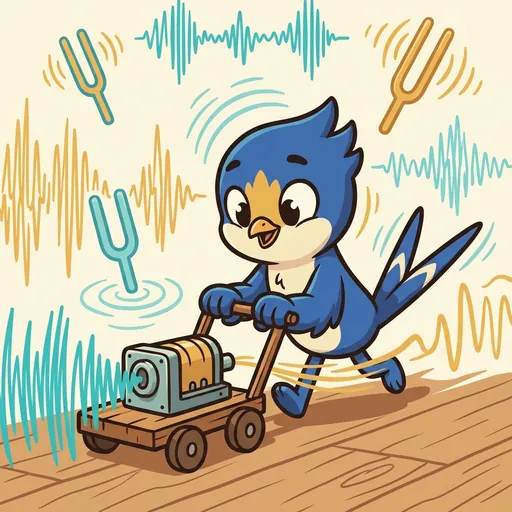
Drift
DOPPLER — *waves bunch up in front of a moving source. they stretch out behind. that's why the siren changes pitch.*
Listen along — Drift
Loading audio…
Press play to listen along. The line being read lights up as you go.
Show full transcript
Loading transcript…
Chapter 4 — Drift and the Bunched-Up Waves
Meet Drift. He’s a small kid, quick as a swallow. He wears chunky flight-streamers that flap behind him. They look like cartoon ribbons in the wind. Drift always has a small wheeled toy with him. It has a loud buzzer. He pushes it back and forth across the workshop floor.
Drift is small and moves fast. His colors are warm cobalt blue and creamy white. He’s super curious about how things move. Especially how that motion changes what you hear. He loves to say, “The siren coming toward you sounds high. The siren going away sounds low.” His special toy is that buzzer cart. It’s a small electric buzzer on four wheels. The buzzer makes the same steady sound all the time. But if you push the cart toward someone, the sound seems higher. If you pull it away, the sound seems lower. It’s the same buzzer. It makes the same actual sound. The motion just changes what your ear hears.
This is a really important idea. Drift helps everyone understand the Doppler effect. That’s a fancy name for something simple. It’s what happens when a sound source moves. It changes how you hear the sound. Even if you stand still. Most people know the ambulance siren changes pitch. But they don’t know why. It’s because the sound waves get squished together.
Imagine a sound making waves, like ripples in a pond. When the sound source moves toward you, it’s like it’s chasing its own waves. Each new wave starts a little closer to the last one. So the waves get squished together. They bunch up. That makes the sound seem higher. We call that a higher pitch. When the source moves away, the opposite happens. The waves stretch out. They spread apart. That makes the sound seem lower. It’s a lower pitch. The actual sound coming from the source never changes. It’s just how your ear hears it because of the motion. Drift’s whole job is to connect that everyday sound (the ambulance) to the way waves bunch up.
Drift is very clear about this. He often says, “Waves bunch up in front of a moving sound. They stretch out behind it.” He’ll tap his buzzer cart. “That’s why the ambulance siren sounds high pitch when it’s coming toward you. And low pitch when it’s driving away.” He’ll look right at you. “Same siren. Same actual sound. The motion changed what your ear heard.”
Drift teaches some key ideas about the Doppler effect:
- Still sound. If a sound source isn’t moving, its waves spread out in even circles. Everyone hears the same sound pitch.
- Moving sound. If a sound source moves, each new wave starts from a slightly different spot. Waves bunch up in front. They stretch out behind. If you are in front, you hear a higher pitch. If you are behind, you hear a lower pitch.
- Moving you. What if the sound is still, but you are moving? If you move toward the sound, you run into waves faster. It’s the same higher-pitch effect.
- Pitch change. The Doppler effect is all about how much the sound’s pitch changes. How much it changes depends on how fast the sound source is moving. It also depends on how fast the sound waves travel.
- Real-life examples. Think of ambulance sirens, train horns, or car horns. Police use radar guns that use this effect. Even light from faraway galaxies shows it. That’s how we know they are moving away from us. Doctors use it to check blood flow inside your body.
- Not about distance. Drift will tell you, “Don’t mix up Doppler with sounds getting quieter when they’re far away.” Just being far away doesn’t change the pitch. Only moving toward or away from the sound does. A still siren one block away sounds the same pitch as a still siren one mile away. The far one is just quieter.
Drift grew up in a place where lots of birds flew by. It was a big path for migrating birds. His family had always been the “swift-flock-listeners” for their village. They were the swallows who paid close attention. They noticed how their flock-mates’ calls changed pitch. Some birds swooped toward them. Others swooped away during aerial hunts. Over many, many years, they learned a simple truth. “The call doesn’t change,” they’d say. “Only how the bird moves changes what you hear.” Drift carried that lesson forward. He knew it in his bones.
He walked to WaveForge when he was thirteen. Sonic, a wise mentor, asked him a question. “What is the Doppler effect?” Drift didn’t even pause. “Waves bunch up in front of a moving sound,” he said. “They stretch out behind it. The sound itself doesn’t change. Just how we hear it.” He took a breath. “That’s why a siren’s pitch changes when an ambulance passes you. The siren didn’t change. The motion did.” Sonic smiled. “You are appointed,” he said. Drift had found his place.
In his workshop, Drift always starts with his buzzer toy. He sets it on the floor. He pushes a small button. A steady, buzzing tone fills the air. “Listen to the steady tone,” he says. He waits a moment. The buzz hums. Then, he pushes the cart quickly toward you. “Now!” he calls out. The pitch of the buzz jumps higher. It sounds like a tiny, angry bee. Then, he pulls the cart back. He pulls it fast, away from you. “Now!” The pitch drops lower. It sounds like the bee is flying away, sad.
Drift picks up the cart. He holds it carefully. “Same buzzer,” he reminds you. “Same actual sound. Motion changed what you heard.” He smiles. “I am Drift. The big idea I teach is the Doppler effect. The main thing to remember is this: waves bunch in front of motion. They stretch behind it.” He puts the cart down. “Once you see it, you’ll hear it everywhere. Ambulances, trains, racing cars. Even the whole universe.”
He is always gentle when he explains. “Don’t confuse Doppler with sounds getting quieter when they’re far away,” he says. He shakes his head slowly. “Distance affects how loud something is. It doesn’t change the pitch. Doppler is only about motion. Moving toward something, or moving away.” He points a finger. “An ambulance one block from you and one mile from you, both sitting still, sound the same pitch. The far one is just fainter.”
Drift remembers one time he messed up. “I missed pushing the cart at the right speed once,” he admitted. He looked a little embarrassed. “A slow push means a small Doppler change. A fast push means a big change.” He nodded. “The faster the motion, the more the waves bunch up. Or stretch out.”
The WaveForge ensemble
Drift is part of WaveForge's distributed-narrative cast. Each character embodies a different curricular primitive; together they teach the full subject.