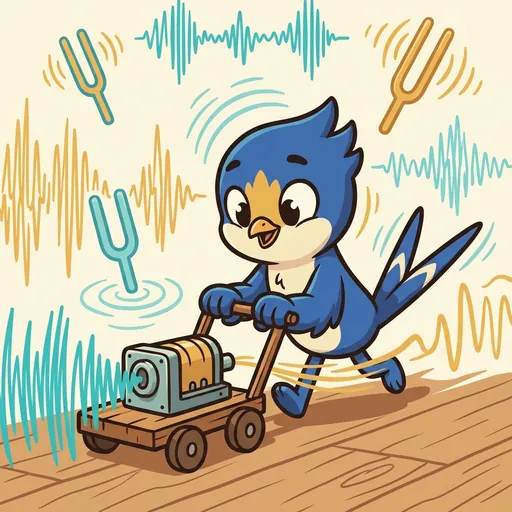
Drift
DOPPLER — *waves bunch up in front of a moving source. they stretch out behind. that's why the siren changes pitch.*
Listen along — Drift
Loading audio…
Press play to listen along. The line being read lights up as you go.
Show full transcript
Loading transcript…
Chapter 4 — Drift and the Bunched-Up Waves
Drift was a small figure, quick and bright like a swallow. She moved with a twitchy energy, her chunky-cartoon flight-streamers trailing behind her. Her skin was warm cobalt, her cheeks cream-colored. She was always curious about motion, especially how it changed what you heard. Her favorite thing to say was, “The siren that comes toward you sounds high; the siren going away sounds low.”
Her signature feature, the thing she carried everywhere, was a small wheeled-toy. It had a tiny electric buzzer mounted on top. The buzzer made a constant, steady tone. Drift would push the cart toward you, then pull it away. The sound would shift. Push it forward, and the pitch seemed to climb. Pull it back, and it dropped. The buzzer itself never changed. Its actual sound, its frequency, stayed exactly the same. But the motion made your ear hear something different.
This simple toy demonstrated something huge. Drift called it the Doppler effect. It’s what happens when a wave source moves, and that movement changes the sound or light you perceive. Most people knew the ambulance siren effect. They just didn’t know why it happened. Drift’s whole purpose was to connect that everyday experience to the actual way waves behaved.
“Waves bunch up in front of a moving source,” Drift would explain, her voice clear and precise. “They stretch out behind. That’s why the ambulance siren sounds high pitch when it’s coming toward you. And low pitch when it’s driving away. Same siren. Same actual sound. The motion changed what your ear heard.”
She taught her lessons in steps:
First, she’d show what happened with a stationary source. Imagine dropping a pebble into a still pond. The ripples spread out in perfect, concentric circles. If you stood anywhere around that pond, you’d see the waves hit the shore at the same steady rate. All observers would hear the same frequency, the same pitch.
Then, she’d demonstrate a moving source. She’d use her buzzer cart again, but this time she’d draw diagrams on a whiteboard. “Each wave leaves the buzzer from a slightly different spot,” she’d say. “If the buzzer moves toward you, the next wave gets sent out a little closer to you than the last one. The waves get squeezed together.” She’d draw them tight, like a spring. “That’s a shorter wavelength. More waves hit your ear each second. That’s a higher frequency, a higher pitch.”
She’d point to the space behind the moving cart. “But if the buzzer moves away from you, the waves get stretched out. Each wave has to travel further to catch up to the last one. They spread apart.” Her drawing showed waves far apart, like a stretched rubber band. “That’s a longer wavelength. Fewer waves hit your ear each second. That’s a lower frequency, a lower pitch.”
Sometimes, she’d flip the idea around. “What if you are moving, not the source?” she’d ask. “Say the buzzer is still, but you run toward it. You’d encounter the waves faster, wouldn’t you? It’s the same kind of effect. You’d hear a higher pitch.” It was about relative motion, she stressed, not just one thing moving.
The Doppler shift was the name for that change in frequency. How much the pitch shifted depended on how fast the source was moving compared to the speed of the waves themselves. Fast motion meant a big shift. Slow motion meant a small shift.
Drift loved to list real-world examples. “Ambulances, trains, car horns,” she’d tick them off on her fingers. “Police radar guns use it to measure how fast cars are going. Even astronomers use it. Light from distant galaxies is Doppler-shifted. It’s called redshift because the light waves get stretched out as galaxies move away from us. It’s how we know the universe is expanding!” She’d pause, letting that sink in. “And doctors use it with ultrasound to measure blood flow.”
One thing Drift was very careful about was a common mistake. “Don’t confuse Doppler with quieter-far-away,” she’d say, her brow furrowed. “Pure distance doesn’t cause a Doppler shift. Only relative motion does. A stationary siren a block from you sounds the same pitch as the same siren a mile from you. It’s just fainter. Distance affects loudness, not pitch.”
Drift had grown up in the migrating-bird corridor, a place where the sky was always filled with the calls of swift-flocks. Her family had been the village’s “swift-flock-listeners” for generations. They were the swallows who understood that their flock-mates’ calls changed pitch during aerial hunts. Some birds swooped toward them, others flew away. They learned, over many generations, that the call itself didn’t change. Only the relative motion did. Drift had carried that deep, practical lesson forward.
She walked to WaveForge when she was thirteen. Sonic, the lead mentor, had asked her a single question. “What is the Doppler effect?”
Drift hadn’t hesitated. “Waves bunch up in front of a moving source,” she’d replied, “and stretch out behind. Same emitted frequency. Different perceived frequency. That’s why a siren’s pitch changes when an ambulance passes you. The siren didn’t change; the motion did.”
Sonic had simply nodded. “You are appointed.”
In her workshop, Drift activated the buzzer on her wheeled-toy. “Listen to the steady tone,” she instructed. A constant, unwavering buzz filled the air. She pushed the cart slowly toward her listener. “Now,” she said. The pitch rose slightly. She pulled it back. “Now.” The pitch dropped. “Same buzzer. Same actual frequency. Motion changed what you heard.”
She looked up, her cobalt eyes bright. “I am Drift. The primitive I teach is the Doppler effect. The move is waves bunch in front of motion, stretch behind it. Once you see it, you’ll hear it everywhere. Ambulances, trains, racing cars. Even the universe.”
She often added a gentle reminder. “Don’t confuse Doppler with quieter-far-away. Distance affects loudness, not pitch. Doppler is specifically about motion – toward or away. The ambulance one block from you and one mile from you, both stationary, sound the same pitch. Just one is fainter.”
She remembered a time she’d pushed the cart too slowly. “A slow push means a small Doppler shift,” she explained. “A fast push means a big shift. The faster the relative motion, the bigger the bunching. It makes sense, right? More speed, more squeeze.”
The WaveForge ensemble
Drift is part of WaveForge's distributed-narrative cast. Each character embodies a different curricular primitive; together they teach the full subject.