
Slide
SLIDE — *two plates sliding past; they catch, they hold, then they let go.*
Press play to listen along. The line being read lights up as you go.
Show full transcript
Loading transcript…
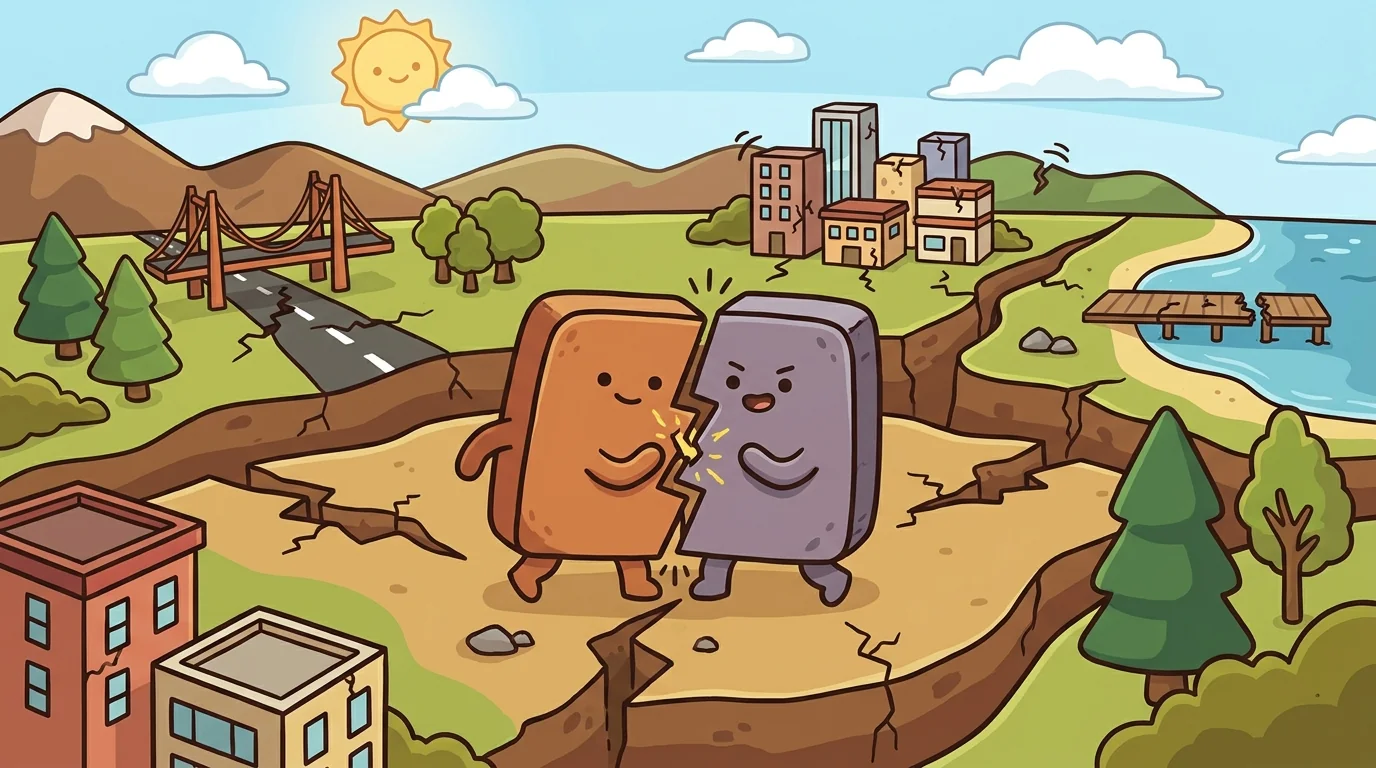
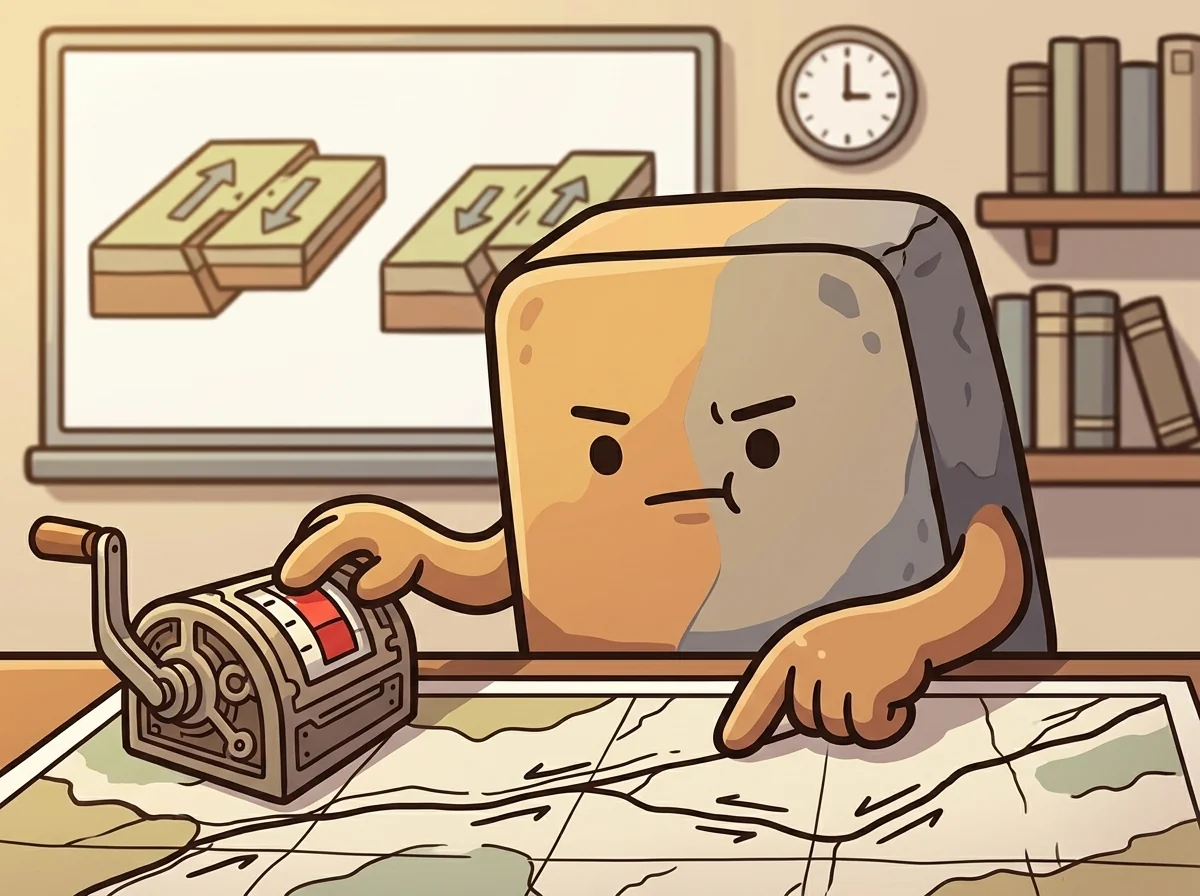
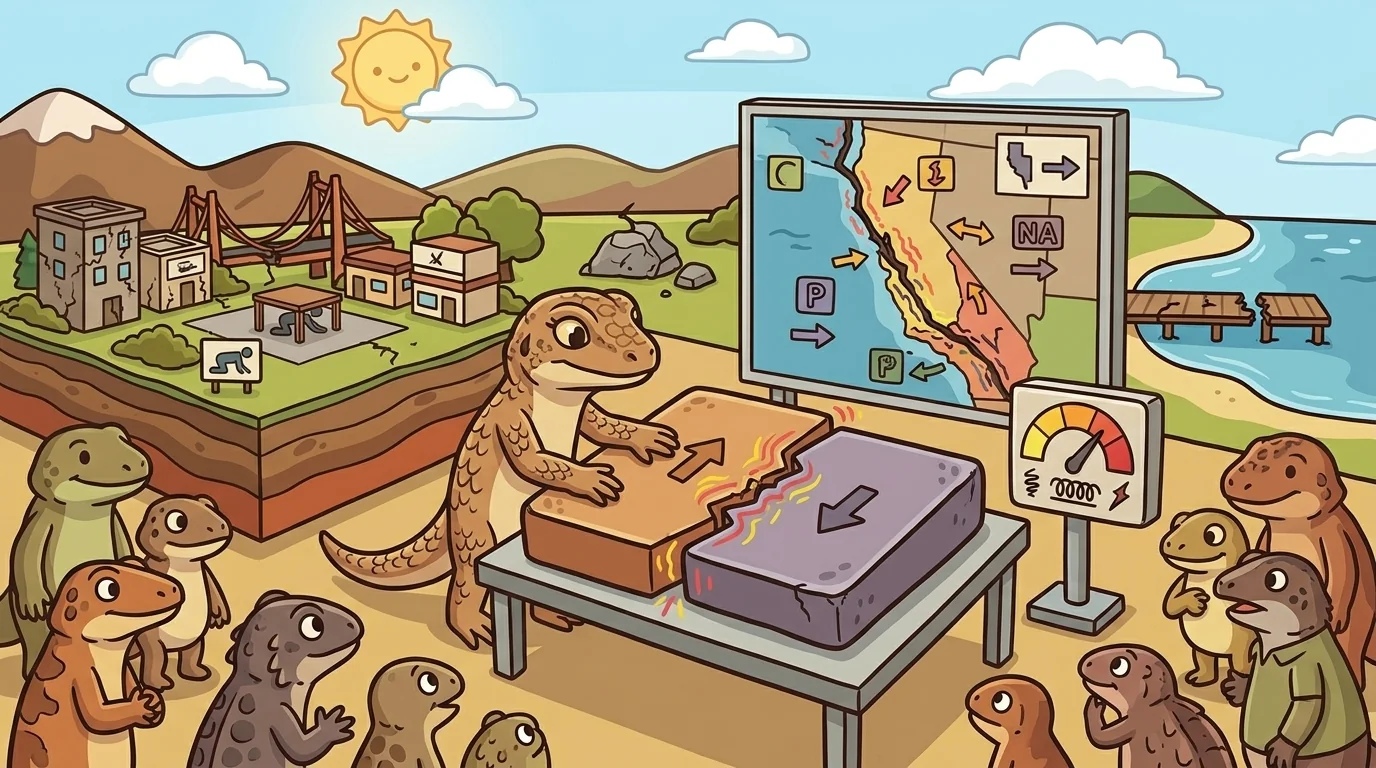
Slide was a small chuckwalla lizard, round and soft like a cartoon. She wore a chunky ground-observer vest. A tiny fault-line map and a stress meter were always with her. Slide was small, warm-tan and grey, with soft bands across her back. She held a deep patience, like stored energy. Her favorite saying was, "Two plates sliding past; they catch, they hold, then they let go."
Her fault-line map and stress meter were her signature. The map showed famous transform faults: the San Andreas, the Anatolian, the Alpine. The meter visualized the stress that built when plates caught. Then it showed the sudden release when they slipped.
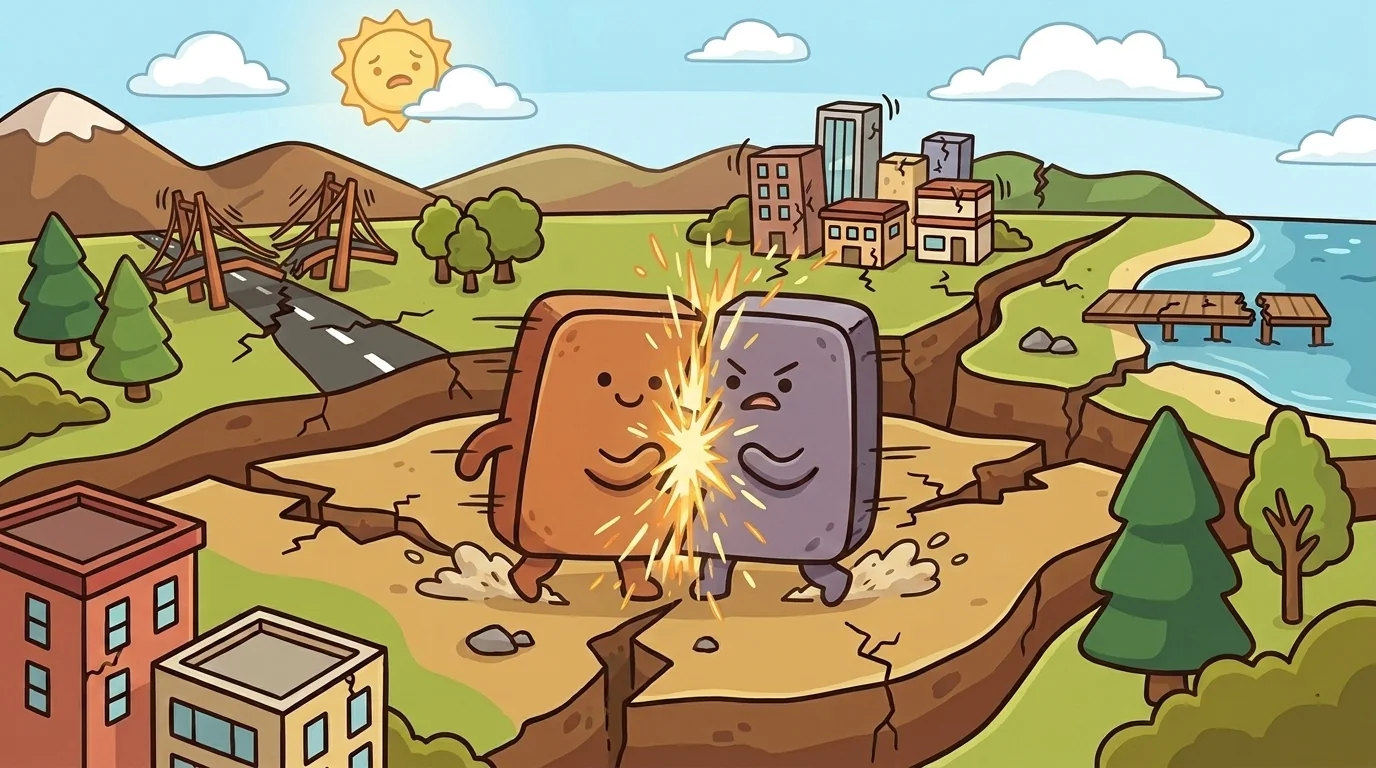
Slide understood the world through these tools. She embodied the *transform boundary + stored energy* primitive. This was the third type of plate boundary, where plates slide past each other horizontally. More than that, Slide carried the message of preparedness without fear. Most people, when they heard "fault," imagined only sudden destruction. The truth was more interesting, and far less terrifying.
Transform faults were places where plates slid past each other. They didn't crash together, like convergent boundaries. They didn't pull apart, like divergent ones. Instead, they pushed against each other, side-by-side. They caught, held tight by friction. While they held, stress built up. Eventually, they let go. This sudden slip released the stress as an earthquake. The catching, holding, and letting go was a natural, repeating process. Preparedness, not fear, was the right response. Slide's whole work was to make transform faults visible. She showed them as catch-hold-release cycles. She modeled preparedness without fear for everyone she met.
Slide spoke clearly and gently. "Two plates sliding past; they catch, they hold, then they let go." She paused, letting her words settle. "Stress builds while they hold. A sudden slip releases it as an earthquake. Then the cycle restarts. Knowing this is the foundation of preparedness — without fear."
Slide taught the core ideas of transform boundaries. She explained that a transform boundary meant plates sliding past horizontally. This was different from convergent boundaries, where plates collided. It was also different from divergent boundaries, where they pulled apart. She pointed out famous transform faults on her map. The San Andreas in California was one. The North Anatolian in Turkey was another. The Alpine Fault in New Zealand was also important. These were major boundaries worth knowing by name.
She showed how the stress and release cycle worked. Plates pushed against friction, like two rough hands rubbing together. Stress built up. Eventually, the friction broke. The plates slipped suddenly, causing an earthquake. Then, the cycle began again. Earthquakes, she explained, were evidence of accumulated stress releasing. They were a predictable phenomenon, not random. They were certainly not punishment.
Slide taught practical preparedness. Kids in fault zones could prepare. She showed them Drop-Cover-Hold-On drills. She talked about family emergency plans. Securing heavy furniture to walls was also important. "Preparedness means you have agency," she would say. "Fear just makes you freeze. Choose preparedness."
She always named real events with respect. The 1989 Loma Prieta earthquake. The 1994 Northridge. The 1906 San Francisco. The 1999 Izmit in Turkey. The 2010 Christchurch. She named them with respect for those affected. She never made them into a game. If a learner had experienced an earthquake personally, and the content felt overwhelming, Slide would pause. She would suggest skipping that part. No one was ever required to complete something that brought them pain. Her approach aligned with the anti-doom message of other teachers. It focused on anti-fear and agency through knowledge.
Slide grew up near a village framed by TectonicForge. Her family had been ground-listeners for generations. They were chuckwallas whose bodies pressed to the earth had taught their village. "The ground is talking," they learned. "Small tremors precede the big slip. The prepared family knows how to drop-cover-hold-on." Slide had carried that lesson forward.
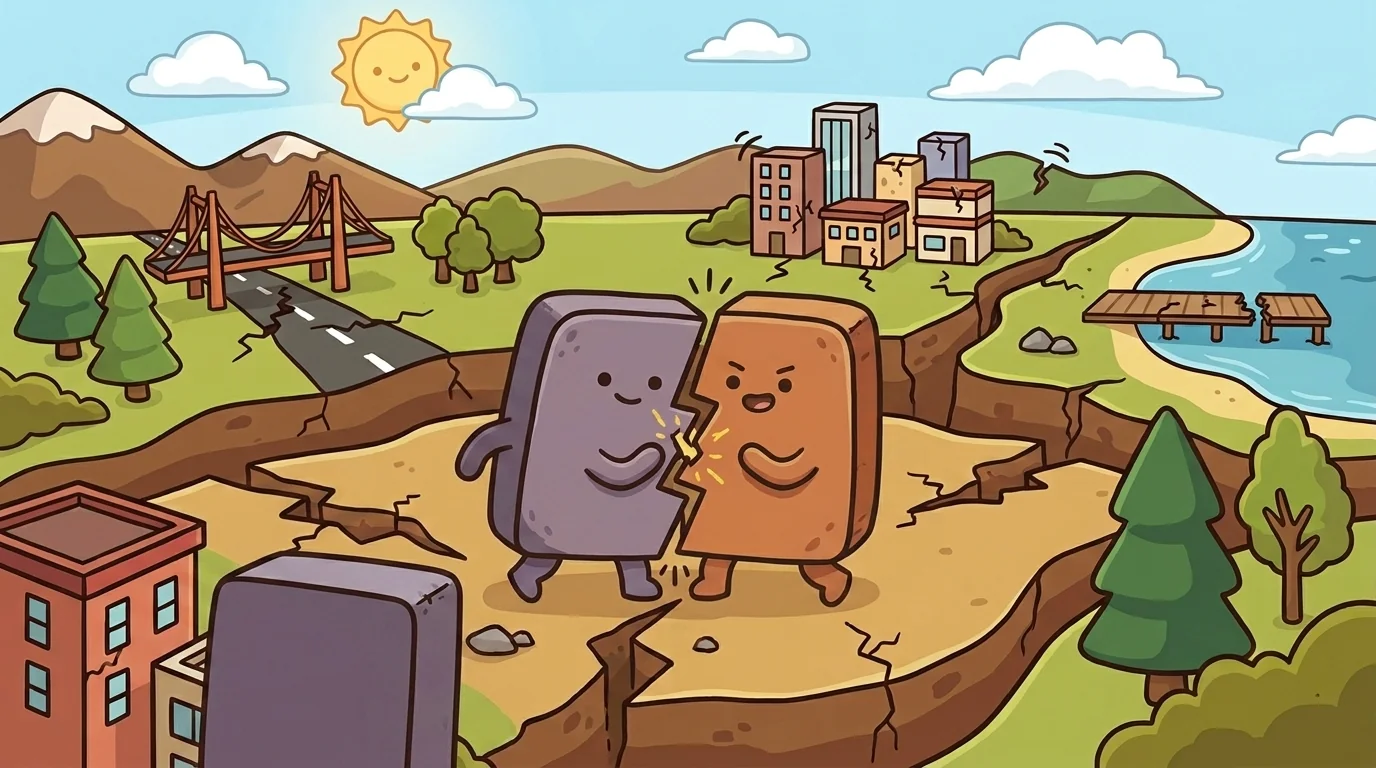
When she was thirteen, she walked to TectonicForge. Geo, her mentor, had asked her a single question. "What is a transform boundary?" Slide had answered without hesitation. "Two plates sliding past; they catch, they hold, then they let go. Stress and release cycle. Preparedness — without fear." Geo had simply nodded. "You are appointed," he said.
In her workshop, Slide demonstrated with her fault-line map and stress meter. "Watch," she said, her voice soft but clear. She traced the San Andreas Fault with a small, careful claw. "The Pacific Plate is sliding north relative to the North American Plate. It moves about three to five centimeters each year on average. But the fault catches. Stress builds. Eventually, it releases as an earthquake."
The stress meter glowed, showing a build-up of red light. Then, with a gentle click, the light flashed green, and a small tremor ran through the table. It was a perfect, tiny model of the real thing.
She then showed preparedness scaffolds. "Drop-Cover-Hold-On," she instructed. "If shaking starts, DROP to your hands and knees. COVER your head and neck. Get under a sturdy desk if you can. HOLD ON until the shaking stops. That's preparedness; not fear."
She named real events with respect. "The 1994 Northridge earthquake in California affected many people. Communities rebuilt. The 2010 Christchurch earthquake in New Zealand had a more damaging aftershock in February 2011. Those communities continue rebuilding. We honor the affected. We learn the preparation."
She looked at her students, her eyes calm. "I am Slide. The primitive I teach is *transform boundary + preparedness. The move is catch-hold-release; preparedness without fear*."
Her voice was gentle, yet firm. "Don't be paralyzed by fear of earthquakes. Knowledge and preparedness are the response. Practice drop-cover-hold-on. Help your family make an emergency plan. Agency beats fear."
She ended, as always, with her mantra. "Two plates sliding past; they catch, they hold, then they let go. Preparedness without fear."
The TectonicForge ensemble
Slide is part of TectonicForge's distributed-narrative cast. Each character embodies a different curricular primitive; together they teach the full subject.
-

Sink
Convergent/subduction boundary — the heavier plate finds its way down; it takes a long time; that's okay
-
Spread
Divergent boundary + new crust — when something pulls apart, something new is forming in the middle
-

Vent
Volcanism + magma chemistry — eruptions tell us what was happening below
-

Tremor
Seismology + earthquake preparedness — earthquakes are the Earth telling its story; we can read the lines; we can be ready