Move
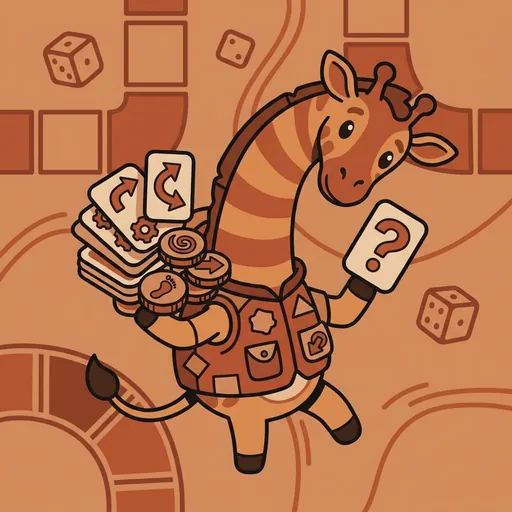
MOVE — every turn is a question, and the move is the answer.
Listen along — Move
Loading audio…
Press play to listen along. The line being read lights up as you go.
Show full transcript
Loading transcript…
Chapter 3 — Move and the Turn That Asks a Question
On the practice board at the edge of the savanna-village, a small giraffe named Move stood at one end and refused to hurry.
The board was a long grid painted on flat stone, and the game was simple: cross to the other side. A younger antelope had already bolted halfway across in a blur of hooves, doubling back, zigzagging, changing his mind six times a step.
Move took exactly one step. She stopped. She looked at the whole board — the paint-lines, the little markers, the far edge. Then she took exactly one more step, in the direction that mattered most.
“You could just run,” the antelope panted, spinning in place. “You get, like, a hundred steps. I’ve got a hundred steps. Why are you counting them?”
“Because you don’t get a hundred,” Move said. “You get one, then the board changes, then you get one more. Every step you already took is spent. So each step is a little question.” She set her long neck level and studied the grid. “This one asks: out of everywhere I could go, where does going help most?”
The antelope stopped, one hoof in the air. ”…That’s a lot of thinking for a walk.”
“It’s not a walk. It’s a turn.” Move stepped again — one clean choice — and she was suddenly nearer the far edge than he was, without ever breaking into a run. “You’ve been doing everything. I’ve been doing the one thing that counts. Watch which of us gets there first.”
He watched. She got there first.
Move had learned that the hard way, back when she was small and there were too many paths.
The elder giraffes of the village were path-walkers — the ones who found the safe crossings through tall grass — and the first time Move tried to lead, she stood at the edge of the savanna and simply couldn’t move. Every direction was open. She could go anywhere. And anywhere felt like a wide, roaring nothing. Her legs locked. Her chest went tight and buzzy, the way it does when a thing is too big and too free at once.
“I’ve got the whole grassland,” she’d whispered, miserable, “and I can’t take one step.”
Her grandmother had ambled up beside her — an old giraffe with a slow, patient sway — and hadn’t told her to be bold. She’d only pressed one heavy foot down in the dirt and said, “Feel that. That’s one step. Not the whole grassland. Just the next one.” She’d nodded out at the grass. “The crossing is too big to solve all at once. So don’t. Ask the little question instead. Where does this step help? Then the grass tells you the answer.”
Move took one step. Only one. And the roaring nothing quieted into something she could actually hold — a single choice, small enough to make. Then the board of grass had changed, just a little, and there was a new one-step question waiting, small enough again.
She never forgot it. The freedom to go anywhere had frozen her. The limit — one step, then ask again — had set her free.
She walked to TableForge at twelve, because a place that studied how games were built ought to understand the thing she loved most: the shape of a single turn.
Blueprint, the old mentor who ran the workshops, met her at the gate. He didn’t ask her to prove she was quick. He asked one question. “What makes a turn worth taking?”
Move didn’t answer with words. She stepped onto his practice grid, and instead of crossing it in a rush, she took one deliberate step and stopped. “If I could leap the whole board at once,” she said, “this turn wouldn’t mean anything. I’d just win. Boring.” She took a second careful step, choosing it. “But I only get a little each turn. So every turn I have to pick. And picking is the whole game.”
Blueprint watched her cross the grid one thoughtful step at a time, each one clearly chosen. “You’re saying the limit is the fun.”
“The limit is the question,” Move said, reaching the far edge. “Take the limit away, there’s no question left to ask.”
Blueprint looked at the trail of single steps behind her for a long moment. “You belong here,” he said.
Move’s workshop was full of little grids and piles of tokens, and one afternoon a boy came in slumped over a game he’d made.
“It’s supposed to be exciting,” he said, “but everybody just does everything and wins. Nobody even thinks.” He dumped the tokens out. “Each turn you can move, and attack, and heal, and build, and draw a card. All of it. Every turn.”
Move knew that slump. She’d felt it standing frozen at the edge of the grass.
“How many of those matter?” she asked.
”…All of them?”
“If you do all of them every turn,” Move said, “then none of them is a choice. You never leave anything on the table. So nothing you pick ever costs you anything else.” She slid a token toward him. “Here. New rule. Two actions a turn. Only two. Out of your whole list.”
The boy stared. “But then I can’t do everything.”
“Right.” She grinned. “Now heal-or-attack is a real question. Build-or-draw is a real question. Every turn you leave something behind, and the thing you leave behind is what makes the thing you keep matter.” She tapped the grid. “You didn’t need more actions. You needed fewer. A turn is only interesting when it can’t hold everything.”
The boy tried it — two actions, chosen — and on the third turn he went quiet, then bent over the board scribbling fast, because for the first time a turn had asked him something he actually had to answer.
Later, when the workshop was empty, the boy came back holding his fixed-up game.
“How do you know,” he said, “when a turn’s got the right amount in it?”
Move thought about the grassland, and the locked legs, and her grandmother’s foot pressing one step into the dirt.
“You feel it,” she said. “That’s the honest answer. When there’s too much, it goes loud and mushy — your chest buzzes, you’re not choosing, you’re just doing, and nothing lands. And when it’s just tight enough, it gets sharp. There’s this little clean pull, this hm, which one? — and when you finally pick, something in your shoulders settles, like you set one foot down in exactly the right place.”
She looked out toward the practice grid where the sun was going long across the painted stone, and for a moment she wasn’t thinking about turns or actions at all. She was thinking about a small giraffe who couldn’t take one step because the whole world was open, and a heavy old foot pressing into the dirt beside her, and how small had felt like a gift instead of a cage.
“You don’t have to hold everything,” she said, softer now, more to herself than to him. “That’s the part that used to scare me and doesn’t anymore. You just take the next one, and it’s enough, and your legs unlock.” She breathed out slow. “That’s the good feeling. Not winning. Just — the quiet after you finally choose, when the loud goes away and one step feels like plenty.”
The boy nodded, and Move watched the last of the slump lift off his shoulders — the same warm, unclenching relief that had settled over her, years ago, when the roaring grass shrank down to one calm step she could actually take. Neither of them said anything else. They just stood there in the long light, both of them a little lighter, glad in a plain quiet way that they didn’t have to do it all at once.
The TableForge ensemble
Move is part of TableForge's distributed-narrative cast. Each character embodies a different curricular primitive; together they teach the full subject.
-
Bones
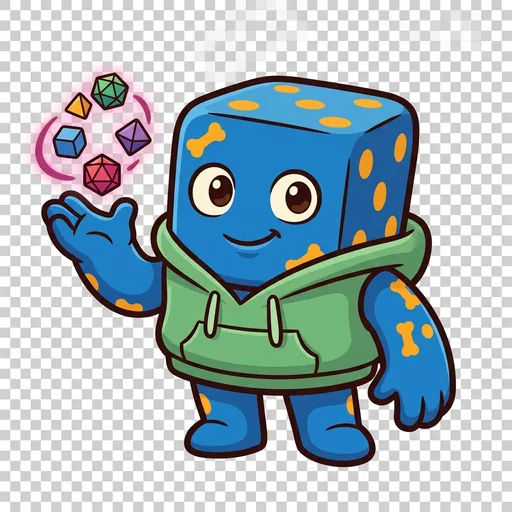
Dice + randomness + probability — chance is design craft, NOT betting; gambling-adjacency gate anchor
-
Hand
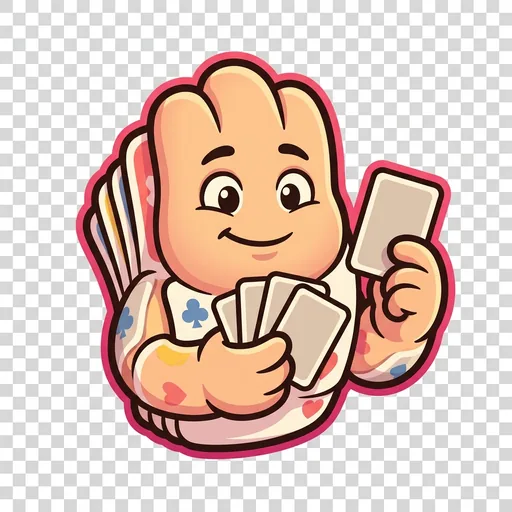
Cards + hidden information — what-you-HOLD is information; what-you-SHOW is a different question
-
Trial
Playtest + iteration — what-they-DID matters more than what-they-SAID; first-playtest-supposed-to-fail framing
-
Theme
Game-mechanic + theme integration — the-game-IS-its-mechanics; Habgood intrinsic-integration anchor; theme-MUST-do-work framing