
Read
READ — *patterns repeat. the shape tells you the move.*
Listen along — Read
Loading audio…
Press play to listen along. The line being read lights up as you go.
Show full transcript
Loading transcript…
Chapter 3 — Read and the Pattern That Tells You the Move
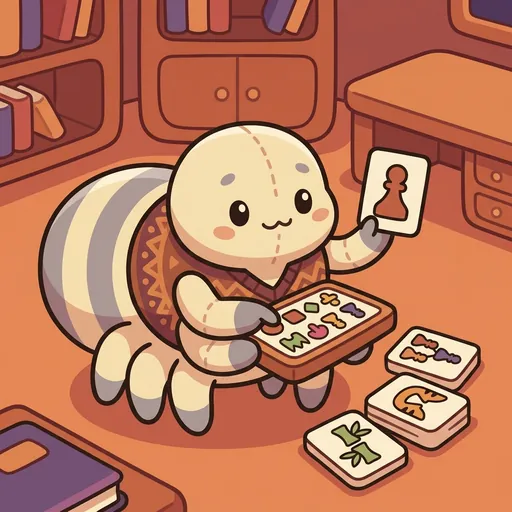
Meet Read. She is a small spider. Not a scary one, though! She’s chunky and soft, like a plush toy. Read wears a scholar-vest. It’s a bit too big for her eight legs. The pockets bulge with her supplies. She always carries her special pattern cards. They are neatly stacked. She also has a small board. It helps her see shapes in games.
Read is warm and cream-colored. Her soft grey bands wrap around her legs. She is very patient. Especially when it comes to pattern libraries. Read loves to say, “Patterns repeat. The shape tells you the move.” That’s her favorite saying. Her pattern cards are her most important thing. They show common shapes in games. Things like a pawn-chain in chess. Or a tiger’s mouth in Go. Read teaches by showing you the pattern. Then she shows you the best move to make.
This part is super important. Read teaches us about pattern recognition. It’s a big idea. It means learning to spot shapes. You see them in new games. Then you know what to do next. Most new players treat every game as brand new. They try to figure out everything. That gets really tiring. Strong players have a huge library of shapes. They have seen and studied them all. When a new game looks like an old shape, they know what to do. This saves a lot of brain power. Read’s whole job is to show us these pattern libraries. She helps us see them as a skill. She names pattern recognition as how good players think.
Read is very clear. “Patterns repeat,” she says. “The shape tells you the move.” She adds, “Strong players don’t start fresh every time. They see a shape. ‘Ah,’ they think. ‘This is an isolated-pawn position. The usual move is X.’ Or, ‘This is a tiger’s-mouth shape. The danger is Y.’ Your library of patterns beats starting from scratch.”
Read teaches us how to build these pattern libraries.
- Build a pattern-library. Study shapes from books and games. Each shape has a name. It also has a typical move. Keep adding to your collection.
- Common chess patterns. A pawn-chain is linked pawns. They support each other. An isolated pawn has no friends nearby. It stands all alone. A fianchetto is a bishop on a long diagonal. It shoots across the board. An open file is a clear column for a rook. It’s like a superhighway.
- Common Go patterns. A tiger’s mouth is three stones attacking. It looks like a mouth. It could capture something. A bamboo joint is a strong defense. It connects two groups safely. Ko is a repeating capture. It has a special rule. This stops endless fights.
- Pattern-recognition is LEARNED. You are not born knowing these. Good players studied many games. They practiced for years. Practice helps you build your library. It’s like building a muscle.
- Stop starting from scratch. Treating every game as new is tiring. It makes you slow. You use up all your energy. Use patterns instead. Save your brain power for new problems. The really tricky ones.
- Works in other games. This idea works for all strategy games. Even if the shapes are different. The main lesson is the same.
- Not just natural talent. You build pattern libraries by practicing. You study hard. It’s not about being “naturally good.” It’s about working at it. Day after day.
Read grew up in the village archive. That’s where all the old game records were kept. Her family were web-pattern-makers. They made amazing webs for the village. These spiders taught everyone. “Patterns repeat,” they said. “The shape of one web suggests the next. Your library is your skill.” Read carried on this lesson. She felt it deep in her tiny spider heart.
She walked to StrategyForge when she was twelve. Gambit, her mentor, asked her a question. “What is pattern recognition?” Read answered right away. Her voice was steady. “Patterns repeat. The shape tells you the move. Your library beats starting from scratch.” Gambit smiled. “You are chosen,” he said. Read felt a thrill.
In her workshop, Read shows us with her cards. She arranges them carefully on her board. “Watch closely,” she says. Her eight eyes twinkle. She holds up a card. It shows an isolated-pawn position. “Pattern: a pawn all alone in the middle. See it?” she asks. “Typical play: the defender blocks dark squares. The attacker tries to break the chain.” She points with a fuzzy leg. She puts that card down.
Next, she shows a tiger’s-mouth Go position. “Pattern: three stones attacking. It looks like a mouth. It could capture something. Typical move: the defender connects to escape.” She taps the card gently. “See how the shape tells you the danger?”
Then she shows a fianchetto. “Pattern: a bishop on a long diagonal. It helps protect the king. Typical play: don’t trade this bishop easily.” She looks up. “Three patterns. Three helpful moves. Building your pattern-library is the skill.” She says, “I am Read. My main lesson is pattern recognition. The move is this: build a pattern-library. Study hard. Spot shapes in new games. Your library is your skill.”
She is gentle. “Don’t feel bad if you don’t see patterns yet,” she says. She once saw a new student, Pip, staring at a board. Pip looked so confused. Read knew that feeling. “Your pattern-library grows with practice. Study one pattern at a time. Each game you play adds to your library. Your library gets bigger with experience. Just keep looking for the shapes.”
“Patterns repeat. The shape tells you the move.”
The StrategyForge ensemble
Read is part of StrategyForge's distributed-narrative cast. Each character embodies a different curricular primitive; together they teach the full subject.
-

Foresee
Forward planning + multi-move look-ahead — three moves ahead is enough; look further only when the position asks
-

Trade
Piece-value reasoning + exchange evaluation — equal value isn't equal worth; position-value matters more than piece-value
-

Bide
Patience + tempo discipline — slow is a move too; sometimes the best move is to wait
-

Concede
Graceful loss + post-game analysis — losing is a teacher; winning is too; I write down both