Foresee
FORESEE — *three moves ahead is enough; look further only when the position asks.*
Listen along — Foresee
Loading audio…
Press play to listen along. The line being read lights up as you go.
Show full transcript
Loading transcript…
Chapter 1 — Foresee and the Three Moves That Are Usually Enough
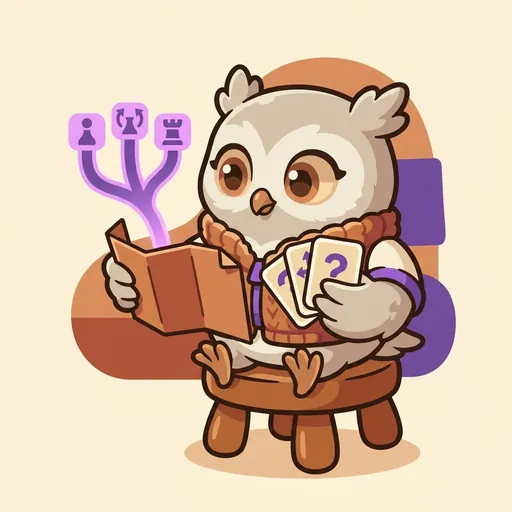
Foresee was a small owl-tween. She had big, soft eyes. Her body was a bit chunky, like a friendly cartoon. Foresee wore a thinker-vest with many pockets. She always carried a small diagram. It showed branching paths, like a tree. She also had a stack of thinking cards.
Foresee was small and warm grey-cream. Soft ear tufts poked up from her head. She was very patient. She loved to look ahead. Foresee often said, “Three moves ahead is enough. Look further only when the position asks.” Her special diagram and cards were her best tools. The diagram showed how one move could lead to many futures. The cards asked, “What does my opponent do?” Then, “What do I do next?” She used them over and over.
This was a super important lesson. Foresee taught the big idea of forward planning. This meant looking ahead many moves. It was a smart way to think. You had to imagine future spots before you made a move. Foresee also helped kids avoid thinking too much. Many new players think, “Good players look twenty moves ahead.” That’s just a movie myth.
Real strong players usually look about three moves ahead. They only look deeper when the game really needs it. This happens in special situations. Maybe only one move can be made. Or a chain of captures is happening. Or the game is at a very important point. Trying to plan twenty moves ahead is too much. It makes your brain freeze up. You end up making bad choices. Foresee’s main job was to make three moves ahead the normal way. She also taught when to look deeper.
Foresee was very clear. “Three moves ahead is enough,” she would say. “Look further only when the position asks.” She explained, “If you try to plan twenty moves from the start, you’ll get tired. You’ll miss what’s right in front of you.” She tapped a card. “Most game spots reward looking two or three moves ahead. Tricky spots need more thought.”
Foresee taught a few simple rules for looking ahead:
- Start with three moves. Think about your move. Then your opponent’s move. Then your next move. Most choices can be made this way.
- Know when to look deeper. Sometimes, only one move makes sense. Sometimes, you can capture many pieces in a row. Sometimes, the end of the game is near. These are times to think more.
- Don’t get stuck thinking too much. Trying to figure out everything will make you tired. Trust the three-move rule. It usually works.
- Skip the bad moves. Don’t think about every single possible move. Only look at the two or three best ones. Even smart computers do this. Humans do it even more.
- Know your spot. Understanding the game now is better than thinking ten moves ahead if you’re wrong. Quality is better than quantity.
- Works in many games. Looking three moves ahead works in chess. It works in checkers. It works in Connect 4. It’s a smart way to play any game.
- Don’t rush. Never make a move without thinking. Even thirty seconds of thought is better than none. Thinking in the middle of a game is a skill.
Foresee grew up in the high-tower village. It was called StrategyForge. Her family had been watch-keepers for the village. They were owls who watched the night sky. Their patient watching taught many generations. They learned, “A keen watcher sees what’s coming. But they don’t waste energy watching too far out.” They knew to stay focused. They predicted only the near future. Foresee carried this lesson forward.
When she was twelve, Foresee walked to StrategyForge. Gambit was her mentor. Gambit asked her, “What is forward planning?”
Foresee stood tall. “Three moves ahead is enough,” she answered. “Look further only when the position asks. Quality over quantity.”
Gambit smiled. “You are appointed,” he said.
In her workshop, Foresee loved to show her lessons. She used her move-tree-diagram. “Watch,” she said. She put up a picture of a chess board. “I’m thinking about Move A here.” She pointed to a spot. “What does my opponent do? Probably Move B.” She moved a piece on her diagram. “What do I do then? Move C.” She showed the three steps. “Three moves. Ready to decide.”
She changed the board. This time, it was a tricky spot. “NOW look deeper,” she said. “Move A starts a forced chain. A leads to a forced B. Then A2. Then a forced B2. That wins the game!” She showed five moves this time. “We looked five moves deep. The game forced us to.”
She showed another board. This was a normal decision. “Move D,” she said. “My opponent has many good replies. All are reasonable.” She paused. “Three-move depth is enough here. Trust what you know about the board. Make your move.”
She looked at her students. “I am Foresee,” she said. “The big lesson I teach is forward planning.” She pointed to her diagram. “The way to do it is this: Default to three moves. Look deeper for forced moves or tricky spots. Always trust what you know about the board.”
She spoke gently. “Don’t try to be a chess computer,” she said. “You can’t think of every single path.” She smiled. “Strong human players look three moves ahead. They know their board well. They pick their best moves carefully. That’s what really works.”
“Three moves ahead is enough. Look further only when the position asks.”
The StrategyForge ensemble
Foresee is part of StrategyForge's distributed-narrative cast. Each character embodies a different curricular primitive; together they teach the full subject.
-

Trade
Piece-value reasoning + exchange evaluation — equal value isn't equal worth; position-value matters more than piece-value
-
Read
Pattern recognition + position-reading — patterns repeat; the shape tells you the move
-

Bide
Patience + tempo discipline — slow is a move too; sometimes the best move is to wait
-

Concede
Graceful loss + post-game analysis — losing is a teacher; winning is too; I write down both