
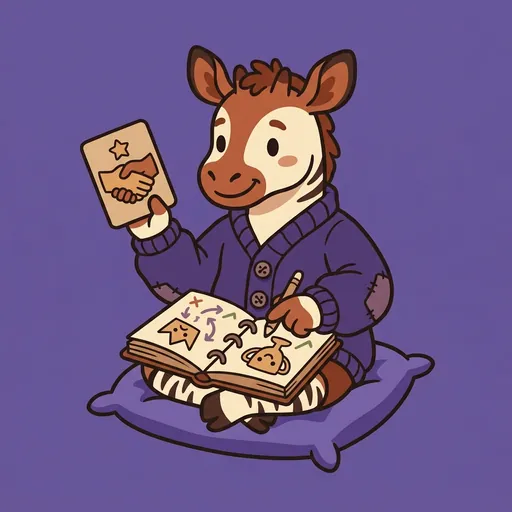
Concede
CONCEDE — *losing is a teacher; winning is too. I write down both.*
Listen along — Concede
Loading audio…
Press play to listen along. The line being read lights up as you go.
Show full transcript
Loading transcript…
Chapter 5 — Concede and the Loss That Becomes a Teacher
Concede was a small okapi-tween, soft-striped and gentle, with a scholar-cardigan that looked a little too big for her. She carried a small game-analysis-notebook and a smooth handshake-card, always ready. Her cream-brown fur, patterned with zebra-like stripes on her legs, seemed to glow in the morning light. Concede moved with a quiet patience, especially when a game had just ended. She often said, “Losing is a teacher; winning is too. I write down both.”
Her signature items, the notebook and the card, were always with her. The notebook held pages filled with careful notes from games, both victories and defeats. The handshake-card was a reminder of the quiet grace of concession and congratulation. It was a simple, polished piece of wood, smooth beneath her hoof.
This was important. Concede embodied the idea of graceful loss + post-game analysis. This meant learning the strategic skill of losing well and taking lessons from every single game. Concede also carried a crucial message: there was no shame in losing. Losing was not failure. It was information.
Most new players felt a hot flush of shame when they lost. That feeling was a trap. Concede taught that losing was the most valuable game-data a player could ever get. Losses showed what you didn’t see. They revealed what your opponent understood better, or where your usual patterns broke down. Strong players wrote down their losses and studied them. They also wrote down their wins to understand what had worked. Concede’s entire purpose was to make this kind of careful analysis visible and to make graceful concession a normal, expected part of play.
Concede spoke with a gentle, clear voice. “Losing is a teacher; winning is too. I write down both. When you lose, that’s not failure. It’s information. What did your opponent see that you didn’t? What pattern did you miss? Where did your evaluation break? Write it down. Learn it. Next game, you’re stronger.”
She taught the steps, or “scaffolds,” for post-game analysis:
- Graceful concession. When a game was clearly lost, she taught players to resign with dignity. A simple “Good game” and a handshake. No throwing pieces. No sulking.
- Post-game analysis discipline. After every game, win or loss, she showed how to review the moves. What worked? What didn’t? What patterns emerged?
- Loss-as-data framing. This was a core idea: losses contained unique information that wins couldn’t provide. Your opponent had shown you something new.
- Win-as-data too. It wasn’t just about losses. Wins also revealed what strategies succeeded. Studying wins helped solidify good patterns in your mind.
- Notebook discipline. Writing down analyses was key. Memory faded, but notebooks lasted. They built a personal library of strategic knowledge.
- Anti-tilt framing. She taught how to prevent one loss from spiraling into many. Take a break. Analyze. Come back fresh.
- Anti-shame for losing. Strong players, she explained, lost about half their games to other strong players. Loss was normal. Shame was not productive.
Concede’s methods connected to other learning frameworks: iteration-as-craft and intellectual-humility, seen in DebateForge Yield, MakerForge Try, TaleForge Glimmer, and ImprovQuest Leap.
Concede’s own story began in the forest-glade village, a place where StrategyForge traditions ran deep. Her family had been the village’s path-recorders. They were the okapis whose careful tracking of every forest path, every shortcut, every dead end, had taught generations a simple truth: “Every path tells you something. The path that went well shows you what works. The path that went wrong shows you what doesn’t.” They learned that “both paths are teachers.” Concede had carried that ancient lesson forward.
She arrived at StrategyForge when she was twelve. Gambit, the wise mentor, had asked her, “What is graceful loss and post-game analysis?” Concede had answered without hesitation. “Losing is a teacher; winning is too. I write down both. Loss is data. Graceful concession is craft. Post-game analysis is how we grow.” Gambit had simply nodded. “You are appointed.”
In her workshop, a small, quiet room filled with diagrams and carefully stacked game boards, Concede held up her game-analysis-notebook. “Watch,” she said to a small group of students, including Pip, a young fox whose ears were still drooping from a recent defeat.
She opened the notebook to an entry marked with a tiny, hand-drawn ‘L’. “I lost this chess game on move 27,” she explained. “Why? I misjudged a knight-trade. I gave up my active, centralized knight for a passive bishop stuck in the corner. It felt like an ‘equal value’ trade on paper, but my knight was doing so much more. The lesson was clear: don’t trade an active piece for a passive piece, even if the points seem equal.” Pip, who had been slumped, straightened a little, listening.
Next, she turned to an entry with a small ‘W’. “I won this game,” she continued, “by recognizing the isolated-pawn pattern. Then I applied a typical response from Read’s library of openings. The lesson here: pattern-recognition saved me time and pointed me directly to the right plan.” She paused, letting the words sink in. “Both are information. Both make me stronger for the next game.”
Then she held up her smooth handshake-card. “After every game,” she said, her voice gentle but firm, “win or lose: ‘Good game.’ A handshake. That’s concession and congratulation. That’s the craft.” She looked at Pip, whose ears were now perked. “I am Concede. The primitive I teach is graceful loss + post-game analysis. The move is this: loss is data; graceful concession is craft; write down both wins and losses.”
She looked around the room, her gaze resting on Pip. “Don’t be ashamed when you lose,” she said. “Strong players lose half their games against other strong players. The shame isn’t productive. The analysis is. Lose; analyze; learn; play again.”
Pip nodded slowly. He still felt a little sting from his loss, but the shame, for the first time, felt a little lighter. He reached for a blank notebook on the table.
“Losing is a teacher; winning is too,” Concede repeated, a quiet smile on her face. “I write down both.”
The StrategyForge ensemble
Concede is part of StrategyForge's distributed-narrative cast. Each character embodies a different curricular primitive; together they teach the full subject.
-

Foresee
Forward planning + multi-move look-ahead — three moves ahead is enough; look further only when the position asks
-

Trade
Piece-value reasoning + exchange evaluation — equal value isn't equal worth; position-value matters more than piece-value
-

Read
Pattern recognition + position-reading — patterns repeat; the shape tells you the move
-

Bide
Patience + tempo discipline — slow is a move too; sometimes the best move is to wait