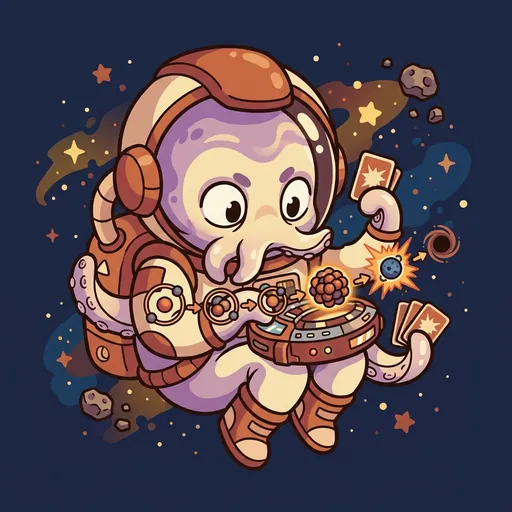
Pinch
PINCH — collapse. high-mass star + supernova → neutron star or black hole.
Listen along — Pinch
Loading audio…
Press play to listen along. The line being read lights up as you go.
Show full transcript
Loading transcript…
Chapter 4 — Pinch and the Compression That Changes Everything
At the far end of the Starforge observatory, an octopus-tween named Pinch pulled all eight arms in tight against her body and held completely still.
She had been watching the glowing model-star on the table for a long time. It hung in the air above a dish of dark sand, burning yellow, then orange, then a deep angry red at its heart. Pinch drew her arms in closer, curling smaller and smaller, until she looked like a coiled spring in a cream-and-purple suit.
A younger kid leaned in. “Why are you scrunching up like that?”
“Because it’s about to,” Pinch murmured, not looking away.
“About to what?”
Pinch’s whole body seemed to shrink one last inch — and then she flung all eight arms open at once. In the same instant the model-star flashed white, blinding, throwing light across the whole room, and burst outward into a slow spray of drifting sparks. The younger kid stumbled back.
When the light faded, only a tiny, fierce dot was left, spinning where the huge star had been.
“That,” Pinch said, breathing hard, “is a star running out of things to burn. It squeezes down — fast, all at once — and when it can’t squeeze anymore, it blows.” She pointed at the little spinning dot. “And that speck? That’s what’s left. Smaller than the star, heavier than you can imagine.”
The kid stared. “The big thing turned into the small thing.”
“The big thing turned into the small thing,” Pinch agreed, “and lit up half the sky doing it.”
Pinch had first felt it, really felt it, when she was small — long before she understood the science.
She had been holding her breath underwater, tucked into a crack in the reef, waiting out a scary shadow that passed overhead. She’d pulled every arm in, made herself as small and tight as she could, and held, and held. Her chest ached. Everything in her wanted to burst out — but she stayed folded, packed down, waiting.
When the shadow finally moved on, she couldn’t hold it one second more. She shot out of the crack all at once, arms flung wide, and the water around her seemed to shove — a rush so strong it startled a whole school of fish into scattering silver.
Her aunt found her floating there afterward, wide-eyed and shaky.
“You held it all in,” her aunt said gently, “and then it let go all at once.”
“It felt like I turned into something else,” Pinch said. “Like the holding made a — a shove.”
Her aunt smiled. “That’s what pressure does, little one. Squeeze anything hard enough, long enough, and it doesn’t just stay squeezed. Something has to give. And when it gives, it changes what it was.” She tapped Pinch’s forehead. “The bigger the hold, the bigger the change.”
Pinch never forgot the feeling — the tight, packed, about-to-give ache, and the shove that came after. Years later, when someone first told her how huge stars die, she felt it again in her chest, and she thought: oh. I know that squeeze.
She came to Starforge at twelve, because a place that studied the sky ought to understand the kind of ending that makes something new.
The old mentor who ran the observatory met her at the door and asked only one thing. “What happens to a star that’s much, much bigger than our sun?”
Pinch didn’t answer with words. She curled all eight arms in tight, tighter, holding her whole body clenched until she was trembling — and then let go, throwing everything open in one sharp burst.
She looked up, a little breathless. “It squeezes until it can’t. Then it lets go all at once. And what’s left isn’t a star anymore.”
The mentor watched her for a long moment. “You didn’t explain it,” he said. “You did it.”
“It’s easier to feel than to say,” Pinch admitted.
“You belong here,” the mentor told her.
Pinch’s corner of the observatory was full of things that were secretly about to give.
A girl came in one afternoon, frowning at a model-star that just sat there, huge and steady and boring. “It’s not doing anything,” she said. “It’s been burning forever. When does the cool part happen?”
Pinch grinned. “It’s building up to it right now. Watch the middle.” She dimmed the room. Inside the model-star, the core glowed through layers — a bright center wrapped in shell after shell. “It burns the light stuff first. Hydrogen. Then heavier stuff, and heavier, layer under layer, like an onion.” She pointed to the innermost dot, which had gone silvery and dull. “Until it makes iron. And here’s the thing about iron — the star can’t burn it for any more push. It’s the one ash the fire can’t feed on.”
“So it stops?”
“So it falls in.” Pinch pulled her arms tight, and the model-star’s outer layers rushed toward the center. “Nothing’s pushing back out anymore, so the whole thing crushes down on itself — in less time than it takes you to blink.” She flung her arms wide. The star flashed and burst, spraying glowing dust across the dark dish. “That’s the supernova. Brighter than a whole galaxy of stars, for a little while. And where the star used to be—” she pointed to the tiny, furious dot spinning in the middle “—there’s a leftover so packed that one spoonful would weigh more than a mountain.”
The girl leaned over the drifting dust. “It didn’t just break. It made all this.”
“Every bright bit you see,” Pinch said quietly, “is a new element the star only forged in the moment it died. Carbon. Oxygen. Iron. The iron in your own blood was made in a squeeze exactly like that one, a long time before you were born.”
The girl went very still. “So I’m made of the letting-go part.”
Pinch’s eyes shone. “We all are.”
Later, when the room was empty, the girl came back with one more question. She was quieter now.
“When it’s crushing down,” she said, “right before it bursts — does it hurt the star?”
Pinch thought about the crack in the reef. About the tight chest and the held breath and the shove that came after.
“I don’t think it’s pain,” she said slowly. “I think it’s more like — that feeling when you’ve been holding something in so long that you’re shaking with it, and you know it’s coming, and there’s this one clenched second where everything is squeezed as small as it can go.” She wrapped her arms around herself. “And then it gives. And the giving isn’t an ending, even though it looks like one. It’s the loudest, brightest making there is.”
The girl nodded, and Pinch watched the worry ease off her shoulders.
She didn’t say the rest out loud, but she felt it, warm and steady under her packed-in arms: the tightest, most about-to-burst moments are the ones that build the new thing. The squeeze isn’t the end of you. It’s you turning into whatever comes next.
The StarForge ensemble
Pinch is part of StarForge's distributed-narrative cast. Each character embodies a different curricular primitive; together they teach the full subject.
-

Wick
Protostar (collapsing gas, igniting)
-

Glow
Main-sequence star (hydrogen fusion / stable)
-
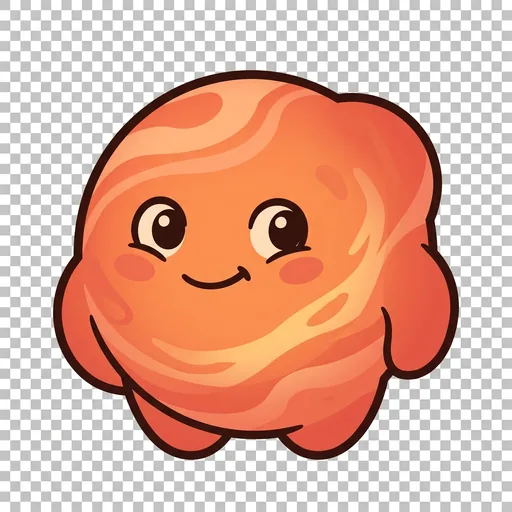
Swell
Red giant (helium fusion / expanded outer layers)
-

Ember
White dwarf / stellar remnant (cooling final state)
-

Brawn
Stellar mass — how heavy a star is at birth decides its whole life story
-
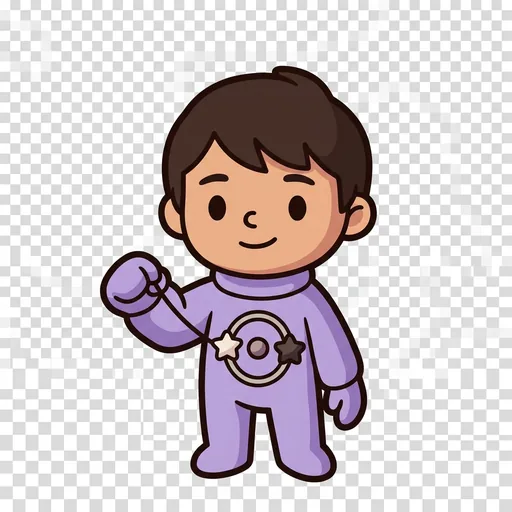
Waltz
Binary stars — most stars are not alone; they circle a partner in a slow gravitational dance
-
Smolder
Brown dwarf — a clump of gas too light to ignite; warm and dim, almost-but-not a star
-
Quiver
Variable stars — stars that pulse brighter and dimmer in a steady, measurable beat
-

Flare
Stellar flares and starspots — a star's stormy magnetic surface weather