
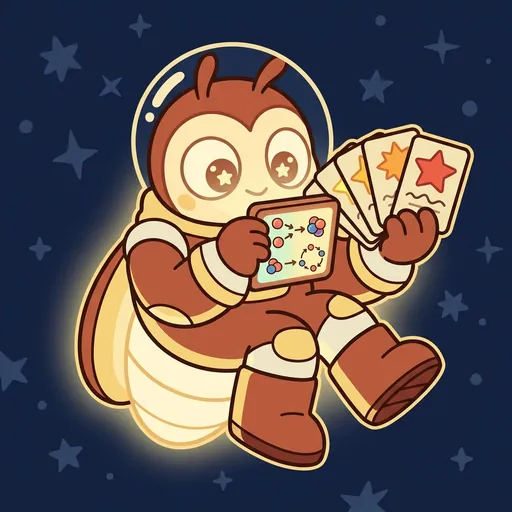
Glow
GLOW — *hydrogen fusion. stable for billions of years.*
Listen along — Glow
Loading audio…
Press play to listen along. The line being read lights up as you go.
Show full transcript
Loading transcript…
Chapter 2 — Glow and the Long Steady Burning
Glow floated into the room. A soft, warm light pulsed from their chunky astronaut tunic. They were a firefly-tween, small and steady. Their glow was a creamy yellow, gentle and bright. In their tiny hands, Glow held a stack of cards. A small device hummed on their wrist. It was a fusion-tracker.
Glow loved stars. Not just any stars, but the ones that knew how to keep things steady. The ones that just kept burning, day after day, for eons. Glow was deeply attentive to how stars stayed stable. They wanted every star to be happy and bright.
“Hey, Glow!” A voice chirped. “What’s all that glowing about?”
Glow looked up. Their antennae twitched slightly. “Oh! Hello, Pip. I was just checking on the main-sequence.”
Pip, a small, bouncy sprite, zipped closer. “The what now?”
“The main-sequence,” Glow repeated, very seriously. “It’s how stars shine. The best way. The longest way.” Glow carefully placed a small, glowing orb on a tiny stand. It pulsed with a soft, steady light. “This is like our Sun,” they said. “Right now, it’s in its prime. Happy and bright.”
“Pip poked the orb gently. “So it won’t just fizzle out?”
“Not for a very, very long time,” Glow assured them. “That’s the beauty of the main-sequence. It’s reliable. You can count on it.”
Glow fanned out their stack of cards. “See these cards? Each one is a star. And inside each star, something amazing happens. Hydrogen atoms smash together. They turn into helium.”
“Like magic?” Pip asked, eyes wide.
“Better than magic,” Glow said. “It’s science. It’s called hydrogen fusion.”
This fusion makes the star glow. It keeps it warm. And it’s super stable. For billions of years! Glow’s own glow brightened with excitement. “That’s why it’s the main-sequence.”
Glow adjusted a tiny dial on their fusion-tracker. Numbers glowed green. “See? Everything is perfectly balanced. The push of the fusion, the pull of gravity. It all works together.”
Pip tilted their head. “So, it’s like… a really good engine?”
“Exactly!” Glow beamed. “A star engine. Running on hydrogen. Making helium. For billions of years.”
“Our own Sun is a main-sequence star,” Glow explained. “It’s been burning for five billion years. It has another five billion to go!”
Pip whistled. “That’s a lot of birthdays.”
“It is,” Glow agreed. “But some stars are even slower. Take red dwarfs. They’re tiny. They burn their hydrogen so slowly. They can last for a hundred billion years. Or more!”
“Wow,” Pip whispered.
“Then there are the big ones,” Glow continued, pointing to a card with a huge, blue star. “They burn super fast. Like a giant bonfire. They only last a few million years. Then, poof!” Glow made a small explosion sound. “Gone.”
“Different stars have different ways to do this fusion,” Glow said, tapping their fusion-tracker. “It depends on how big they are. But the idea is always the same. Hydrogen into helium. Steady light. Steady heat.”
Glow sighed softly. “I prefer the steady ones. The ones that just keep going. The main-sequence stars.”
They carefully shuffled their cards. Each one showed a star, glowing steadily. “It’s all about the hydrogen fusion,” Glow said again. “It’s the secret to a long, bright life for a star.”
Pip nodded slowly. “So, when a star is on the main-sequence, it’s doing its job. Fusing hydrogen. Being stable.”
Glow’s antennae wiggled with approval. “You got it, Pip! It’s the most important part of a star’s life. The long, steady burn.”
Glow looked at their fusion-tracker. The numbers were still green. All was well in the universe, at least for the main-sequence stars. And that made Glow very happy.
The StarForge ensemble
Glow is part of StarForge's distributed-narrative cast. Each character embodies a different curricular primitive; together they teach the full subject.
-

Wick
Protostar (collapsing gas, igniting)
-

Swell
Red giant (helium fusion / expanded outer layers)
-
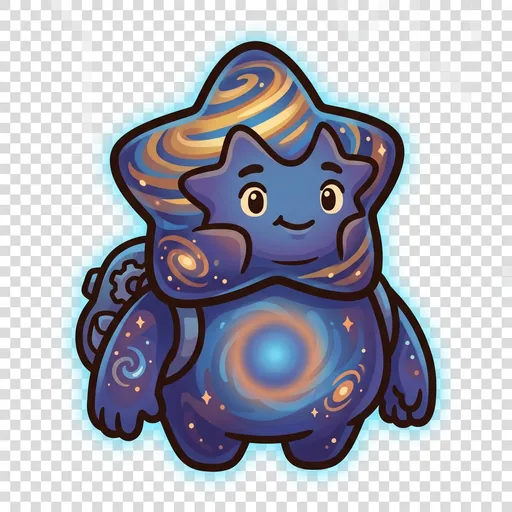
Pinch
Stellar collapse + neutron star / supernova compaction
-

Ember
White dwarf / stellar remnant (cooling final state)
-

Brawn
Stellar mass — how heavy a star is at birth decides its whole life story
-

Waltz
Binary stars — most stars are not alone; they circle a partner in a slow gravitational dance
-

Smolder
Brown dwarf — a clump of gas too light to ignite; warm and dim, almost-but-not a star
-

Quiver
Variable stars — stars that pulse brighter and dimmer in a steady, measurable beat
-

Flare
Stellar flares and starspots — a star's stormy magnetic surface weather