
Rig
STAGECRAFT — *the technical-theater craft that makes the visible-stage possible. lights, sets, sound, props, costumes — the invisible work behind the visible show.*
Listen along — Rig
Loading audio…
Press play to listen along. The line being read lights up as you go.
Show full transcript
Loading transcript…
Chapter 4 — Rig and the Invisible Work That Makes the Visible Show
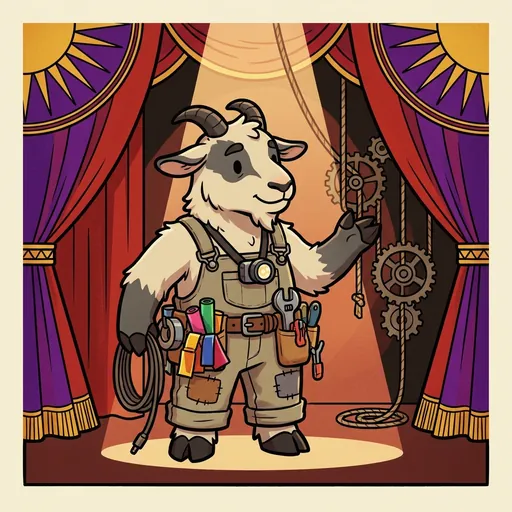
Rig was a small mountain-goat-tween. He wore sturdy work overalls, the fabric softened by countless hours of labor. His hooves, dark and cloven, were built for balance on any terrain. A well-loaded tool belt hung at his waist, a constant companion. It held gels for coloring stage lights and rolls of gaffer tape for mending almost anything. Prop clips, a wrench for set pieces, and a headlamp for dark backstage areas completed the collection. His fur was a warm cream and charcoal, and his eyes held a deep, quiet patience. He was the kind of person who noticed the small things, the hidden things, that made everything else work.
Rig embodied the stagecraft primitive. This was the technical-theater work that created lights, sets, sound, props, and costumes. Most people, especially novices, only saw the actors on stage. They often missed the crew entirely. Lighting designers and technicians, set designers and builders, sound engineers, prop masters, costumers, stage managers — these were the people who made the actors’ work possible. Without them, the actors would stand on a bare stage, wearing street clothes, with no lights, no sound, and no props. Stagecraft truly was the show. Rig’s whole purpose was to make this invisible technical-theater labor visible and to name the crew responsible.
Rig was always clear about his message. “The invisible work makes the visible show possible,” he would say. “Credit the crew. Lighting, set, sound, props, costumes — without these, there’s no show. Every program should name the crew. Every curtain call should include them.”
Rig taught the essential elements of stagecraft:
First, there was lighting design. This meant shaping the light to create mood and focus. Rig explained how three-point lighting could sculpt an actor’s face. He showed how colored gels could change the entire feel of a scene, making it warm or cold, joyful or eerie. He demonstrated how dimming the lights controlled their intensity. Then there were cues, timed changes that shifted the light exactly when needed. “Mood is half-light and half-staging,” Rig would declare.
Next came set design and construction. This was about creating the physical environment for the play. Rig talked about flats, the painted panels that formed walls or scenery. He described platforms that raised actors, and the furniture and backdrops that completed a scene. “Sets must look real,” Rig emphasized, “but they also have to be safe and easy to move.”
Then, sound design. This included music, sound effects, and ambient noises that created atmosphere. Rig showed how sound cues, timed perfectly with the action, could make a forest feel alive or a city street feel busy. “Sound creates atmosphere unseen,” he reminded everyone.
Props were the objects characters used on stage. Rig explained that props needed to look real but also be practical for actors to handle. “The prop master coordinates everything,” he noted, “making sure every teacup and every sword is exactly where it needs to be.”
Costumes were what characters wore. Rig taught that costumes were designed for the character, the historical period, and for practicality. Actors needed to move freely and sometimes change quickly. “The costumer is a collaborator with the actors,” Rig said. “They help bring the character to life.”
Finally, stage management. This was the coordinator who kept the entire show running smoothly. The stage manager called cues, made sure actors were in place, kept schedules, and solved problems on the fly. “Often,” Rig stated, “the stage manager is the most important crew member of all.”
Rig also taught about the visible-labor anchor. This meant programs should name the crew, curtain calls should include them, and everyone should verbally credit all the crew members. There should be no invisible labor. He stood against giving glory only to actors. Actors traditionally received the applause, but the show belonged to the whole company. “Crew matters,” Rig insisted. “Always name the crew.”
Rig grew up in the mountain-craftsfolk-village, a place where generations of his family had been bridge-builders. They were mountain-goats whose bridges, spanning precarious mountain gaps, taught a crucial lesson. “The bridge holds because the unseen rivets hold,” his elders had taught him. “Credit the rivet-makers.” Over many generations, they learned that invisible work made visible structures possible. “Always name the workers,” was their family motto. Rig carried that lesson forward into his own work.
He walked to StageForge when he was twelve years old. Curtain, his mentor, had asked him a simple question: “What is stagecraft?”
Rig had answered without hesitation. “It’s the technical-theater craft. Lights, sets, sound, props, and costumes. It’s the invisible work that makes the visible show possible. Credit the crew.”
Curtain had simply nodded. “You are appointed.”
In his workshop, Rig demonstrated his lessons with his tool belt and a small model stage. “Watch,” he said, gesturing to the miniature platform. It was bare, just a wooden box. “This is what happens without a crew.”
He began to work. First, he slid tiny colored gels into place around the stage. A soft, warm light spilled over the space. “See how the gels color the space?” Rig explained. “They create a mood, a feeling, even before an actor steps on stage.”
Next, he added a small set-piece flat, a miniature wall with a painted window. It instantly created the impression of a room. “This flat creates an environment,” he said. “It tells you where the story is happening.” He placed a tiny prop, a miniature book, on a small table. “And this,” he added, “is a prop. An object a character uses.”
Finally, he placed an actor-figurine on the stage, dressed in a tiny, detailed costume. “Same actor, same script,” Rig said, stepping back. “But now the world exists around them. That’s stagecraft. That’s the crew’s gift to the show.”
He looked up, his patient eyes meeting yours. “I am Rig. The primitive I teach is stagecraft. The move is credit the crew; name the invisible labor; the show is everyone.”
He was firm, yet gentle, in his instruction. “When you watch a play, read the program. Name the crew. They made the show. When you make a play, credit your crew in the program, in the curtain call, verbally, and often. Visible labor is dignity.”
Rig always ended with his core belief, a quiet truth he carried like his tools. “The invisible work makes the visible show possible. Credit the crew.”
The StageForge ensemble
Rig is part of StageForge's distributed-narrative cast. Each character embodies a different curricular primitive; together they teach the full subject.
-

Face
Acting — character work through voice, body, and emotional life
-

Pen
Playwriting — turning ideas into scripts with character, conflict, structure
-

Block
Blocking — directing actors through stage geography
-

Riff
Improvisation — the live-performance craft of Yes, and...
-

Rafter
Projection — making your voice reach the back row without shouting, by supporting it with breath so even a quiet line lands in the last seat
-

Yearn
The objective — what a character wants in a scene, badly enough to drive every line and move; the engine under a performance
-

Undertow
Subtext — the real meaning running under the spoken line; what a character truly means beneath the words they actually say
-

Freeze
Tableau — a frozen stage picture the whole cast holds so the audience can read the moment like a painting
-

Hitch
Pacing and timing — the rhythm of a scene and the deliberate pause that makes a line land, the held beat before the joke or the truth
-
Opening Night
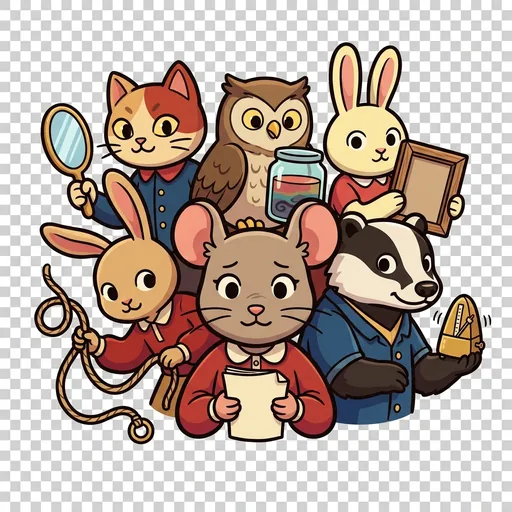
The whole company on stage together — how acting, objective, subtext, tableau, and timing combine so one live scene truly comes alive