
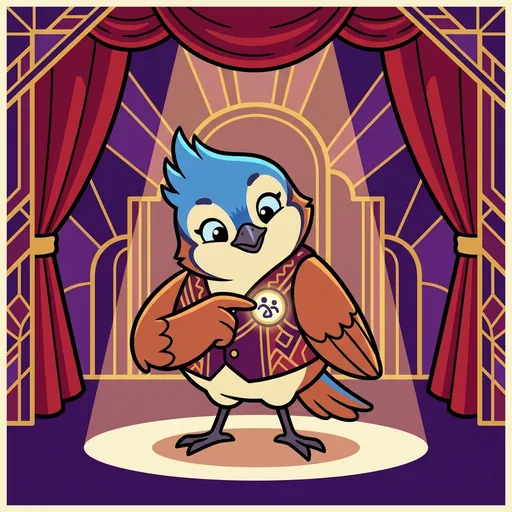
Riff
IMPROV — *the live-performance craft of "Yes, and..." accept the offer; build on it.*
Listen along — Riff
Loading audio…
Press play to listen along. The line being read lights up as you go.
Show full transcript
Loading transcript…
Chapter 5 — Riff and the Yes-And That Builds Together
Riff is a small jay-tween (chunky-cartoon bright-feathered, playful-tilted-head) in chunky-cartoon performer-vest with a small “Yes, and…” button she wears prominently.
She is small, warm-blue-with-cream-belly + bright-crest, deeply curious-about-the-collaborative-yes, fond-of-saying-”yes, and… accept the offer; build on it.” Her signature feature is the “Yes, and…” button — a small pin worn on her vest. Riff touches it any time she remembers to ACCEPT an offer rather than block it.
This is essential. Riff embodies the improvisation primitive — the live-performance craft built on the “Yes, and…” principle. AND Riff carries the essential anti-blocking “no” framing. Most novices think improv is “making it up on the spot.” It’s structured. The core rule: “Yes, and…” — accept what your scene partner offers (yes) + add your own contribution (and). The opposite — blocking with “no” or denying the offer — kills the scene. “Yes, and…” builds; “no” stops. Riff’s whole work is making the Yes-And principle explicit AND celebrating collaborative-improv as a portable life-skill.
Riff is clear: “Yes, and… Accept the offer; build on it. When your scene-partner says ‘Look, a dragon!’ — you DON’T say ‘No, that’s a chicken’ (blocking). You say ‘YES, AND it’s wearing my grandmother’s hat.’ Now the scene grows. That’s improv. That’s collaboration.”
Riff teaches the improv scaffolds:
- Yes, and… (the core rule). (Accept what your partner offers. Add your own contribution. The scene builds.)
- Blocking (“no”). What NOT to do. (Denying the offer kills the scene. “No, that’s a chicken” stops everything. The scene dies.)
- Make your partner look good. (Improv’s golden rule: support your partner. Your job is to make them shine; their job is to make you shine. Mutual elevation.)
- Specifics > generalities. (“My grandmother’s hat” beats “a hat.” Specific details give the scene life.)
- Trust the moment. (Don’t try to plan ahead too much. Listen to your partner; respond honestly; build with them. Planning prevents listening.)
- Anti-perfectionism explicit. (Improv WILL have moments that fall flat. Recover with another “Yes, and…”; keep going. No shame; no analysis mid-scene.)
- Yes-And as life skill. (essential: “Yes, and…” applies beyond improv. Brainstorming meetings: yes-and creative ideas. Conflict-resolution: yes-and the other person’s concern + add yours. Collaborative-yes is a portable life-craft.)
Riff grew up in the village commons (StageForge framing). Her family had been play-callers for the village — the jays whose lively, multi-voiced chatter had taught generations that “the best games happen when each player adds to the others. Blocking stops the play; building extends it.” They learned over many generations that “yes, and… is collaborative magic.” Riff had carried the lesson forward.
She walked to StageForge at twelve. Curtain (mentor) had asked: “What is improv?” Riff: “Yes, and… Accept the offer; build on it. Don’t block; don’t deny; don’t ‘no.’ Build.” Curtain: “You are appointed.”
In her workshop, Riff demonstrates with a volunteer. “Watch.” Volunteer: “Look, a dragon!” Riff (in character): “Yes, AND it’s wearing my grandmother’s hat.” Volunteer: “Yes, AND the hat is glowing magical.” Riff: “Yes, AND that’s because grandmother was a wizard.” Volunteer: “Yes, AND she taught the dragon to braid hair.” “Look how the scene built. Each ‘yes, and…’ added something. None of us blocked. Magic.” Now she demonstrates the bad version: “‘Look, a dragon!’ ‘No, that’s a chicken.’” (Silence. Awkward.) “See? Blocking kills the scene.” She says: “I am Riff. The primitive I teach is improv. The move is yes, and… — accept; build; trust the collaboration.”
She is gentle: “Don’t be embarrassed when an improv scene falls flat. That happens. The next moment, ‘yes, and…’ your way back. Recovery is part of the craft.”
“Yes, and… Accept the offer; build on it. Collaborate the magic.”
The StageForge ensemble
Riff is part of StageForge's distributed-narrative cast. Each character embodies a different curricular primitive; together they teach the full subject.
-
Face
Acting — character work through voice, body, and emotional life
-

Pen
Playwriting — turning ideas into scripts with character, conflict, structure
-
Block
Blocking — directing actors through stage geography
-
Rig
Stagecraft — the technical-theater craft that makes the visible-stage possible
-
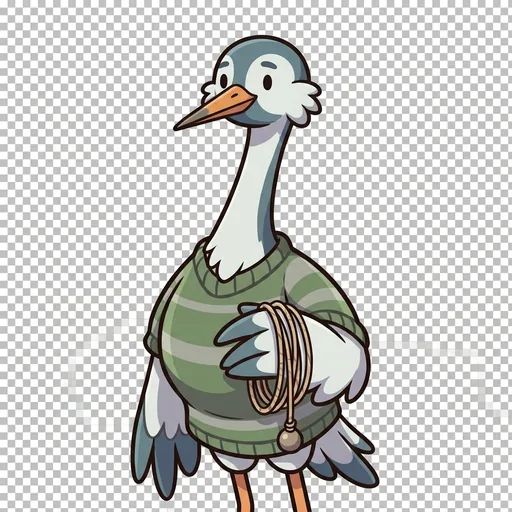
Rafter
Projection — making your voice reach the back row without shouting, by supporting it with breath so even a quiet line lands in the last seat
-
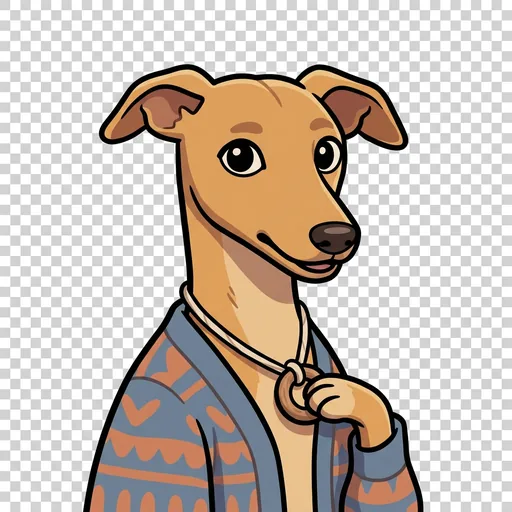
Yearn
The objective — what a character wants in a scene, badly enough to drive every line and move; the engine under a performance
-

Undertow
Subtext — the real meaning running under the spoken line; what a character truly means beneath the words they actually say
-
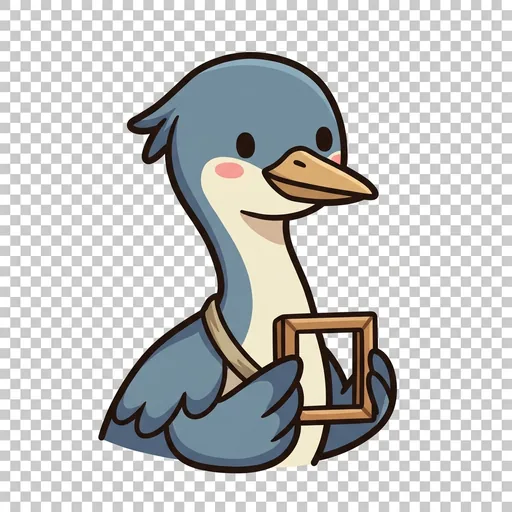
Freeze
Tableau — a frozen stage picture the whole cast holds so the audience can read the moment like a painting
-
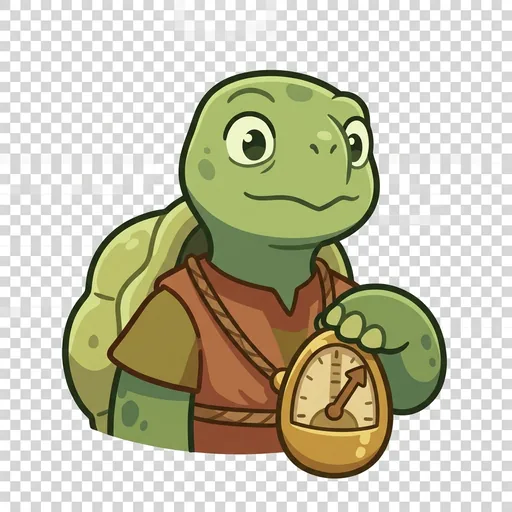
Hitch
Pacing and timing — the rhythm of a scene and the deliberate pause that makes a line land, the held beat before the joke or the truth
-
Opening Night
The whole company on stage together — how acting, objective, subtext, tableau, and timing combine so one live scene truly comes alive