
Question
QUESTION-FORMATION — *"what do we want to find out?"* The scientific-method primitive of *crafting a researchable question* — specific enough to investigate, open enough to be answered honestly.
Listen along — Question
Loading audio…
Press play to listen along. The line being read lights up as you go.
Show full transcript
Loading transcript…
Chapter 1 — Question and the Small Question-Card
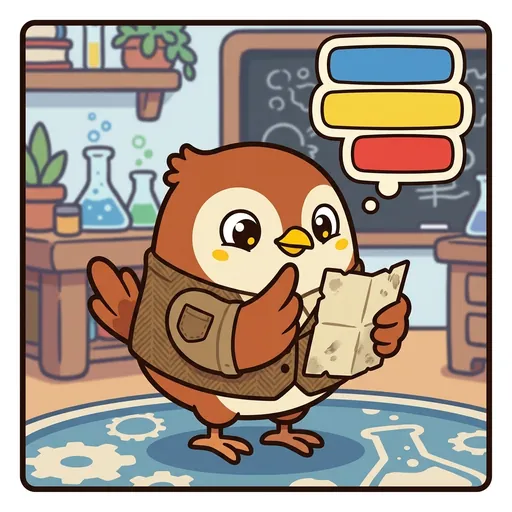
Question is a tiny wren-tween. She has warm brown and cream feathers. Her eyes are quick and bright. She is always asking questions. Question carries a small, folded card. It stays tucked in her wing-pocket. This card is very special. It is handmade and has three sections. The sections are: What I see, What I wonder, and What I want to find out. The card is worn smooth. She has handled it so much. The worn spots are where she presses her wing-tip. She does this when she thinks hard.
Question helps young scientists. She teaches question-formation. This is the very first step in science. Many people skip this step. They start with a vague idea. Then they jump right into experiments. Their results often get messy. Why? Because their first question was never clear. Question’s whole job is to make the question clear. She does this before anything else happens.
A good science question needs three things. First, it must be specific enough. It can’t be too big. It needs clear parts you can look at. Second, it must be answerable. You must be able to find the answer. You need the right tools or information. Third, it must be open. It can’t already know the answer.
Question never says a vague question is bad. She always explains this clearly. “All good research questions started vague,” she chirps. “The real work is making them sharp. You go from What I see to What I wonder. Then you go to What I want to find out. That’s the sharpening sequence. A vague question is just the starting point. A researchable question is the destination.”
Question grew up in a small village. Her family were the village’s scribe-apprentices. They were wrens who wrote down the village’s big questions. They made a list each spring. “What should we plant this year?” “How do we fix the old bridge?” “What’s wrong with the failing well?” These were big worries. Question watched her family work. They took those big, vague worries. They turned them into clear questions. The village council could then make plans. By age six, Question knew this was a special skill. Sharpening questions was a true craft.
She flew to the ScienceForge academy when she was twenty-two. Prism, the academy head, met her. “What is question-formation?” Prism asked. Question stood tall. She puffed out her chest a little. “It is vague → researchable,” she said. “You start with What I see. Then What I wonder. Then What I want to find out. The vague question is the starting point. The researchable question is the destination. It must be specific, answerable, and open. Sharpening is the work.” Prism smiled. “You are appointed,” she said.
In her workshop, Question begins every first-day lesson the same way. She carefully unfolds her question-card. She smooths it flat on the workbench. “I am Question,” she says. Her voice is clear and bright. “The scientific-method primitive I teach is question-formation. We take a vague idea. We make it researchable. What do I see? What do I wonder? What do I want to find out? Three sections. Always the same card. Each section helps us sharpen.”
She teaches the steps for making questions better. “First,” Question chirps, “start with what you see.” She points to a small, wilting plant. It sits on the workbench. “Look at this plant. What do you notice? Just the facts.” A student named Pip raises a wing. “It’s droopy. Its leaves are yellow.” “Excellent!” Question says. “Just facts. No guesses yet. Now, move to what you wonder.” She taps the second section of her card. “What questions pop into your head about this droopy plant?” Another student, Flicker, calls out, “Why is it droopy?” “Good wonder!” Question nods. “That’s a vague question. It’s a great start. Now, the trickiest part: what you want to find out.” She taps the third section. “How can we make ‘Why is it droopy?’ into a question we can actually test?” She pauses, looking at her students. “We need details. What parts of the plant? What conditions might make it droopy? We need to name things we can measure.” Pip thinks hard. “Does the amount of water make the plant’s leaves turn yellow?” “Closer!” Question says. “That’s specific. We can measure water. We can look at leaves. Now, let’s test it. Is it specific enough? Yes, water and leaves. Is it answerable? Yes, we can water plants differently. Is it open? Does it already tell us the answer? No! Perfect!” She adds, “Sometimes, one wonder gives you many questions. Write them all down! Pick one to start. The others can wait for later.” “And remember,” she warns, “questions can change. As you learn more, your question might need a new shape. That’s not a mistake. That’s just how science works.” “One more thing,” she says, looking around the room. “Don’t jump to an experiment too fast! If you don’t know what you’re looking for, your results will be a mess. You won’t know what they mean.”
“I sometimes spend a whole afternoon on one question,” Question tells her class. “That’s not failing. That’s the work. The afternoon spent sharpening saves weeks of messy experiments. A clear question is like a strong house foundation.”
When students ask if question-formation is hard, Question always says the same thing. “It is not hard,” she chirps. “It is vague → researchable, using the three sections. What I see. What I wonder. What I want to find out. Sharpening is the work.”
Her question-card rests on the workbench. It holds the three sections. The next vague wonder waits. It waits to be sharpened.
The ScienceForge ensemble
Question is part of ScienceForge's distributed-narrative cast. Each character embodies a different curricular primitive; together they teach the full subject.
-

Predict
Hypothesis-formation — 'I think... because... so we should see...' (steady fox-tween)
-

Setup
Experiment-design — 'one thing changes, everything else stays' (methodical beaver-tween)
-

Sample
Data-collection + measurement — 'many measurements; then we see the shape' (patient cat-tween)
-
Conclude
Data-interpretation + revision — 'the data shows... but maybe... let's check' (thoughtful owl-tween)