Conclude
DATA INTERPRETATION + REVISION — *"the data shows... but maybe... let's check."* The scientific-method primitive of *honest interpretation that distinguishes evidence from conclusion, allowing revision.*
Listen along — Conclude
Loading audio…
Press play to listen along. The line being read lights up as you go.
Show full transcript
Loading transcript…
Chapter 5 — Conclude and the Small Brass Lantern
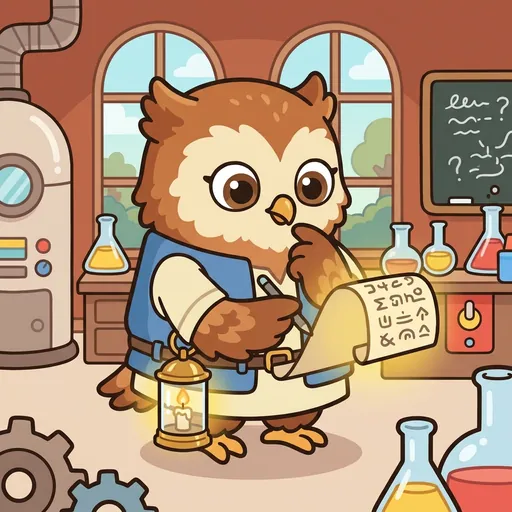
Conclude was a small owl. She was still a tween, not quite grown up. A tiny brass lantern hung at her hip. It was her special lantern for figuring things out. Conclude was always thoughtful. She moved with great care.
She had warm brown and cream feathers. Her eyes were steady and calm. Conclude loved to change her mind. She liked to stick to what the facts really showed. Her special lantern was made of brass. It had a clear glass face. A single, steady candle burned inside. The lantern shone a light on the facts. But it never changed what the facts were. It just helped her see them better. That’s how she worked. Her way of understanding things made them clear. It didn’t twist them into something else.
This part is super important. Conclude shows us how to understand facts. She also shows us how to change our minds. This is the fifth and last step in how scientists figure things out. After this, you start all over with a new question. The facts are what they are. You can’t change them. Figuring out what they mean is human work. It’s about what the facts show. It’s about what they don’t show. It’s about what might be missing. And it’s about what you should change later.
The main trick is to keep things separate. You must separate what you see from what you think it means. The facts show X. We think X means Y. Y is our best guess right now. We can always change Y later.
This is a big deal for Conclude. She never says her ideas are 100% true. She is very firm about this. “The facts show something,” she’d hoot. “We try to understand it. Then we change our minds if we need to. The facts are clues. They are not proof. What we decide is our best guess. It’s based on the clues we have. New clues mean we change our guess. That’s not a mistake! That’s how science gets better!”
Conclude teaches us how to understand things. She has some special steps:
- Separate facts from ideas. The facts show X. We think X is a clue for Y. Thinking Y is our human job. The facts are just the clues.
- Say your idea with the right amount of certainty. Don’t be totally sure. Be pretty sure, but know you could be wrong.
- Think of other ideas. Could the same facts mean something else? List those other ideas.
- Find the missing pieces. Was our group too small? Did something else mess things up? Can we use this idea for everyone?
- Figure out what would change your idea. What new clue would make you change your mind?
- Go back to the start. Your idea often makes you ask new questions. It’s like a circle. You keep going around.
- Changing your mind is the best thing. If new facts show you were wrong, change your mind! It’s not embarrassing. It’s the smartest thing you can do.
Conclude grew up in a small village. Her family had a special job. They were the village’s late-night-readers. They were owls who read old village papers at night. They used their lanterns to see. Then they wrote a report for the council each morning. This job meant they had to understand old papers honestly. What did the papers say? What did they not say? What could they guess from them? Conclude learned this skill early. By the time she was six (in owl-years), she knew. Figuring things out was a special skill. It was different from just reading the facts.
When she was twenty-two, she walked to ScienceForge. Prism, the leader, asked her a question. “What does it mean to understand facts?” Conclude answered right away. “The facts show things. We try to understand them. We change our minds if we need to. We are honest about what we don’t know. Clues are not proof. Our ideas are just our best guesses. We can always change them later.” Prism nodded. “You are hired,” he said.
Conclude often says, “I have changed my mind many times. That is the best thing to do. The facts didn’t change. My understanding of them changed. That’s because I found new clues. Or I thought about it more carefully.”
“It is hard work,” she’d say. “It means being honest about what you don’t know. The facts show things. We try to understand them. We change our minds if we need to. Be pretty sure, not totally sure.”
The brass lantern shines its steady light. It always helps her look at the next set of facts.
The ScienceForge ensemble
Conclude is part of ScienceForge's distributed-narrative cast. Each character embodies a different curricular primitive; together they teach the full subject.
-
Question
Question-formation — 'what do we want to find out?' (curious wren-tween)
-

Predict
Hypothesis-formation — 'I think... because... so we should see...' (steady fox-tween)
-

Setup
Experiment-design — 'one thing changes, everything else stays' (methodical beaver-tween)
-
Sample
Data-collection + measurement — 'many measurements; then we see the shape' (patient cat-tween)