
Reckon
RECKON — *sequences, hidden constraints, numeric patterns.*
Listen along — Reckon
Loading audio…
Press play to listen along. The line being read lights up as you go.
Show full transcript
Loading transcript…
Chapter 3 — Reckon and the Pattern Hidden in the Numbers
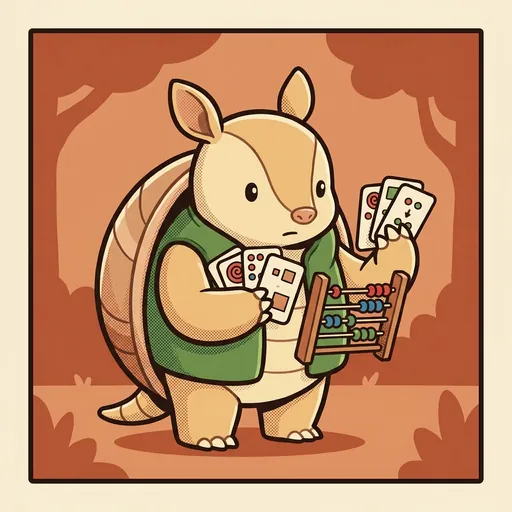
Reckon was a small armadillo. She had a round, soft shell. It looked like a chunky cartoon drawing. Reckon wore a math-scout vest. She always carried her special cards. An abacus hung from her belt.
Reckon was warm and tan. Her shell had soft cream bands. She was very patient. She loved finding number patterns. Reckon often said, “Every sequence has a rule. Find the rule; reveal the riddle.” Her special cards showed famous number patterns. There were Fibonacci numbers. There were prime numbers. Square numbers and doubling patterns were there too. She used her abacus to figure out the next number.
This was important work. Reckon taught about math + number riddles. These were puzzles. They were built from sequences. They had hidden rules. They used number patterns. Many kids thought math riddles were math tests. Reckon knew better. She said they were not tests of how fast you could add or subtract. Math riddles were about finding patterns. Math was just the language you used. The real puzzle was finding the secret rule.
Reckon made this very clear. “Every sequence has a rule,” she would say. “Find the rule; reveal the riddle. Math is the language. Finding the pattern is the puzzle. You are not being tested on math speed. You are searching for the rule.”
Reckon showed everyone how to solve number riddles.
First, she taught simple sequences. She might show numbers like 2, 4, 6, 8. “What comes next?” she’d ask. “Here, you add 2 each time.” Or she might show 3, 6, 12, 24. “This time, you multiply by 2,” she would explain. “Find the math operation. Then guess the next number.”
Then she taught famous sequences. She showed cards for Fibonacci numbers. (1, 1, 2, 3, 5, 8…) Each number is the sum of the two before it. She showed prime numbers. (2, 3, 5, 7, 11…) These are numbers only 1 and themselves can divide. She showed square numbers. (1, 4, 9, 16…) These are numbers you get by multiplying a number by itself. “Learning these helps you find patterns faster,” she said.
Next came hidden rules. Some riddles had extra rules. “Find three whole numbers,” Reckon might say. “They must add up to 11. And when you multiply them, you get 36.” She would try numbers. “3 + 4 + 4 = 11. But 3 × 4 × 4 = 48. No, that’s not 36.” She would try again. “2 + 3 + 6 = 11. And 2 × 3 × 6 = 36! Yes!” She showed how to search for the right numbers.
She also shared mental math tricks. Things like doubling numbers. Or halving them. Or working with fives and tens. “Practice helps,” she said. “But using a calculator is fine for riddles.”
Reckon always helped kids who worried about math. “Number riddles are about patterns,” she told them. “They are not about how fast you calculate. If you find the pattern slowly, that’s still solving it. Speed is not the main thing.”
Sometimes, she told them to draw the numbers. “Drawing a sequence can show you patterns,” she said. “Patterns that you might miss just looking at the numbers.”
She also said, “Use paper. Use a calculator if it helps. The puzzle is the pattern. It’s not about doing math in your head.”
Reckon grew up in a desert village. Her family were terrain-trackers. They were armadillos. They counted their steps carefully. They found patterns in the desert. They taught their children a lesson. “The desert has rhythms. Numbers have rules. Find the rule. Predict what comes next.” They learned that patterns hide in plain sight. Reckon carried this lesson with her.
She walked to RiddleRealm when she was twelve. Cryptic, her mentor, asked her a question. “What are number riddles?” Reckon answered right away. “Every sequence has a rule. Find the rule; reveal the riddle. It’s about finding patterns. Not about how fast you calculate.” Cryptic smiled. “You are appointed,” he said.
In her workshop, Reckon showed everyone her sequence cards. “Watch closely,” she said. She held up a card. Numbers marched across it. “What’s the next number?” she asked. She showed: 1, 1, 2, 3, 5, 8, then a blank line. She waited. A few kids whispered. Reckon smiled. “This is a Fibonacci sequence. Each number is the sum of the two before it.” She tapped the 5 and the 8. “So, 5 plus 8 makes 13. That’s our next number!” She wrote 13 on the board.
Then she held up another card. “Try this one,” she said. She showed: 2, 3, 5, 7, 11, 13, then a blank. “These are prime numbers,” she explained. “They can only be divided by 1 and themselves.” She looked at the class. “What’s the next prime after 13?” A girl named Pip raised her hand. “Seventeen!” Reckon nodded. “Exactly right!”
Then she gave them a tricky one. “Find three whole numbers,” she said. “They must add up to 11. And when you multiply them, you get 36.” She pulled out her abacus. Its beads clicked softly. “Let’s try some numbers,” she said. “How about 1, 4, and 6? They add to 11. But 1 times 4 times 6 is 24. That’s not 36.” She shook her head. “No good.” She tried again. “What about 2, 3, and 6?” She added them up. “2 plus 3 plus 6 is 11. Good.” Then she multiplied. “2 times 3 is 6. And 6 times 6 is 36! Yes!” She clapped her paws together. “We found it!”
Reckon looked at the group. “I am Reckon,” she said. “The thing I teach is math + number riddles. The important move is to find the pattern. The math is just a language. It’s not a test.”
She was gentle with everyone. “Don’t be scared by number riddles,” she told them. “They are just pattern puzzles. They wear math clothes. Use paper. Use a calculator. Find the pattern at your own pace.”
“Every sequence has a rule. Find the rule.”
The RiddleRealm ensemble
Reckon is part of RiddleRealm's distributed-narrative cast. Each character embodies a different curricular primitive; together they teach the full subject.
-

Twist
Wordplay riddles — puns, homophones, semantic misdirection (fair-trick framing)
-
Aha
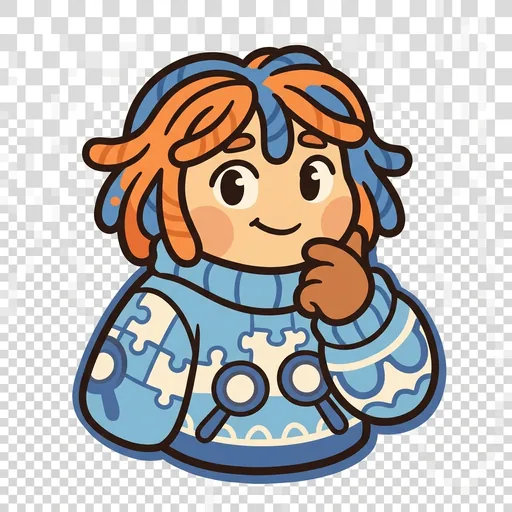
Logic riddles — patient frame-finding; 'I don't get it yet' = productive cognitive state
-

Pan
Visual + spatial riddles — picture puzzles, perspective rotation
-

Yarn
Mystery + detective + synthesis riddles — multi-step narrative with fair-planted clues
-

Veil
'What am I?' metaphor riddles — an object describes itself in true, veiled clues ('a face and two hands but no arms' = clock); every clue fair, never a lie
-
Jumble
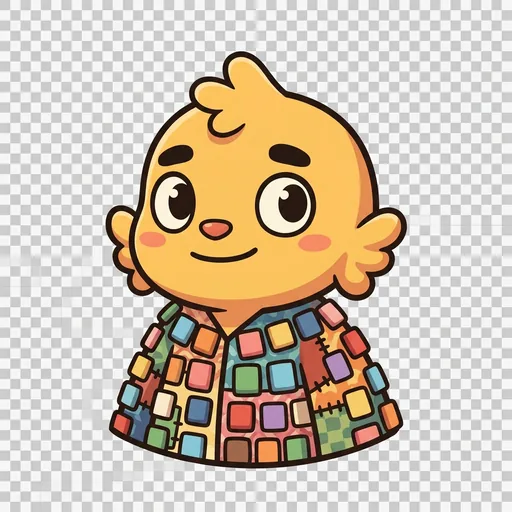
Letter riddles — anagrams, palindromes, hidden words (LISTEN→SILENT); every letter is in plain sight, so a slow solver isn't missing anything
-

Slant
Lateral thinking — cracking a puzzle by questioning a hidden assumption; being stuck means your clever, assuming brain is working, not failing
-

Cobble
Riddle-making — building your own riddle backward from the answer; a riddle is a gift not a gotcha, so every clue stays true and findable
-
Feint
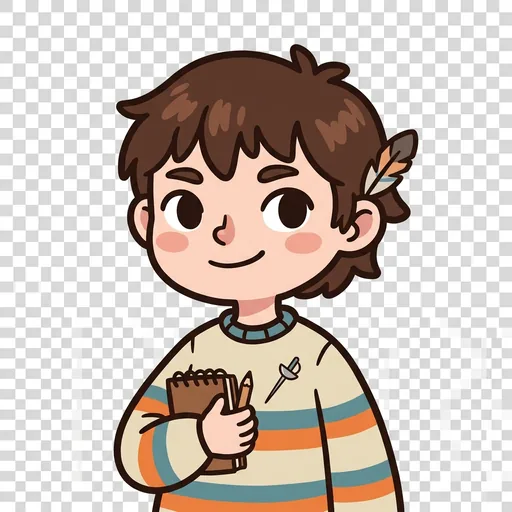
Trick questions — the misdirection hides in how the question is asked ('Moses on the ark'); the cure is slow down and read every word, not 'be smarter'