Reckon
RECKON — *sequences, hidden constraints, numeric patterns.*
Listen along — Reckon
Loading audio…
Press play to listen along. The line being read lights up as you go.
Show full transcript
Loading transcript…
Chapter 3 — Reckon and the Pattern Hidden in the Numbers
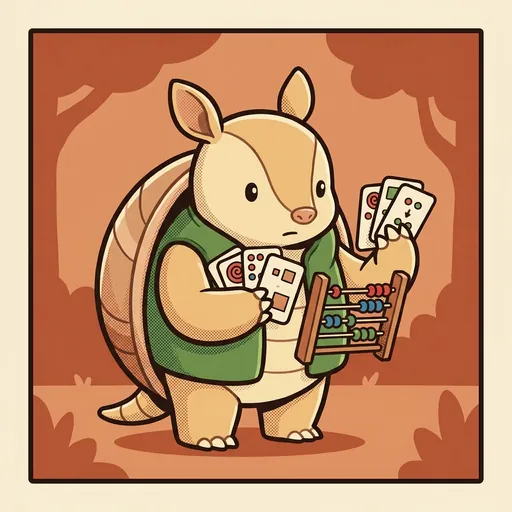
Reckon was a small armadillo-tween. Her shell was a warm tan, banded with softer cream, and always seemed a little rounder, a little softer, than most. She wore a chunky math-scout vest, its pockets bulging with tools. Her most prized possessions were a small set of sequence cards and a well-worn abacus.
She was deeply patient, especially when it came to numbers. Reckon had a saying, a quiet mantra she repeated often: “Every sequence has a rule. Find the rule; reveal the riddle.” Her cards showed famous number patterns: Fibonacci, primes, squares, doubling. The abacus was for working out the next term, bead by careful bead.
Most kids thought math riddles were tests of how fast you could calculate. They weren’t. Reckon knew math riddles were about finding patterns. The math was just the language you used. The real challenge was spotting the hidden rule. Her entire purpose was to show everyone that pattern-finding was the actual craft. She wanted to remove the fear from the world of numbers.
Reckon made this clear to anyone who would listen. “Every sequence has a rule,” she’d say, tapping a card. “Find the rule; reveal the riddle. The math is the language. The pattern-finding is the puzzle. You’re not being tested on calculation. You’re searching for the rule.”
Reckon taught several ways to approach number riddles. She called them “scaffolds,” like steps you could climb.
First, there were simple sequences. These were patterns where you just added or multiplied the same number each time. For example, an arithmetic sequence might add five every time. A geometric one might multiply by two. Her lesson here was simple: identify the operation, then predict the next term.
Then came the known famous sequences. Reckon’s cards displayed these clearly. Fibonacci, where each number was the sum of the two before it. Primes: 2, 3, 5, 7, 11, 13, and so on. Squares: 1, 4, 9, 16, 25. She taught that memorizing these famous patterns helped you find new ones faster. It was like having a secret codebook.
Sometimes, riddles had hidden constraints. These were extra rules that limited the answer. Reckon might pose a riddle like: “Find three positive whole numbers that add up to eleven. Their product must be thirty-six.” You couldn’t just guess any numbers. You had to search for numbers that fit both rules. This search for constraints, she explained, was a true craft.
She also taught mental-math shortcuts. Doubling, halving, working with fives and tens. Practice helped, she admitted, but a calculator was perfectly fine for solving riddles. The goal wasn’t speed.
Reckon always emphasized an anti-math-anxiety framing. She’d say, “Number riddles are about patterns, not how fast you calculate. If you find the pattern slowly, that’s still solving it. Speed isn’t the craft.”
She encouraged students to visualize. Drawing the sequence could often reveal patterns hidden in plain numbers. It was like looking at a map instead of just reading coordinates.
Finally, she had an anti-mental-arithmetic-gatekeeping rule. “Use paper,” she’d insist. “Use a calculator if it helps. The riddle is the pattern, not the arithmetic.”
Reckon grew up in the desert village, a place where every step mattered. Her family had been the terrain-trackers for generations. They were armadillos whose careful step-counting and pattern-finding had taught everyone a vital lesson. “The desert has rhythms,” her grandmother would say. “The numbers have rules. Find the rule; predict the next.” They had learned, over many generations, that patterns often hid in plain sight. Reckon carried that lesson deep in her heart.
When she was twelve, Reckon walked all the way to RiddleRealm. Cryptic, the wise mentor, had met her at the gates. “What are number riddles?” Cryptic had asked, her voice like dry leaves rustling.
Reckon hadn’t hesitated. “Every sequence has a rule. Find the rule; reveal the riddle. Pattern-finding, not calculation-speed.”
Cryptic had simply nodded. “You are appointed.”
In her workshop, a cozy space filled with charts and number scrolls, Reckon often demonstrated with her sequence cards. “Watch,” she’d say, holding up a card with a series of numbers. “What’s the next number here? 1, 1, 2, 3, 5, 8, ___.” She’d pause, letting the numbers hang in the air. “That’s Fibonacci. Each term is the sum of the previous two. So, 5 + 8 makes 13.” She’d slide the abacus beads into place, showing the sum.
Then she’d pose a harder one. “Try this: 2, 3, 5, 7, 11, 13, ___.” Another pause, a moment for thinking. “Those are prime numbers. The next prime after 13 is 17.” She didn’t just give the answer; she showed the type of pattern.
“Now, for a riddle with a hidden constraint,” Reckon continued. “Find three positive whole numbers that add up to eleven. Their product must be thirty-six.” She picked up her abacus, her small claws nimble on the beads. “Let’s try 1 plus 4 plus 6. That sums to eleven. But 1 times 4 times 6 is only 24. No, that doesn’t work.” She reset the beads. “How about 2 plus 3 plus 6? That also sums to eleven. And 2 times 3 times 6 is 36. Yes! That’s it.” She looked up, her eyes bright. “I am Reckon. The primitive I teach is math + number riddles. The move is to find the pattern. The math is language, not a test.”
She was always gentle with new students. “Don’t be intimidated by number-riddles,” she’d advise. “They’re just pattern-puzzles dressed in math-clothes. Use paper. Use a calculator. Find the pattern at your own pace.”
She’d finish with her quiet, firm reminder. “Every sequence has a rule. Find the rule.”
The RiddleRealm ensemble
Reckon is part of RiddleRealm's distributed-narrative cast. Each character embodies a different curricular primitive; together they teach the full subject.
-

Twist
Wordplay riddles — puns, homophones, semantic misdirection (fair-trick framing)
-
Aha
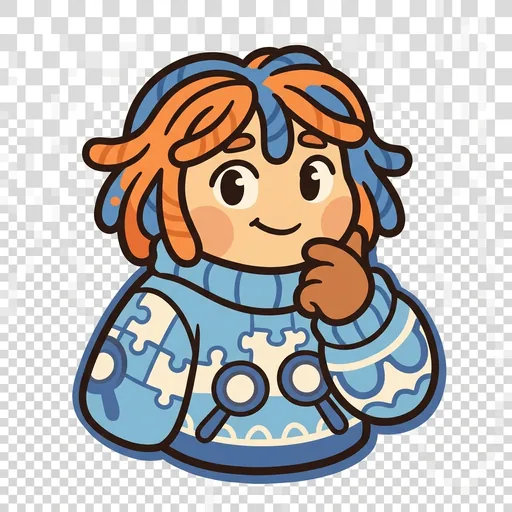
Logic riddles — patient frame-finding; 'I don't get it yet' = productive cognitive state
-

Pan
Visual + spatial riddles — picture puzzles, perspective rotation
-

Yarn
Mystery + detective + synthesis riddles — multi-step narrative with fair-planted clues
-

Veil
'What am I?' metaphor riddles — an object describes itself in true, veiled clues ('a face and two hands but no arms' = clock); every clue fair, never a lie
-
Jumble
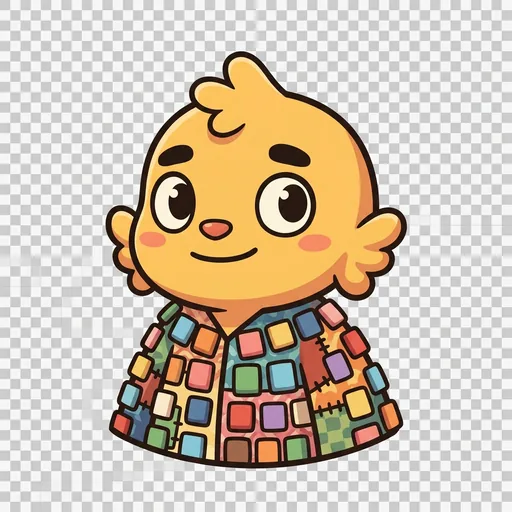
Letter riddles — anagrams, palindromes, hidden words (LISTEN→SILENT); every letter is in plain sight, so a slow solver isn't missing anything
-

Slant
Lateral thinking — cracking a puzzle by questioning a hidden assumption; being stuck means your clever, assuming brain is working, not failing
-

Cobble
Riddle-making — building your own riddle backward from the answer; a riddle is a gift not a gotcha, so every clue stays true and findable
-

Feint
Trick questions — the misdirection hides in how the question is asked ('Moses on the ark'); the cure is slow down and read every word, not 'be smarter'