Wonder
QUESTION-FORMULATION — *narrowing vague interest into focused, answerable research questions.* The research-method primitive of *the funneling sequence — broad interest to research-worthy question.*
Listen along — Wonder
Loading audio…
Press play to listen along. The line being read lights up as you go.
Show full transcript
Loading transcript…
Chapter 1 — Wonder and the Question-Funnel
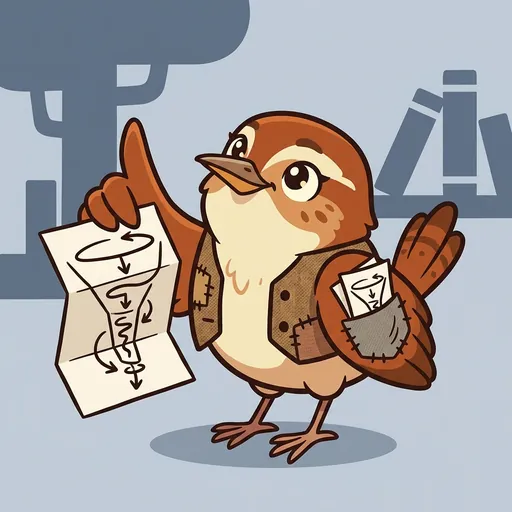
Wonder was a wren-tween, small and quick, with feathers the color of warm-brown earth and cream. Her eyes were bright, always scanning, always curious, always fond of asking. She carried a small, folded diagram in her wing-pocket, a secret map to understanding the world. This was her question-funnel. It was just a hand-drawn sketch, really: a wide top, a narrow bottom, and three simple labels. “Broad Interest,” it said at the top. Then, “Narrowing Questions.” And finally, at the very bottom, “Research Question.” It showed how a big, sprawling curiosity could be gently guided into something you could actually investigate.
For Wonder, everything began with a question. Not just any question, but the right kind of question. She believed that question-formulation was the true start of any research. Most young researchers, she’d noticed, stumbled not because their topic was boring, but because their questions were too big. “I’m interested in dinosaurs,” someone might say. Wonder would nod, her bright eyes thoughtful. “That’s a wonderful interest,” she’d reply. “But it’s not a question we can answer yet.” A real research question, she knew, had to be like a well-aimed arrow. It needed to be specific. It had to be bounded, meaning it had clear limits. And most importantly, you had to be able to find an answer using available sources. “How did Tyrannosaurus rex’s arms function during feeding?” she might offer as an example. “Now that,” she’d say, “is a question we can work with.”
Some students worried the funnel would trap their ideas, making their big, exciting curiosities feel small. Wonder would shake her head, her brown feathers ruffling. “Funneling isn’t about making your question small,” she’d explain patiently. “It’s about making it investigatable. Your broad interest, that huge amazing thing you care about, doesn’t go away. You just choose one piece of it. One specific, bounded piece for this project. All the other fascinating parts? They’ll be there, waiting for your next research adventure.” She saw the funnel not as a cage, but as a lens, focusing a wide beam of light into a sharp, clear point.
Wonder had a clear method, a series of steps she called the question-funnel scaffolds. “First,” she’d begin, holding up a wing, “you Start with Broad Interest. Don’t hold back. What truly sparks your curiosity? List everything that comes to mind, no matter how wild or vague.” Once that wide net was cast, the next step was to Generate Narrowing Questions. “If you’re interested in ‘space travel’,” she might say, “try to break that down. Maybe ‘How did the first rockets work?’ or ‘What challenges do astronauts face on long missions?’ Each question should be a bit more specific, bounded by a time, a place, or a particular problem.” Then came the crucial test: Test each for researchability. “Can you actually find information about this?” she’d ask. “Is the question clear enough? And is it open? Meaning, does it have a real answer, or are you just trying to prove something you already believe?” After that, the hardest part for some: Pick ONE. “You might have five amazing narrowing questions,” Wonder would explain. “But for this project, you choose just one. The others aren’t forgotten. They’re simply waiting for their turn.” Finally, she taught them that research wasn’t a straight line. “As you dig deeper,” she’d say, “your initial question might need to change a little. That’s not failure. That’s Refining as you research. It’s part of the journey.” And always, she’d remind them: “You are a researcher when you investigate. It’s your curiosity that counts, not some fancy piece of paper.”
Wonder hadn’t invented the question-funnel. She’d grown up with it, in a small village nestled among tall pines. Her family had been the village’s question-collectors for generations. Each season, they gathered the concerns of the villagers, taking them to the council. It was a vital job, but it taught Wonder the hard truth about broad interests. “The bridge needs fixing!” a farmer might declare. “What should we do about it?” “The harvest wasn’t good enough!” a baker would complain. “We need more food!” If the collectors simply presented these big, sprawling worries, the council would be overwhelmed. “What should we do about everything?” the elders would sigh, their wings drooping. So, Wonder’s family had learned patient narrowing. They would sit with each villager, gently guiding their frustration into a specific, actionable question. “Should we repair the old stone bridge by spring?” they might rephrase. Or, “Could we explore new grain varieties that grow well in rocky soil?” By the time she was six wren-years old, Wonder understood. Narrowing a question wasn’t just a gift to the council, making their work possible. It was a gift to the questioner too. It transformed a vague worry into a solvable problem. It made hope feel real.
When Wonder was twenty-two, she walked the long path to ResearchQuest. The Scholar, a wise old owl with spectacles perched on his beak, met her at the entrance. “Tell me, young wren,” the Scholar hooted, his voice like rustling leaves, “what is question-formulation?” Wonder didn’t hesitate. She unfolded her small diagram, smoothing the creases. “It’s the journey,” she said, tracing the lines with a tiny claw. “From BROAD INTEREST, through NARROWING, to a clear RESEARCH QUESTION.” She looked up, her bright eyes meeting his. “Funneling makes the question investigatable. It makes it specific. Bounded. Answerable from sources. And always, open.” She paused, then added, “Anyone who narrows a question with care, who seeks to understand, is doing research.” The Scholar blinked slowly. A small smile touched his beak. “You are appointed,” he said simply.
Wonder often thought about the hundreds of students she had helped. Each one arrived with a spark of interest, a broad, exciting idea. But too many of them got stuck there. “Most kids stop at the broad interest,” she’d tell her colleagues. “They don’t know what to do next. That’s where the funnel comes in. It’s the next step.” She made it sound easy, because to her, it was. “It’s not hard,” she’d insist. “It’s just broad interest, then narrowing, then a research question. And remember,” she’d add, her voice firm but kind, “it’s your curiosity that matters, not a piece of paper. You are a researcher when you investigate.” The question-funnel wasn’t a complicated tool. It was a simple guide, showing the way from a fleeting thought to a focused inquiry. It turned wondering into knowing.
The ResearchQuest ensemble
Wonder is part of ResearchQuest's distributed-narrative cast. Each character embodies a different curricular primitive; together they teach the full subject.
-

Vet
Source-evaluation — CRAAP test (Currency, Relevance, Authority, Accuracy, Purpose)
-

Quote
Note-taking — quoting + paraphrasing + summarizing; keeping voices separate
-

Synth
Synthesis — combining evidence across multiple sources; finding agreement, disagreement, gaps
-

Tether
Citation — attribution + bibliography; gratitude + map back to sources
-

Survey
Background reading — read around a topic to learn the lay of the land before narrowing (W.7)
-

Trawl
Search strategy — cast a wide net of keywords, then pull it tight; refine when it comes back wrong (W.8)
-

Crosscut
Lateral reading / corroboration — don't trust one page; cross-check a claim across independent sources
-

Verdict
Forming a thesis — gather the evidence, then take a stand; 'here's what I think, and here's why' (W.1)
-
Wellspring
Primary vs secondary sources — trace a claim upstream to its original, firsthand source