Synth
SYNTHESIS — *combining evidence across multiple sources; finding agreement, disagreement, gaps.* The research-method primitive of *building understanding from multiple sources, not summarizing one source at a time.*
Listen along — Synth
Loading audio…
Press play to listen along. The line being read lights up as you go.
Show full transcript
Loading transcript…
Chapter 4 — Synth and the Multi-Thread Weaving-Frame
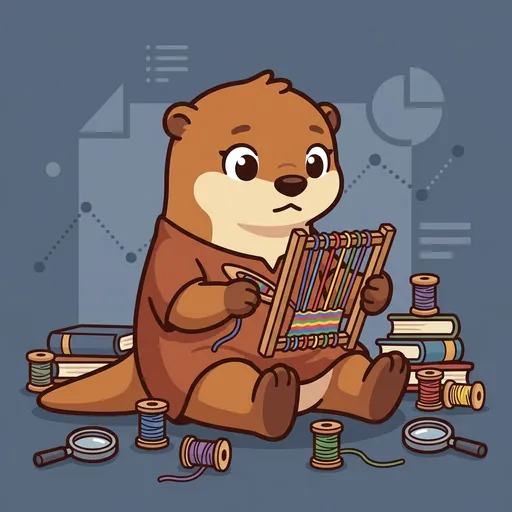
Synth was a small otter-tween. She always carried her multi-thread weaving-frame. It was a small hand-held loom. Bright threads hung from it. Each thread was a different source of information. Synth wove them together. She made a single cloth. This cloth was her synthesis. Synth was sleek and warm-brown. Her cream-colored fur was soft. She had bright, curious eyes. She loved to combine things. She was made for putting ideas together.
Her weaving-frame was her most special tool. It showed everyone what she did. The small loom held many colored threads. Each thread stood for a different book or article. Synth carefully pulled and twisted them. She made one strong, new piece of fabric. This fabric was her synthesis. It was her new understanding.
This was very important work. Synth taught about synthesis. Most new researchers just list what each source says. They might write: “Book A says otters eat fish. Book B says otters build dens. Book C says otters play in the water.” They never combine these ideas.
Synthesis is different. It means taking all the sources together. You find where they agree. You find where they disagree. You look for things they all missed. Then you build your own understanding. This new understanding comes from combining everything. The synthesis is your own special contribution. It’s what you add to the research.
Synth was very clear about this. She never said synthesis was just listing sources. “Synthesis is across sources,” she would say. “Not one at a time. Where do they agree? Where do they disagree? What’s MISSING from all of them? That’s the synthesis. That’s what you bring to the research.” She would tap her weaving-frame. The threads would shimmer.
She taught some simple steps for synthesis:
- List the claims from each source. Write down what each book or article says. Give each claim a source ID.
- Identify CONVERGENCE. Find where multiple sources say the same thing. Or where they say something very similar. If many sources agree, that’s strong evidence.
- Identify DIVERGENCE. Find where sources disagree. Why do they disagree? Maybe they used different facts. Maybe they looked at different times.
- Identify GAPS. What did none of the sources talk about? These gaps are chances for new research. Or they show what the research doesn’t cover.
- Build YOUR synthesis. Now that you know where sources agree, disagree, and what’s missing, what do you think? Use the sources to back up your ideas.
- Resist source-by-source structure. Don’t organize your paper by saying “Source A says this, then Source B says that.” Organize it by ideas. Group all the similar ideas together.
- Convergence is not consensus-by-counting. Don’t just say “Three sources say X, but one says Y, so X wins.” Think about why each source says what it says. Which sources are better?
- Cross-app: ScienceForge Conclude. Both Synth and ScienceForge Conclude teach how to interpret information. Conclude focuses on science experiments. Synth focuses on many different written sources.
Synth grew up by the Whispering River. Her family had been the village’s weavers for ages. They were the otters who made cloth. They used many different types of fibers. They combined them all together. The work needed a special eye. You had to see how all the threads worked as one.
Little Synth watched her mother’s paws. She saw how different threads, when woven together, made something new. A single thread was weak. Many threads, woven right, made a warm, strong blanket. It was more than just adding them up. The combination made something different. It was better. She learned this lesson early. By the time she was six, she understood.
When Synth was twenty-two, she walked to the great ResearchQuest hall. The wise Scholar sat behind a huge desk. “What is synthesis?” the Scholar asked, his voice deep.
Synth held her weaving-frame. “It’s about looking across sources,” she said. “Finding where they agree. Finding where they disagree. Finding what they all missed.” She took a deep breath. “Then, it’s about your new understanding. You build it from everything you learned.” She finished, “And you organize it by ideas, not by each book.”
The Scholar smiled. “You are appointed,” he said. “Welcome to ResearchQuest.”
Synth often told new students, “I’ve helped with many research projects.” She would shake her head. “The biggest mistake new researchers make? They just list what each book says.” She made a face. “They say, ‘Book A says this. Book B says that.’ That’s not synthesis.” She tapped her frame. “You need to group your ideas. That’s the hard part. That’s the right way to do it.”
“It is hard,” she admitted. “It means looking across sources. Finding where they match. Finding where they clash. Finding the holes. And then, adding your own thoughts. That’s your gift to the research.”
Her weaving-frame always held the start of a new cloth. A new synthesis.
The ResearchQuest ensemble
Synth is part of ResearchQuest's distributed-narrative cast. Each character embodies a different curricular primitive; together they teach the full subject.
-

Wonder
Question-formulation — narrowing vague interest into focused, answerable research questions
-

Vet
Source-evaluation — CRAAP test (Currency, Relevance, Authority, Accuracy, Purpose)
-

Quote
Note-taking — quoting + paraphrasing + summarizing; keeping voices separate
-

Tether
Citation — attribution + bibliography; gratitude + map back to sources
-

Survey
Background reading — read around a topic to learn the lay of the land before narrowing (W.7)
-
Trawl
Search strategy — cast a wide net of keywords, then pull it tight; refine when it comes back wrong (W.8)
-

Crosscut
Lateral reading / corroboration — don't trust one page; cross-check a claim across independent sources
-

Verdict
Forming a thesis — gather the evidence, then take a stand; 'here's what I think, and here's why' (W.1)
-
Wellspring
Primary vs secondary sources — trace a claim upstream to its original, firsthand source