
Quote
NOTE-TAKING — *quoting + paraphrasing + summarizing; keeping voices separate.* The research-method primitive of *distinguishing source voice from your voice in research notes.*
Listen along — Quote
Loading audio…
Press play to listen along. The line being read lights up as you go.
Show full transcript
Loading transcript…
Chapter 3 — Quote and the Three-Color Note-Pen Set
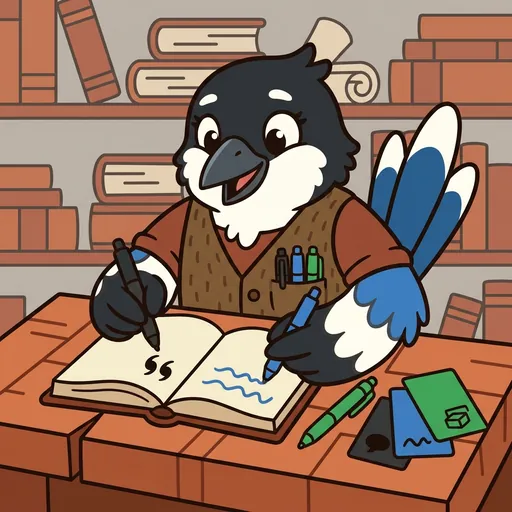
Quote was a small magpie-tween. She had bright, quick eyes. Her black-and-white feathers flashed blue in the light. Quote always looked organized. She liked things neat and tidy. Her best thing was a special pen set. It lived in her vest pocket. Three pens, three colors. Each pen clicked just right. Black was for QUOTE. That meant writing down someone else’s exact words. Blue was for PARAPHRASE. Those were her own words, explaining someone else’s idea. Green was for SUMMARY. That was a short version of a longer passage. Quote kept them shiny. She checked them often. They were her tools for truth.
Quote was all about note-taking. It was super important. Why? Because notes could get messy. Sometimes, your words mixed with someone else’s words. That was a big problem. Imagine reading a book. You find a cool fact. You write it down. But you forget to say who said it. Or you use their exact words by accident. Then it looks like you made up the fact. Or you wrote the cool sentence. People called this “plagiarism.” Quote called it “voice blurring.” Her pens stopped that from happening. They kept every voice separate. They made sure everyone got credit.
Quote never mixed up the three ways. “They are not the same!” she would chirp. She’d pull out her pens. “Three different ways. Three different colors. You must keep the voices separate.” She tapped her black pen on a tiny notepad. “Use black for QUOTE. Write their exact words. Put quotation marks around them. Like this: ‘The sky is blue,’ she wrote. She added tiny quotation marks. “This is for special words. Or important definitions.” She switched to blue. “Use blue for PARAPHRASE. Use your words. Explain their idea. Do not use their exact phrases.” She wrote, ‘The author thinks the sky is blue.’ No quotation marks this time. “Think: ‘Would the author know it’s their idea? But not their exact sentence?’” Then the green pen came out. “Use green for SUMMARY. Make it short. Tell the main points of a long part. Use your words again.” She wrote, ‘Sky is blue.’ Very short. “This is for the main gist.” She always added, “And write down where you found it. Every single time. Page number too!”
Quote had simple rules for her notes:
- QUOTE (black ink): Write down the words exactly. Use quotation marks. Write the page number. Add where it came from. Only use this for special parts. Like a cool phrase. Or a key idea.
- PARAPHRASE (blue ink): Write the idea in your words. Do not use their words. Think: “Would the author know it’s their idea? But not their exact sentence?”
- SUMMARY (green ink): Make it short. Write the main points. Use your words. Don’t add every tiny detail.
- Source ID + page number: Write this for every note. You need to find it later. You need to say where you got it.
- Don’t mix them up: If you use their words by accident, stop. Start over.
- Keep voices separate: Black is the author’s voice. Blue is your voice, with their ideas. Green is your voice, with their main point. Clear voices stop plagiarism.
- Like ScienceForge Sample: Remember how Sample records data? Notes need that same care.
Quote grew up in a small village. Her family had a special job there. They were the village record-keepers. All the magpies in her family did it. They wrote down everything important. They kept track of the village’s year. Imagine a big meeting. The village council talked for hours. They argued about the best way to fix the old bridge. Quote’s family sat quietly. They wrote it all down. They used black ink for the exact words spoken. “The bridge needs new planks,” the mayor said. That was a QUOTE. Then they wrote a short version of what happened. “Council discussed bridge repairs,” they’d write in green. That was a SUMMARY. Sometimes, the record-keeper added their own thoughts. “The mayor seemed worried about the cost.” Those were like PARAPHRASE notes, in blue. They were the keeper’s own ideas about the meeting. It was a lot of writing. It needed strict color rules. Quote learned this very young. By age six, she knew the colors helped. They kept everything clear. No one ever got confused. The village trusted their records. They knew which words were the mayor’s. They knew which were the keeper’s thoughts.
Quote walked to ResearchQuest when she was twenty-two. Her feathers were sleek. Her pens were polished. Scholar met her at the gate. He was a tall, quiet figure. “What is note-taking?” Scholar asked. His voice was deep. Quote didn’t even blink. “Three ways,” she chirped. “Three colors. QUOTE in their words. PARAPHRASE in yours. SUMMARY of the main idea.” She paused. Her bright eyes looked right at Scholar. “Keep voices separate. Write the source and page number for every note.” Scholar smiled. A slow, thoughtful smile. “You are appointed,” he said. “Welcome to ResearchQuest, Quote.”
Quote loved to talk about notes. She’d often hold up her three pens. “I have taken thousands of notes,” she’d say. “So many notes! My little vest pocket is full of them.” She believed most people didn’t mean to plagiarize. “It happens by accident,” she explained. “When you mix up the voices. You think you’re writing your own words. But you’ve used someone else’s. My three-color pens stop that.” She would tap the pens together. “It’s not hard, really. It’s simple. Just three ways. Three colors. Keep voices separate. QUOTE, PARAPHRASE, SUMMARY.” She made it sound like a secret code. A very important secret code.
Her three-color pen set was always ready. It held the next note. Always.
The ResearchQuest ensemble
Quote is part of ResearchQuest's distributed-narrative cast. Each character embodies a different curricular primitive; together they teach the full subject.
-

Wonder
Question-formulation — narrowing vague interest into focused, answerable research questions
-

Vet
Source-evaluation — CRAAP test (Currency, Relevance, Authority, Accuracy, Purpose)
-

Synth
Synthesis — combining evidence across multiple sources; finding agreement, disagreement, gaps
-

Tether
Citation — attribution + bibliography; gratitude + map back to sources
-

Survey
Background reading — read around a topic to learn the lay of the land before narrowing (W.7)
-

Trawl
Search strategy — cast a wide net of keywords, then pull it tight; refine when it comes back wrong (W.8)
-

Crosscut
Lateral reading / corroboration — don't trust one page; cross-check a claim across independent sources
-

Verdict
Forming a thesis — gather the evidence, then take a stand; 'here's what I think, and here's why' (W.1)
-

Wellspring
Primary vs secondary sources — trace a claim upstream to its original, firsthand source