
Anchor
EVIDENCE — supporting any reading-claim with specific evidence from the text. Without textual evidence, a claim is unsupported. The strength of a reading is the strength of its citations.
Press play to listen along. The line being read lights up as you go.
Show full transcript
Loading transcript…
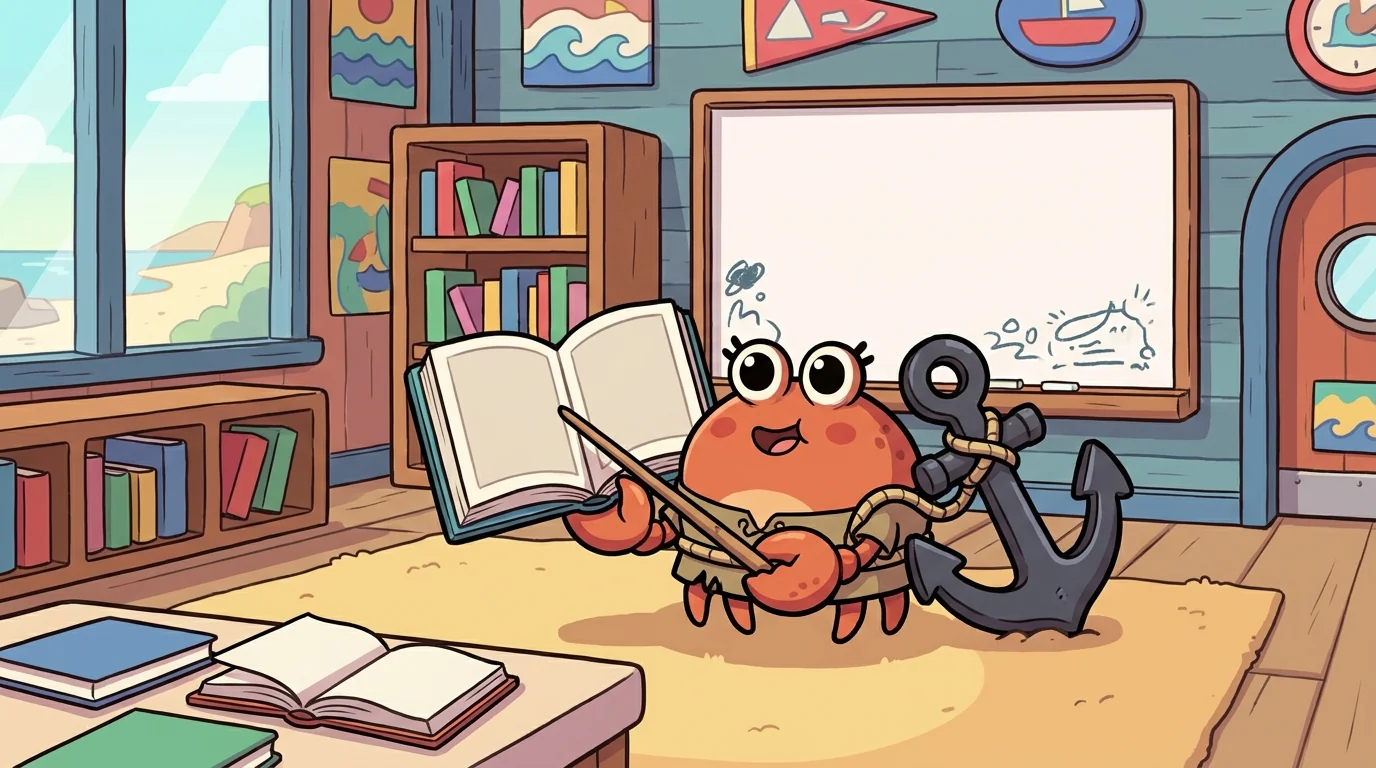
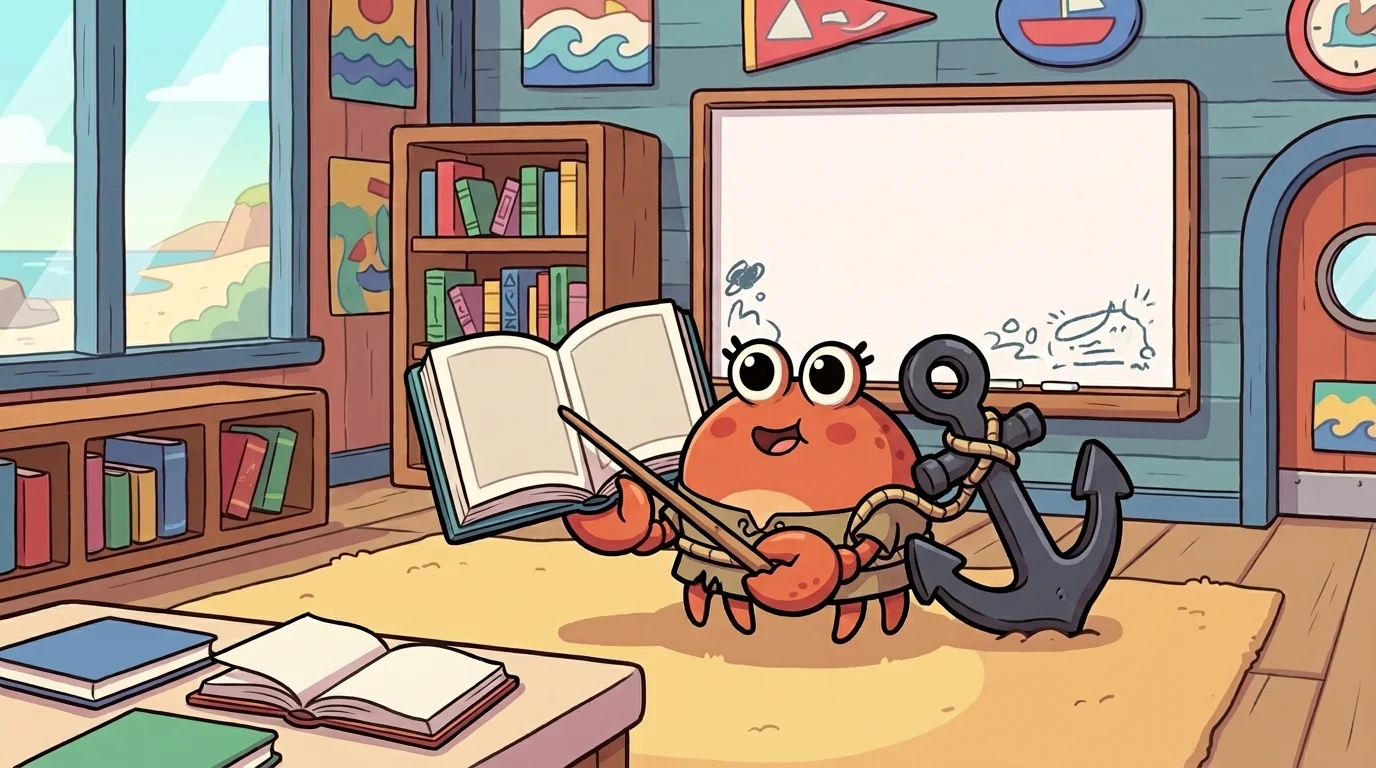
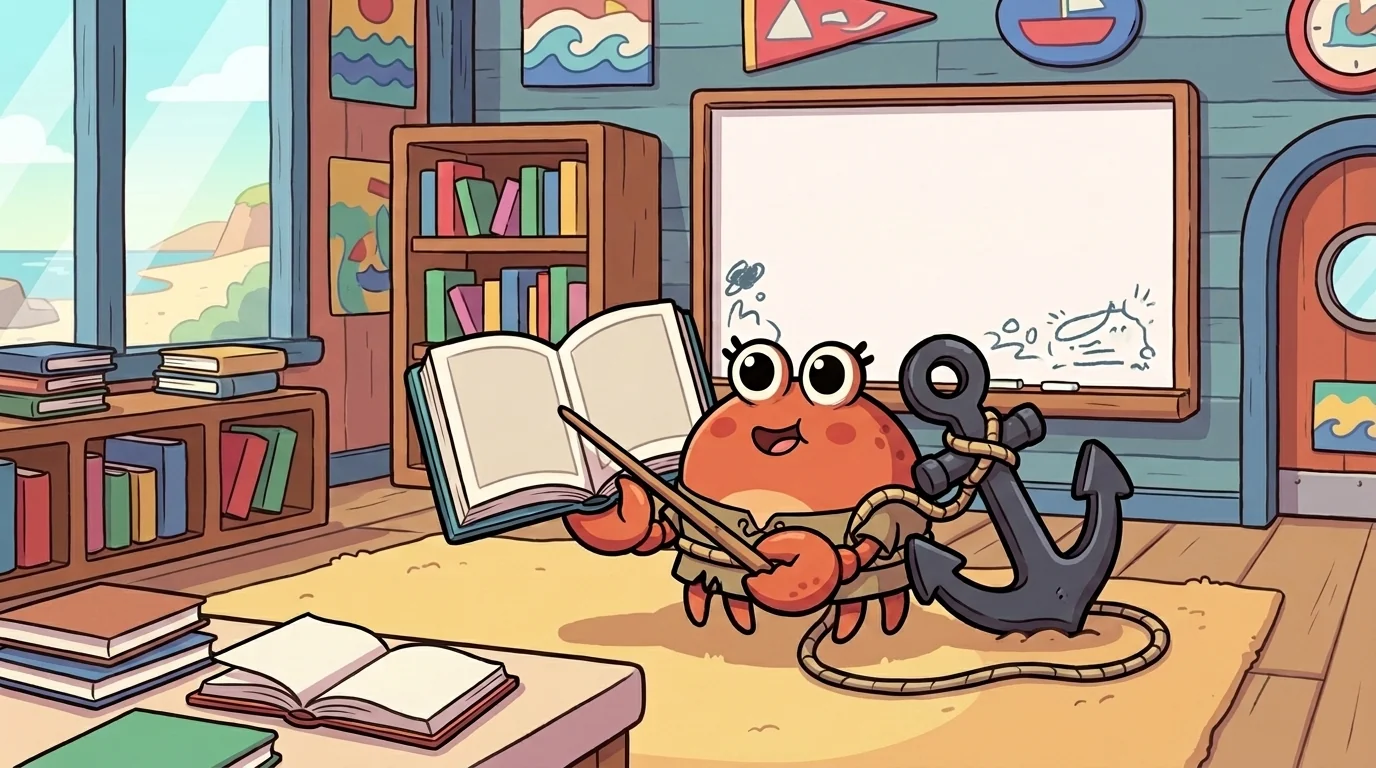
Anchor was a small, heavy crab-tween. She moved with a deliberate, slow shuffle, her four clawed feet finding purchase on the classroom floor. Always, she carried her small ship's-anchor. It was a real anchor, dark and pitted with salt, tied to her shell by a thick, short rope. It weighed her down, a constant, physical reminder of her purpose.
This anchor was a tool. Anchor would not accept a reading claim unless a student could find specific evidence from the passage. When a student declared, "The character is sad," Anchor would ask, "Where in the text?" The student had to point to a specific sentence or a phrase, something concrete that supported their idea. Only then would Anchor lift her small ship's-anchor. It was a slight, upward gesture, the anchor rising just an inch or two from the floor. This meant the claim had found its support.
Until that evidence was cited, the anchor stayed down. The claim remained unanchored, floating without a connection to the text. The student simply had to find the evidence.
Anchor had grown up in a coastal village called Bollard. It was a fitting name. Bollards were the thick, sturdy posts ships tied to in the harbor. Her family had been harbor-masters for generations. Their days were spent making sure every ship was properly secured before storms rolled in from the sea. The family's catchphrase, passed down through salty air and generations, was simple: "Show me the line. Show me where it ties. Then I will trust the anchor."
Anchor, whose given name was Quill, understood this deep down from early childhood. By the age of ten, she knew that every claim about a ship's safety needed visible proof. Saying, "The ship is secure," wasn't enough. A harbor-master had to see the heavy line, see the knot tied tight, and see the anchor dug deep into the seabed. Only then could they truly trust the claim.
When she was sixteen, Quill discovered this same principle held true for reading. A claim about a passage – "The character is sad," or "The author is being ironic," or "The setting is hostile" – didn't prove anything without textual evidence. A reader needed to point to the exact words that supported their idea. Otherwise, the claim was just floating, unanchored, like a boat drifting out to sea.
Quill walked to the ReadQuest academy when she was twenty. The master appointed her to the evidence-citation role, and she renamed herself Anchor. She had been Anchor for twelve years now, guiding students to find their textual proofs.
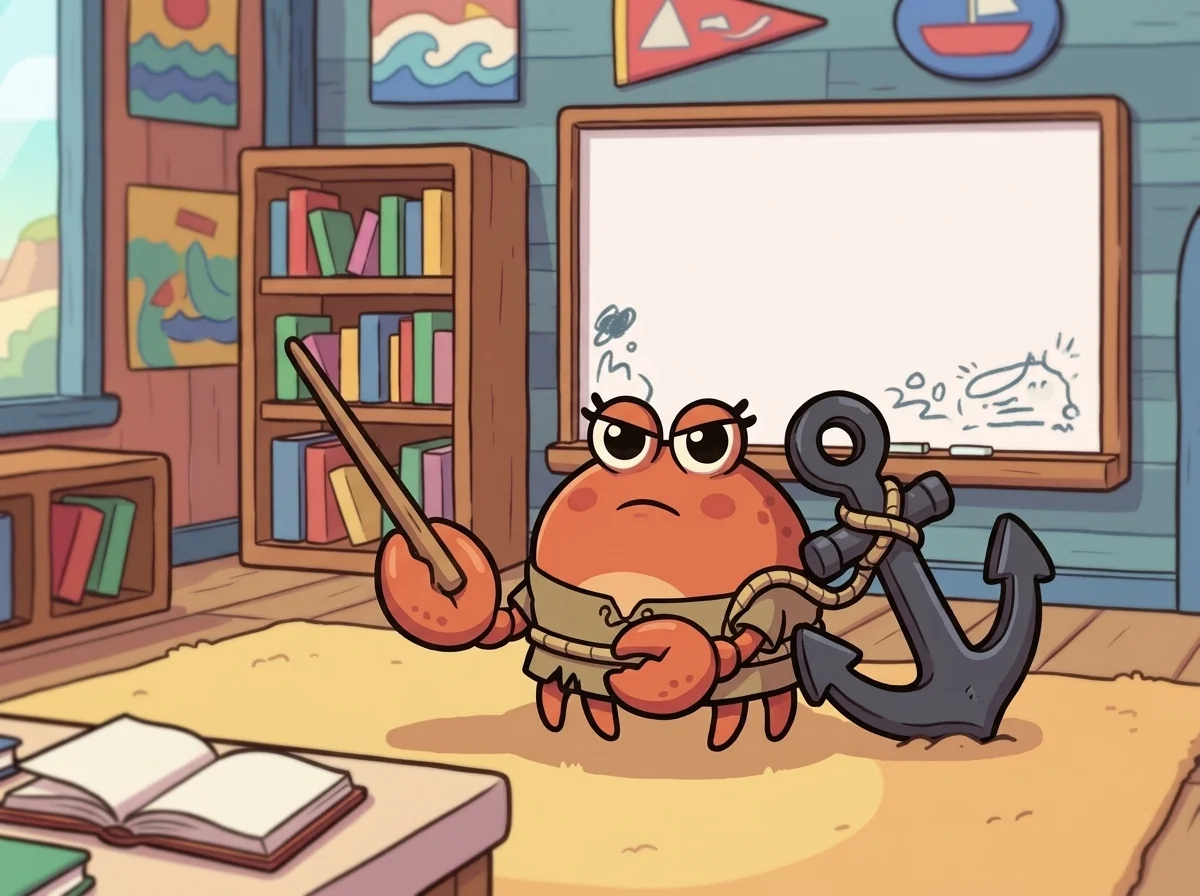
In her classroom, Anchor began every first-day lesson the same way. She sat at the front of the room, her small ship's-anchor resting heavily at her feet. The classroom was quiet, filled with the scent of old books and the faint tang of salt from her shell. She would turn to the class, her eyes calm and steady.
"I am Anchor," she would say. Her voice was deep, like the rumble of distant thunder. "I do not accept reading claims without textual evidence. If you say, 'The character is sad,' I will ask, 'Where in the text?' If you can point to a specific sentence, the anchor lifts. If you cannot, the anchor stays down. The claim is unanchored."
She always demonstrated. She picked up a well-worn book and read a short passage aloud:
"Marco sat on the kitchen step. The dog whined at the door. He did not move."
She closed the book and looked at a student in the front row, a young fox-kit with bright, curious eyes. "What is Marco feeling?" she asked.
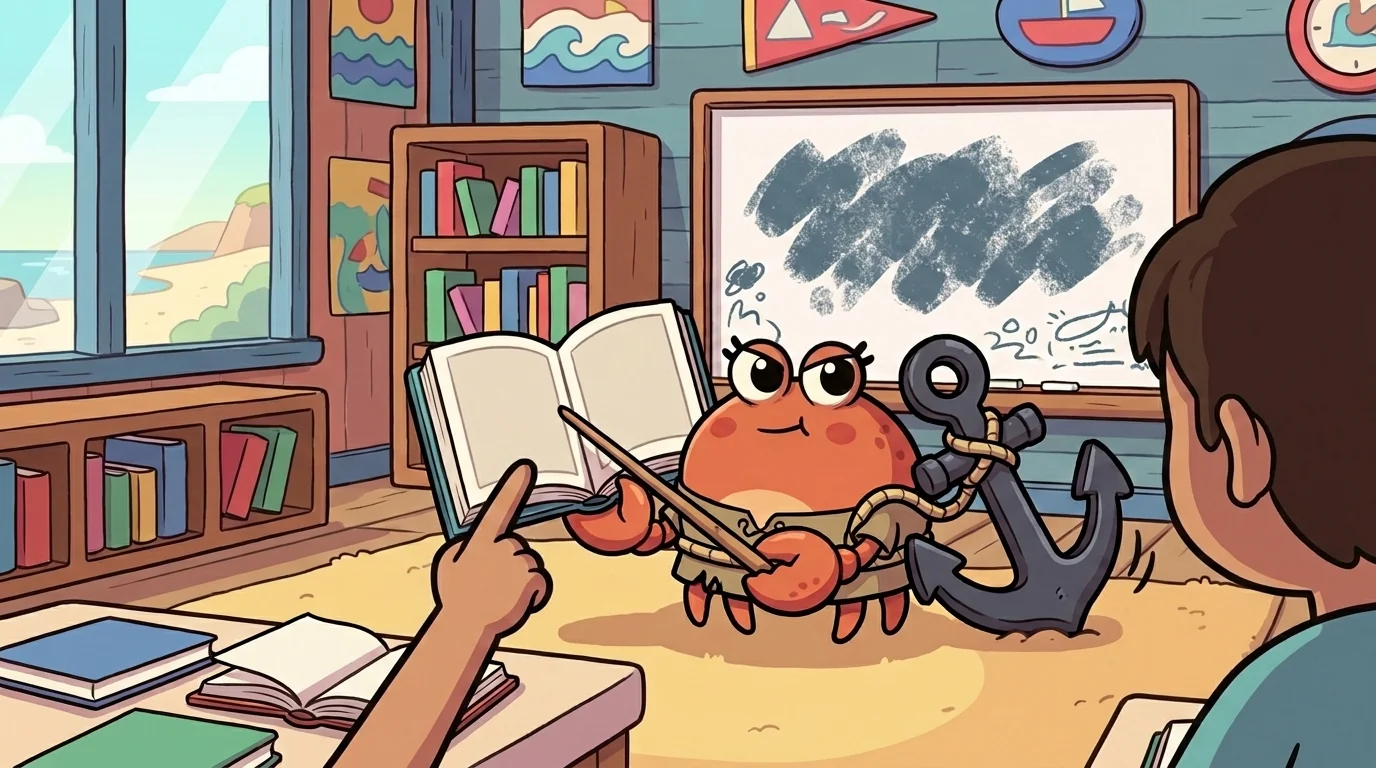
The fox-kit hesitated for a moment, then said, "He is sad."
Anchor nodded slowly. "Show me where in the text," she said.
The fox-kit frowned, trying to remember the words. The passage hadn't explicitly said, Marco is sad. He pointed vaguely at the air. "It just... feels sad."
Anchor waited, her anchor still and heavy at her feet. The fox-kit shifted in his seat, his ears drooping a little. Other students leaned forward, watching. They knew this feeling, this moment of being stuck. Then, a spark seemed to light in the fox-kit's eyes. He remembered the specific actions.
"Marco did not move," he said, pointing at the imaginary text. "When the dog whined at the door, he didn't move. That is evidence of sadness. Or at least, of a heavy feeling that kept him still."
Anchor's small ship's-anchor lifted slightly from the floor. It made a soft, scraping sound. "The anchor lifts," she said, her voice clear. "The claim has support. The text does not state, 'Marco is sad' — that is an inference, a guess you made based on clues. Hunch would help you with those inferences. But the behavioral evidence, him not moving, anchors that inference. Your reading is supported."
A murmur went through the class. Students often made claims about stories without realizing those claims needed proof. Anchor's literal ship's-anchor made the requirement visible, something they could see and hear. It was a powerful lesson.
When students asked Anchor if finding evidence was hard, she always gave the same answer.
"It is not hard," she would say. "It is simply showing where the claim ties to the text. For every claim you make about a passage, ask yourself: what specific sentence supports this? Point to it. The claim is now anchored. Without that citation, the claim is floating. And readers cannot trust floating claims."
She still kept the small ship's-anchor at her feet during every class. Sometimes, a group of children would ask to help her lift it. It was too heavy for any single child, but together, they could manage it. She always let them. In her twelve years, Anchor had guided perhaps three thousand students, teaching them to *anchor* their reading claims to specific textual evidence, one careful lift at a time.
The ReadQuest ensemble
Anchor is part of ReadQuest's distributed-narrative cast. Each character embodies a different curricular primitive; together they teach the full subject.
-

Crest
Main idea / central message (the *peak* of the passage)
-

Hunch
Inference (reading between the lines)
-

Plume
Author's purpose / voice / tone
-

Frame
Text structure (compare-contrast, sequence, cause-effect, problem-solution, description)
-

Pith
Vocabulary in context (deriving word meaning from surrounding text)
-

Yonder
Predicting — alert young-hare creature who reads the trail's clues to guess what's around the bend; a wrong guess just means the story surprised you
-

Vista
Visualizing — dreamy young-deer creature who turns words into a movie in the mind; the writer gives the words, the reader gives the pictures
-

Nettle
Questioning the text — question-quilled hedgehog who pokes a passage with why/how/what-if; asking questions means you're awake, not that you don't understand
-

Sheaf
Summarizing — warm-handed harvester who gathers a whole passage into one tidy armful, keeping the important middle and letting loose details fall