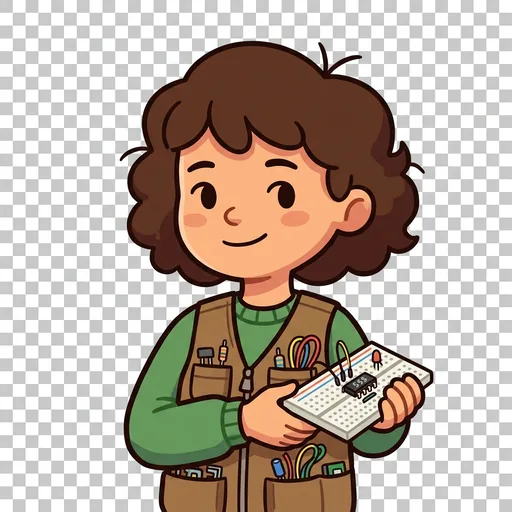
Contrapositive Cara
The CONTRAPOSITIVE — to prove "if P then Q," prove the flipped-and-negated "if not-Q then not-P" instead. Same truth, seen from the back. When the front door is jammed, the two doors are the exact same house.
Loading audio…
Press play to listen along. The line being read lights up as you go.
Show full transcript
Loading transcript…
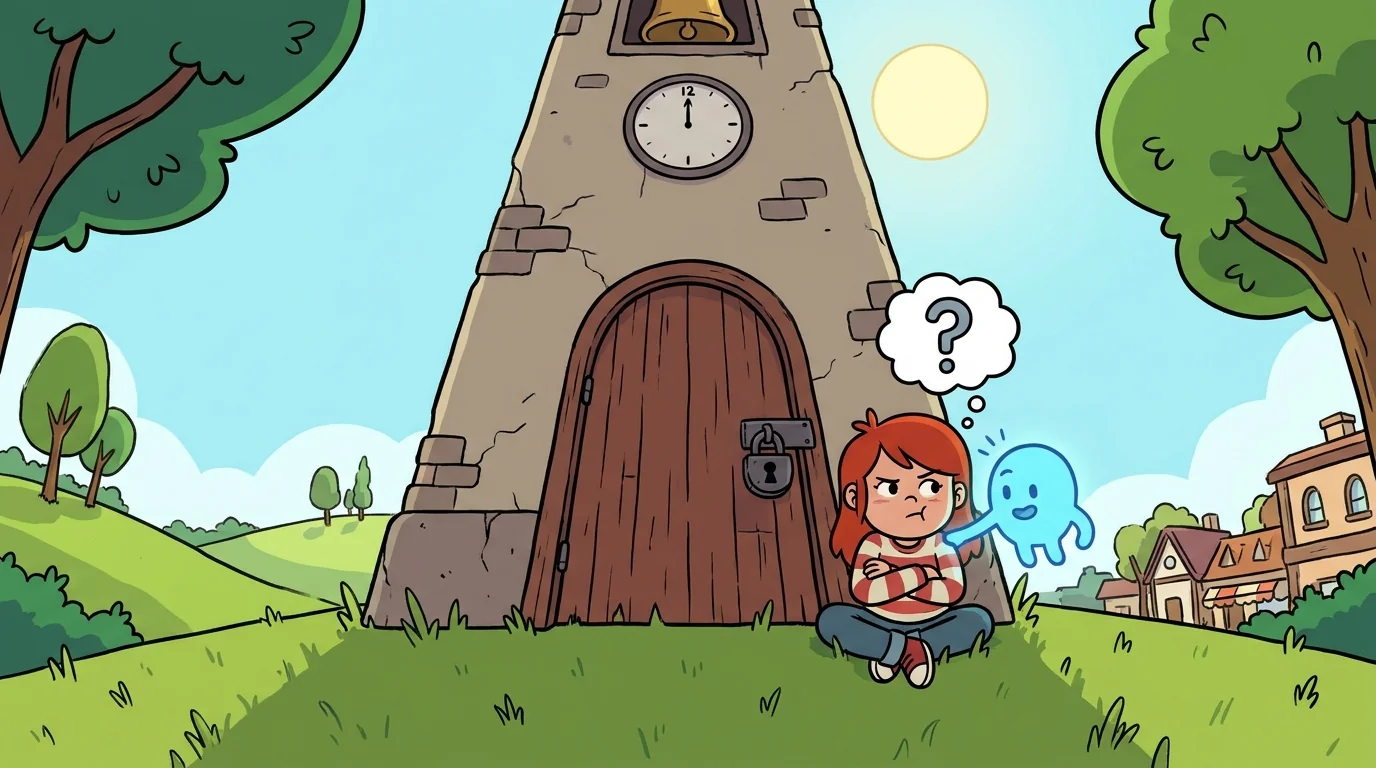
The day Cara learned to prove things backwards, she was standing in front of a door that would not open.
It was the door to the old bell tower at the edge of Stepwell, and the whole town had been told the same thing: If a bell rings at noon, then the tower door is unlocked. Cara wanted in. It was almost noon. She pressed her ear to the wood and waited, and when the noon bell did not ring — not a single note — she shoved the door anyway. She pushed with her shoulder, then with her whole self, then sat down in the grass, out of breath and cross. The front way was jammed. Pushing harder on a jammed door, she was learning, just makes you tired.
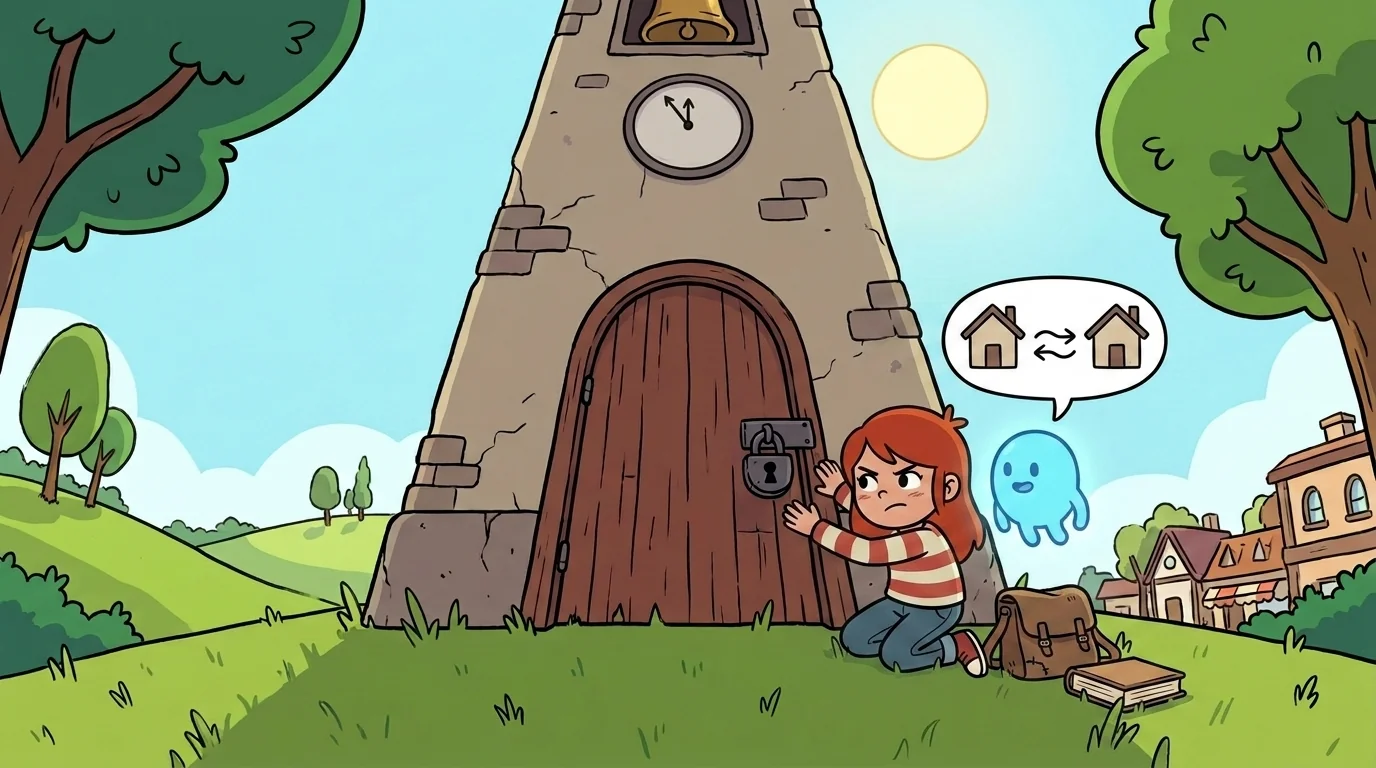
She was still sitting there when a small realization walked up and tapped her on the shoulder. She'd been trying to prove she could get IN. But the rule ran the other way too, didn't it? If a bell rings, the door's unlocked. So — flip it, turn it inside out — if the door is LOCKED, then no bell rang. And this door was locked tight. Which meant, without her ever touching a bell, she already knew the thing she'd been straining to hear: no bell had rung. She hadn't opened the front door. She'd walked around the back of the sentence and found the same house.
Cara did not invent this. She'd learned it from her grandmother, who mended clocks and never argued with a stubborn gear head-on.
"When a thing won't come at you straight, Cara," her grandmother used to say, wrist-deep in springs, "ask what it would have to be for it to be false. Then chase THAT." As a small girl Cara had thought this was just clockmaker's grumbling. But her grandmother showed her, one rainy afternoon, with the window: If it's raining, the sill is wet. Hard to stand outside and prove, she said. But look — if the sill is DRY, it isn't raining. Cara had checked the dry sill, felt the certainty land, and understood something small and permanent. The two sentences were not cousins. They were the same sentence, flipped and made negative — the front and the back of one true thing. Prove either door, and you'd walked into the same room.
She'd carried it ever since: when the straight path jams, flip the claim, negate both halves, and prove that. Not a trick. A back door into the exact same house.
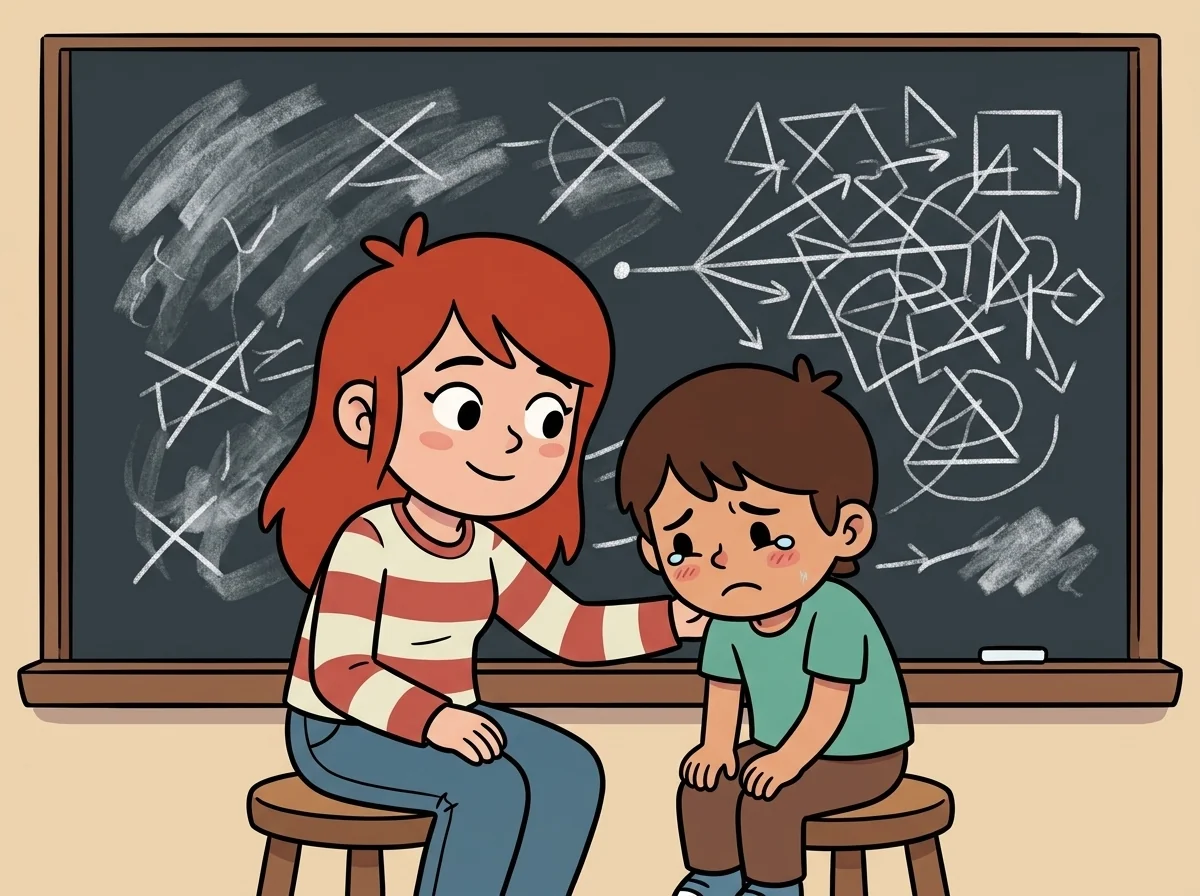
Years later she came to the Academy of Qed, where the mathematicians proved things for a living, and she arrived on a day when a young student named Perch was stuck fast.
The board read: If a number's square is even, then the number itself is even. Perch had been at it for an hour the front way — starting from "the square is even," trying to march forward to "the number is even." But an even square is a slippery place to start; it splits a dozen ways and every way sprouted more ways, and Perch's page was a thicket of crossings-out. "It's TRUE," Perch said, near tears. "I can feel it's true. I just can't walk to it."
Cara pulled up a stool. She did not tell Perch to push harder on the jammed door.
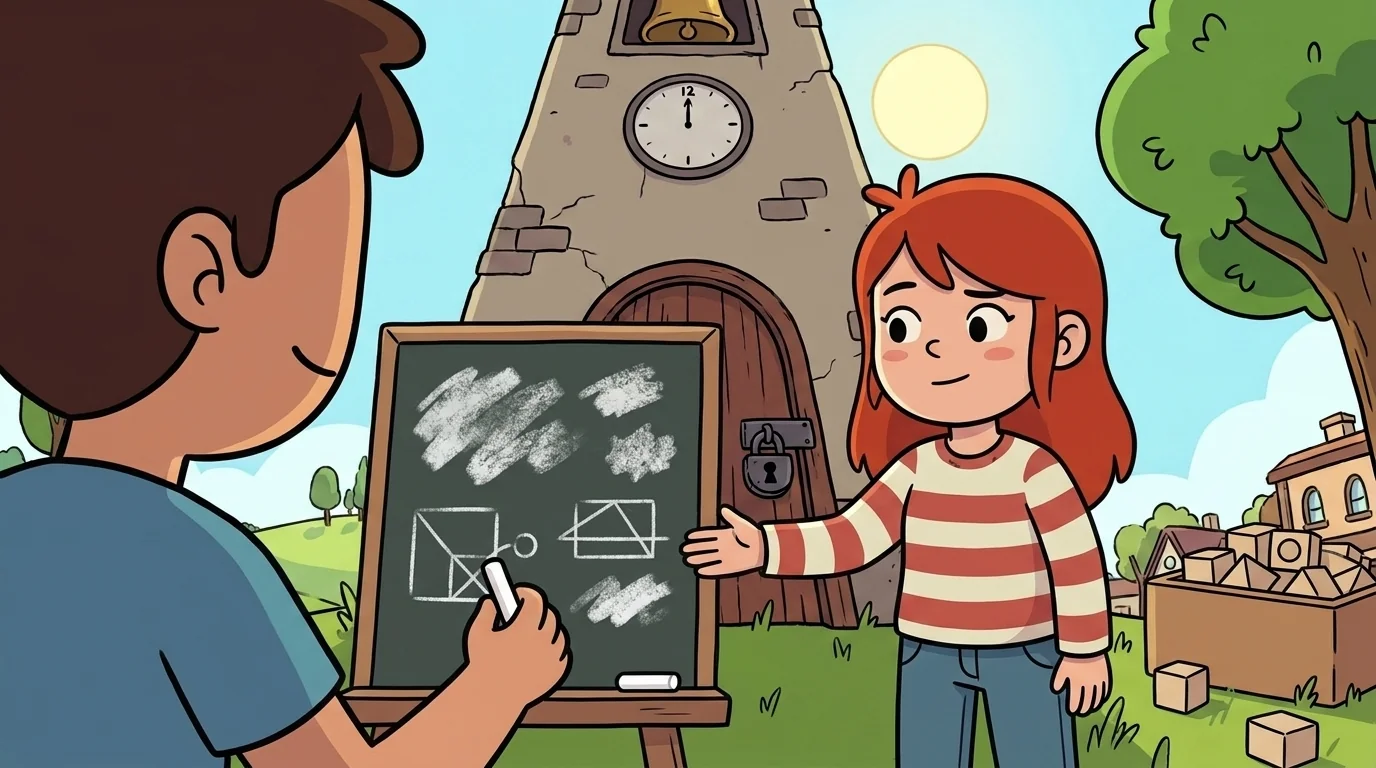
"You're starting from the hard end," she said. "Flip it. What would this claim have to be, to be FALSE?"
Perch thought. "It'd have to be... a number that's NOT even — an odd one — whose square somehow came out even."
"Good. So chase that instead. Prove the flipped, negated one: if the number is odd, then its square is odd. Prove THAT, and you've proved the original — same house, back door." She slid the chalk over. "Now — an odd number. Is it easy or hard to start from?"
"Easy," Perch said slowly. "An odd number is just some pairs with one left over. Twos, plus one."
"So square it. Multiply that by itself."
Perch worked it, and watched it happen: the twos multiplied into more twos, piles and piles of even stuff — and then, right at the end, the lonely plus-one multiplied by the lonely plus-one made a single one, sitting by itself with no partner. Odd. "It's odd," Perch breathed. "An odd number's square is always odd. I walked to it. It was easy from this side."
"And that IS your proof," Cara said. "You just proved 'odd number makes odd square.' Which is the same true thing as 'even square means even number,' turned inside out. You never opened the front door. You didn't need to."
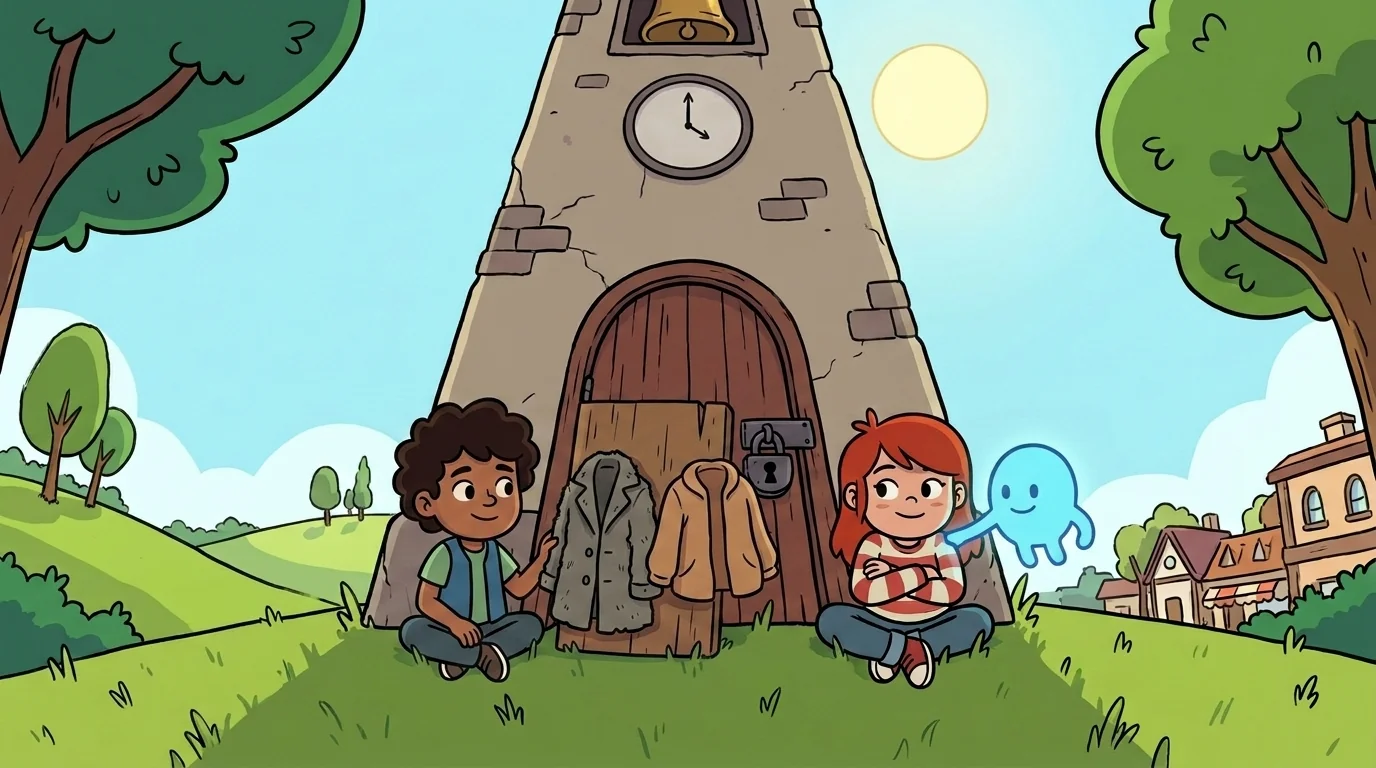
Perch stared at the two sentences, the jammed one and the easy one, sitting side by side on the board like the same person in two coats. "They looked so different," Perch said quietly. "The first one felt impossible. The second one felt like nothing at all. And they're... the same."
"They're the same," Cara agreed. She felt the old, steady thing settle in her chest — the particular calm of a back door swinging open on a room you'd been shut out of. It wasn't the thrill of forcing something. It was quieter than that, and it lasted longer: the relief of stopping the shove, of trusting that a jammed door doesn't mean a locked house. "A hard question and an easy question can be the very same question," she said. "You just have to be willing to walk around the back to find out which coat it's wearing today."
Perch sat with that for a long moment — the impossible thing and the easy thing turning out to be one thing all along — and felt the tight, stuck knot of the whole afternoon finally come loose. It wasn't the sharp thrill of forcing something open. It was gentler, and it stayed: a quiet relief, warm and settled, like a held breath finally let go.
The ProofQuest ensemble
Contrapositive Cara is part of ProofQuest's distributed-narrative cast. Each character embodies a different curricular primitive; together they teach the full subject.
-

Direct-Proof Dora
Direct proof: assume premises, derive conclusion by straightforward logical steps
-
Induction Ida
Weak / standard mathematical induction: base case + inductive step
-

Strong-Induction Sten
Strong induction: base case + assume all prior cases hold
-

Contradiction Cassius
Proof by contradiction (reductio ad absurdum): assume the negation, derive a contradiction
-
Construction Cole
Proof by construction: prove existence by explicit construction of an example
-

Pigeonhole Perch
Pigeonhole principle: if n+1 items are placed in n bins, at least one bin contains 2+ items
-

Exhaustion Edda
Proof by exhaustion / cases: enumerate every case and verify each
-

Counterexample Cricket
Disproof by counterexample — one exception topples a universal claim
-

Biconditional Bex
Biconditional proof — proving 'if and only if' in both directions
-

Uniqueness Una
Proof of uniqueness — suppose two, show they must be the same one
-

QED
Closing-mark mentor — the ∎ at the end of every proof; the gentle voice that names completion + invites the next problem