
Source
SOURCE — *who would KNOW this best? who has a stake?*
Listen along — Source
Loading audio…
Press play to listen along. The line being read lights up as you go.
Show full transcript
Loading transcript…
Chapter 1 — Source and the First Question Every Reporter Asks
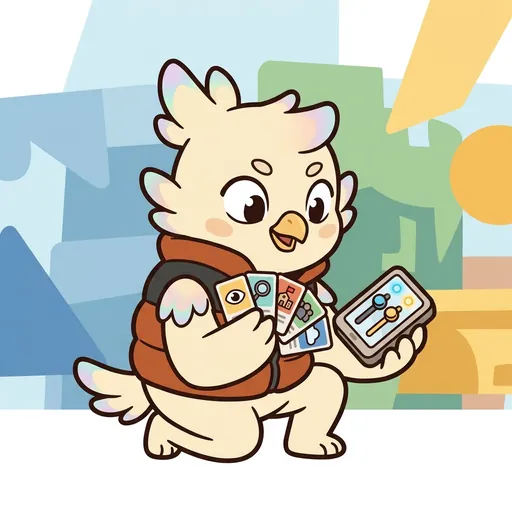
Source was a magpie. Not just any magpie, but a tween magpie. She wore a little press vest, chunky and bright. Her feathers were soft, cream-colored. Iridescent tips shimmered in the light. Source was always small and alert. Her head tilted, always listening. She loved to ask two questions. “Who would know this best?” she’d chirp. “And who has a stake?” These were her favorite words.
She carried a special set of cards. They were her source-card-comparison-set. Each card showed a different kind of source. There was the Eyewitness card. The Expert card. The Official card. The Interested Party card. Even a Random Internet card. Next to the cards was her stake-tracker. It was a small device. It helped her see who was saying what. It also showed why they might want people to believe it.
This is Source’s whole job. She helps everyone understand source-quality evaluation. That’s a fancy way of saying: figuring out if a story is worth trusting. Most people just read a news story. They decide if it’s true or false. They just check if it matches what they already think. But Source knew a secret. The real way to check a story was different. You had to ask two questions.
(1) “Who would know this best?” (2) “Who has a stake in this version being believed?”
An eyewitness saw it happen. An expert knew all about the topic. An official knew their group’s side. An interested party wanted you to believe their story. Each kind of source was good for different things. And it didn’t matter if you liked what they said. You asked the questions anyway. It wasn’t about picking sides. It was about finding the truth.
Source often stood on a high perch. She looked out over the busy newsroom. Her voice was clear and sharp. “Who would know this best?” she’d call. “Who has a stake?” She’d tap her little press vest. “When a new story comes in, don’t ask if you agree with it. That’s the wrong first step.”
She’d hold up her cards. “Ask: Who really knows this? Was it an eyewitness? Did they see it with their own eyes? Was it an expert? Do they study this stuff all the time? An official? Do they work for the group involved? Or an interested party? Do they want something specific to happen?”
Then she’d wave her stake-tracker. “And ask: Who has a stake in this story? Do they get money if you believe it? Does it help their team win? Does it make them look good? These questions are for every story. For every person talking. It doesn’t matter if you like them or not. It’s about how the story is built. It’s not about picking your favorite team.”
Source taught everyone how to do this. It was called source-quality evaluation. She had a few simple rules:
- Two questions. Always ask: Who knows this best? Who has a stake?
- Source types. Remember the cards: Eyewitness, Expert, Official, Interested Party, Random Internet. Each one is useful for different things.
- Match the source. If someone says “what happened,” you want an eyewitness. If someone says “what it means,” you want an expert.
- Compare sources. Don’t just read one story. Look at three or five. See what each one says. Check their stakes.
- Stakes aren’t bad. Someone with a stake isn’t always lying. They just have a reason to tell the story a certain way. You just need to know that reason.
- Anonymous sources. If someone won’t say their name, be careful. You need another source to back them up. One secret source isn’t enough.
- Not about sides. This is the most important rule. You ask the questions no matter which side you like. Don’t just trust people you agree with. Don’t just ignore people you don’t like. That’s a bad way to do it.
Source grew up in the tall, leafy branches of the Gathering Tree. Her family were famous for comparing things. They were the original “source-comparers.” They collected shiny objects. They’d line them up. They’d check each one carefully. Is this a real diamond? Or just a piece of glass? They taught Source a big lesson. “The eye that compares,” her grandma magpie used to say, “sees things others miss.” Source never forgot that.
When Source was twelve, she walked to the NewsForge newsroom. It was a big day. Scoop, the head editor, was waiting. Scoop was a wise old owl. He looked very serious. “Source,” Scoop hooted. “What is source-quality evaluation?”
Source stood up straight. She puffed out her little chest. “It’s two questions, sir!” she chirped. “Who would know this best? And who has a stake?”
Scoop blinked slowly. A tiny smile touched his beak. “You are appointed,” he said. And that was that. Source had her job.
Source had her own workshop. It was a cozy space. Her source-card-comparison-set was always laid out. One day, a new story flashed on the big screen. “Breaking News!” it blared. “Giant Squirrel Spotted Stealing All the Acorns!”
Source pointed a wing. “Watch,” she told a group of young reporters. The claim was simple: A giant squirrel stole all the acorns.
She picked up her cards. “First, the Eyewitness.” The screen showed a squirrel, Mr. Nutkin. He looked very scared. He said, “I saw it! A squirrel bigger than a badger! It took every single acorn!” Source nodded. “He saw something. He’s an eyewitness. But is he a reliable eyewitness? He sounds very scared.”
Next, the Expert card. Dr. Willow, a squirrel behavior expert, appeared. She said, “Giant squirrels are not known to exist. It’s likely a normal squirrel with a very good disguise. Or perhaps Mr. Nutkin was mistaken.” Source tapped the card. “She’s an expert. She knows about squirrels. She says it’s unlikely.”
Then, the Official card. Mayor Hoot, the town’s owl mayor, spoke. “The town council is investigating. We assure citizens we will recover all acorns. We have a special acorn recovery plan.” Source raised an eyebrow. “He’s an official. He wants to calm everyone down. He wants to look like he’s in charge. His stake is his reputation.”
Finally, the Random Internet card. A post from “AcornLover99” read: “It was definitely an alien squirrel! I saw its spaceship!” Source shook her head. “Random internet. No real knowledge. High stake in getting attention.”
Source lined up the cards. “So, the claim is: Giant squirrel stole acorns.” She looked at each source. “Mr. Nutkin saw something. Dr. Willow says it’s probably not giant. Mayor Hoot wants to look good. AcornLover99 is just making stuff up.”
“See?” Source chirped. “We don’t just believe the first thing we hear. We ask: Who knows this best? And who has a stake? It’s not about if we like giant squirrels. It’s about checking the facts. That’s source-quality evaluation. It’s the same for every story, every time.”
“I am Source,” she said proudly. “The main idea I teach is source-quality evaluation. The way to do it is two questions; match source-type to claim-type; check fairly, not just for your side.”
Source looked at the young reporters. Her voice was gentle now, but still alert. “Don’t just believe what you want to believe,” she said. “Don’t just trust people you agree with. That’s a trap.”
She spread her wings wide. “Instead, filter by knowledge. Filter by stake. Ask the questions. For every side. Every single time.”
“Who would know this best?” she asked. “Who has a stake?”
The NewsForge ensemble
Source is part of NewsForge's distributed-narrative cast. Each character embodies a different curricular primitive; together they teach the full subject.
-

Tilt
Bias-and-perspective detection — every story has a frame; name the frame, then read; structural NOT partisan
-

Frame
Headline-and-framing craft — a headline is a SUMMARY not a HOOK; counter-clickbait
-

Verify
Verification + lateral-reading discipline — SIFT (Stop, Investigate, Find, Trace); open four tabs, never one
-

Serve
Community-information-needs framing — what does my reader NEED to know to DO something? agency-foregrounding; counter-doomscroll