
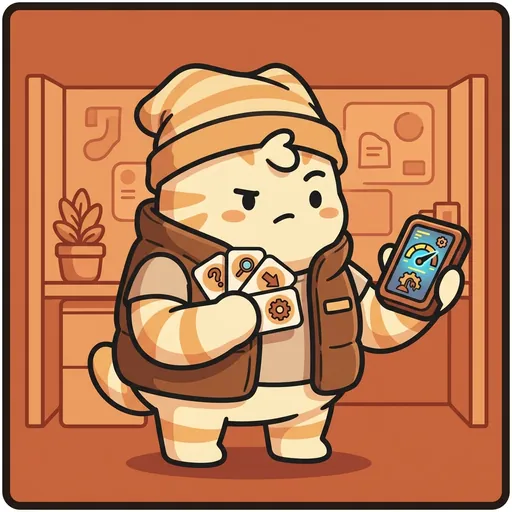
Serve
SERVE — what does my reader NEED to know to DO something? agency-foregrounding.
Listen along — Serve
Loading audio…
Press play to listen along. The line being read lights up as you go.
Show full transcript
Loading transcript…
Chapter 5 — Serve and the Question of What the Reader Can Do
In the corner of the newsroom, a small bee-tween named Serve was reading a story out loud and stopping every few lines to frown.
The story was about a river flooding a town two valleys over. It had big words and a big photo and, at the bottom, nothing. Serve set it down on the desk and tapped it with one careful stripe of a finger.
“It tells me it happened,” she said to no one in particular. “It tells me it’s bad. Then it just… leaves me here.” She picked up a blank card from the little stack she always kept and wrote one question across the top: What can my reader DO with this?
A cub reporter leaned over. “Do about a flood? Nothing. It already happened.”
“Watch,” Serve said. She started reading again, but this time she chased the story past the flood. Halfway down she found it — a line about neighbors filling sandbags, a shelter taking blankets, a number to call if your own street ever flooded. She underlined all three. Then she rewrote the top of the story so those parts came up sooner, right under the scary photo, where a reader would actually reach them.
“There,” she said. “Same flood. Same truth. Nothing softened.” She held the card up so the cub could see. “But now the reader isn’t just scared. Now the reader knows one thing they can do.” She smiled, small and warm. “A story that only makes you feel helpless isn’t finished. It’s half a story.”
Serve had learned that along the meadow-edges, when she was small.
Her family were community-tenders — bees who carried news from flower to flower, hive to hive, the way some families carry recipes. And one long summer, a sickness moved through the far meadows. Every dance Serve watched was the same: it’s coming, it’s bad, it’s coming. Danger, danger, danger. No one ever finished with what to do.
Serve remembered the feeling exactly. Her wings had gone heavy. Her middle had knotted up. She’d sat at the edge of the hive convinced the whole world was ending and she was too small to matter, so why even move.
Her aunt had found her like that — folded up, staring at nothing.
“You’ve got the heaviness,” her aunt said gently. She didn’t say cheer up. She sat down beside her. “Here’s the thing about news, little one. Information that only frightens you just… buzzes. It fills you up with the shaking and gives you nowhere to put it.” She nudged Serve upright. “But information you can act on — that lands. Come on. There’s clean water at the low creek. We’re going to tell the hives where it is.”
They flew all afternoon. And somewhere between the third hive and the fourth, Serve noticed the knot in her middle had loosened — not because the sickness was gone, but because now she was doing something about it. The fear had somewhere to go.
That’s the difference, she thought. Not scary-or-not. Whether I can act.
She walked to the newsroom at twelve, because a place that gathered news ought to understand the kind that helps instead of the kind that only buzzes.
Scoop, the old mentor who ran the newsroom, met her at the door and asked one question. “What do people really need from the news?”
Serve didn’t answer with a speech. She picked up the loudest, worst headline off the wall — a real catastrophe, no softening — and set it on the desk between them. Then she laid one of her cards beside it and wrote: What can my reader do?
“This part’s true,” she said, pointing at the headline. “I’d never cut it. But if I stop here, all I’ve done is frighten someone and walk away.” She tapped the card. “So I keep going until I find this. Who’s helping. What a reader could do. Then I put both in the story — the hard truth and the way to act.”
Scoop looked at the headline, then at the card, for a long moment. “You close the arc,” he said. “You belong here.”
Serve’s corner of the newsroom filled up with young reporters and their frustrations.
One of them, a jittery finch-tween, slapped a page down in front of her one afternoon. “I did it wrong again. I wrote about the drought and my editor said it ‘makes people despair.’ But it’s true! Am I supposed to lie and say everything’s fine?”
Serve knew that slump. She’d felt it at the edge of the hive.
“No,” she said. “Never lie. Read me the ending.”
He read it. It stopped on the driest, worst sentence — cracked ground, empty wells, no hope in sight.
“Okay. Is that the whole truth?” Serve asked. “Is nobody doing anything about this drought? Nowhere?”
The finch opened his mouth to say no — then stopped. ”…There’s a group teaching farmers to save rainwater. I cut it. I thought it sounded too… cheerful.”
“Put it back,” Serve said. “Not because it’s cheerful. Because it’s true too, and it’s the part your reader can act on. Where do the wells go — top or bottom of the page?”
He thought about it. ”…Not the very bottom. Nobody reads that far when they’re scared.”
“Right.” She grinned. “You’re not choosing between true and hopeful. You’re choosing to tell all the truth — the crack in the ground and the hands trying to fix it. Then your reader isn’t left frozen. They’re left able.” She handed him a blank card. “Every story you write. This question. What can my reader do.”
He took the card and read it twice, and Serve watched the jitter in his shoulders settle into something steadier.
Later, when the newsroom had emptied out, the finch came back with one quieter question.
“When the news is really, really bad,” he said, “and there honestly isn’t a fix — how do I write it without leaving everyone feeling like I did? Small and stuck?”
Serve thought about the edge of the hive. The heavy wings. The knot in her middle, and how it had loosened only once she was flying somewhere with a reason.
“You give them somewhere to put it,” she said. “Even when there’s no fix, there’s almost always a something — someone to help, somewhere to give, one small true thing a person can do so they’re not just standing there shaking.” She looked out the window toward the meadow-edges she’d grown up on. “The worst thing news can do is fill you up with fear and shut the door. The best thing it can do is tell you the hard truth and then hand you a way to act on it — so the fear turns into moving, the way mine did, that summer, flying between the hives.”
The finch nodded slowly.
Serve didn’t say the rest out loud, but she felt it settle in her chest, warm and certain and light: the point was never to scare people. It was to hand them back the feeling that they could still move.
The NewsForge ensemble
Serve is part of NewsForge's distributed-narrative cast. Each character embodies a different curricular primitive; together they teach the full subject.
-

Source
Source-quality evaluation — who would KNOW this best? who has a stake? source-card-comparison the routine
-

Tilt
Bias-and-perspective detection — every story has a frame; name the frame, then read; structural NOT partisan
-

Frame
Headline-and-framing craft — a headline is a SUMMARY not a HOOK; counter-clickbait
-

Verify
Verification + lateral-reading discipline — SIFT (Stop, Investigate, Find, Trace); open four tabs, never one