Tell
TELL — *telling is the most powerful medical move.*
Listen along — Tell
Loading audio…
Press play to listen along. The line being read lights up as you go.
Show full transcript
Loading transcript…
Chapter 4 — Tell and the Sentence That Changes Everything
Maya sat hunched over her notebook. Her pencil lay still. She wasn’t drawing the amazing dragon she’d planned. Instead, she just stared at the page. A knot had been growing in her stomach for days. It wasn’t just a regular tummy ache. This one felt like a tiny, worried hamster doing acrobatics inside her.
She sighed. “Just go away,” she whispered to her stomach.
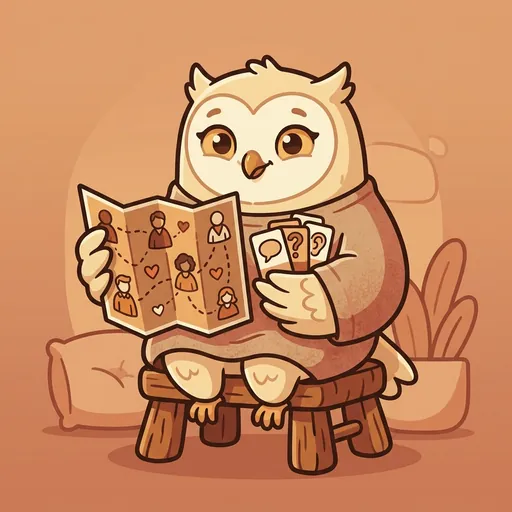
A soft hoo-hoo came from her window. Maya jumped. Perched on the sill was an owl. But not just any owl. This one looked like it had flown straight out of a cartoon. It was small and round, with warm, creamy feathers. Its eyes were big and amber, watching her closely. It wore a tiny, plain tunic. A small map was tucked into a pocket. In its other wing, it held a stack of little cards.
The owl tilted its head. It looked very serious.
“Uh, hello?” Maya said. She wasn’t sure if she should be scared. The owl seemed friendly. It just sat there, watching her. It looked like it was waiting for something.
The owl held up one of its cards. Maya leaned closer to read it. The card showed a picture of a kid talking to an adult. Big, bold letters spelled out: TELLING IS THE MOST POWERFUL MEDICAL MOVE.
Maya frowned. “Medical move?” she mumbled. “I don’t need a doctor.” The hamster in her stomach did another flip.
The owl, who seemed to understand, hooted softly. It shuffled its cards. Another one appeared. This one had a picture of a kid looking worried. The words said: When something is wrong, tell a trusted adult.
“But what if it’s not that wrong?” Maya asked the owl. “What if it’s just… a little wrong?” She thought about the knot. It wasn’t bleeding. It wasn’t broken. But it wouldn’t go away.
The owl gently tapped the card with its wing. It then pointed to itself. “I am Tell,” a soft, clear voice seemed to echo in Maya’s mind. It wasn’t spoken aloud. It was more like a thought that wasn’t hers, but came from the owl. “I teach about help-seeking.”
Maya blinked. “You teach?”
Tell nodded. It held up another card. Telling is courage, not weakness.
“But what if I get in trouble?” Maya asked. “Or what if no one believes me?” She imagined telling her mom about the hamster. Her mom would probably say, “Did you eat too much candy?” or “Are you just trying to get out of homework?”
Tell ruffled its feathers. It held up a card with a picture of many different adults. A mom, a dad, a teacher, a school nurse, a grandma, a coach. Trusted-adult network (multiple options).
“You mean I don’t just have to tell one person?” Maya asked.
Tell shook its head. It pointed to the card. “If the first doesn’t help, tell another.” The voice in Maya’s head was calm. It sounded very wise.
“Okay,” Maya said slowly. “So, if my mom doesn’t get it, I could tell my dad?”
Tell gave a tiny, encouraging hoot. It then held up a blank card. It seemed to be waiting.
“What’s this for?” Maya asked.
“Practice the sentence,” the voice said. “It makes telling easier.”
Maya thought about it. “What kind of sentence?”
Tell showed her a card with a few examples.
- “Something is happening with my body. Can I tell you about it?”
- “I need to talk to you about something important.”
- “I’m feeling really worried about something.”
Maya tried the first one. “Something is happening with my body. Can I tell you about it?” She said it quietly. It felt a little silly talking to an owl. But the words felt strong. They weren’t whiny. They were serious.
“That’s a good start,” Tell’s voice said. “Practice it a few times. Get comfortable with it.”
Maya practiced. “Something is happening with my body. Can I tell you about it?” She liked how it sounded. It gave her a way to start. It wasn’t just blurting out “My stomach feels like a hamster!”
Tell then showed her another card. This one had a picture of a school. A teacher, a school nurse, and a counselor were highlighted. Mandatory reporters.
“What are those?” Maya asked.
“Some adults must help,” Tell’s voice explained. “Teachers, school nurses, and doctors are examples. If you tell them about something really bad, they have to act. It’s the law. They are safe people to tell.”
Maya’s eyes widened. “So, if something really, really bad happened, they have to do something?”
Tell nodded. Its amber eyes were steady.
“What if… what if there’s no trusted adult around?” Maya asked. “Or what if no one helps, even after I tell lots of people?” Her voice was small again. The hamster in her stomach started its acrobatics once more.
Tell’s cards shuffled quickly. A new set appeared. These cards had phone numbers and website addresses. Crisis-resources when network fails.
“These are for when you need help right away,” Tell’s voice said. “Or if you feel like no one else can help. There are people waiting to listen.”
- 988 (Suicide & Crisis Lifeline)
- Crisis Text Line: Text HOME to 741741
- Childhelp: 1-800-422-4453
- RAINN: 1-800-656-HOPE
Maya looked at the numbers. They were a lot to remember. But it was good to know they were there. It was like having a secret superhero team.
“Telling is never weakness,” Tell’s voice repeated. “It is the most courageous and competent move you can make.”
Maya looked at the owl. Its small, round body seemed to glow. The knot in her stomach hadn’t completely vanished. But the hamster had stopped its flips. It was just sitting there now. Maybe even taking a nap.
“Thank you, Tell,” Maya whispered. She picked up her pencil. She still wasn’t going to draw a dragon. She was going to write down those important sentences. And the numbers. Just in case.
Tell gave a final, soft hoo-hoo. Then, with a gentle flutter of its creamy wings, it flew out the window. It disappeared into the afternoon light. Maya knew she wouldn’t forget its message.
Telling is the most powerful medical move.
The MedicQuest ensemble
Tell is part of MedicQuest's distributed-narrative cast. Each character embodies a different curricular primitive; together they teach the full subject.
-

Notice
Symptom-noticing without alarm — most symptoms are minor + temporary; notice without catastrophizing
-

Ask
Clinical-history-taking + questioning — your questions are MEDICAL EVIDENCE; never feel silly asking
-

Boundary
Body-autonomy + consent — your body is YOURS; ask-first is universal; pangolin curl-pose models self-protection-as-positive
-

Whole
Wellness-as-multi-factor-system — health is sleep + food + movement + relationships + meaning + safety; never single-factor; explicit health-equity foregrounding