
Tell
TELL — *telling is the most powerful medical move.*
Listen along — Tell
Loading audio…
Press play to listen along. The line being read lights up as you go.
Show full transcript
Loading transcript…
Chapter 4 — Tell and the Sentence That Changes Everything
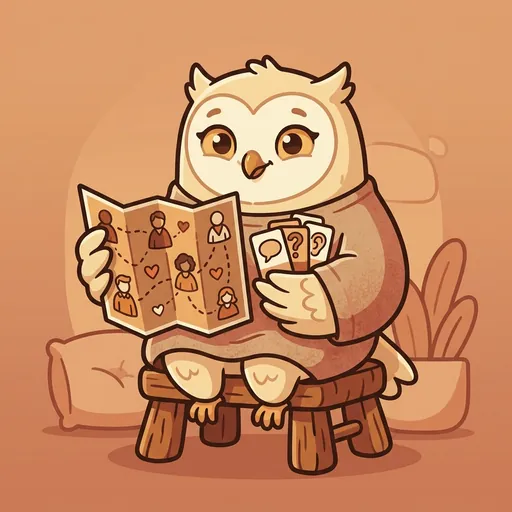
Tell was a quiet, watchful presence. She often sat in the library, tucked into a corner armchair, her small frame almost swallowed by the cushions. She looked like a chunky-cartoon screech owl, all soft, warm cream and amber eyes, perched with an air of trusting observation. Her plain tunic was practical, and her hands usually held two items: a small, laminated map of the school, covered with names and faces, and a stack of index cards. These were her telling-script cards.
Tell was small, yes, and she seemed to trust everyone until given a reason not to. Her amber eyes held a deep attentiveness, especially toward anyone who looked like they needed help but didn’t know how to ask. She had a favorite saying, one she murmured to herself sometimes, or to the air around her: “Telling is the most powerful medical move.”
This idea was essential, a shared design language with the SafetyForge program. Tell embodied the help-seeking primitive. It was the medical-literacy craft of understanding that telling is the most powerful move you can make. When something felt wrong—an illness, an injury, a knot of emotional distress, an unsafe situation, or even abuse—telling a trusted adult was the single most powerful action available. Kids often hesitated. They worried about getting into trouble, about not being believed, about adults overreacting. Tell’s job was to make telling feel normal, to provide simple scripts, and to help identify a network of trusted adults. She also knew about crisis resources for when the usual network failed or wasn’t safe.
Tell believed, with every fiber of her being, that telling was never a weakness. It was the most courageous and competent thing a person could do. Sometimes, the first adult you told didn’t respond well. That was hard, but it didn’t mean you stopped. It just meant you told another. She knew that mandatory reporters—like teachers, school nurses, doctors, and counselors—were legally required to act on disclosures of abuse. They were safe places to tell.
Tell taught that telling was powerful and competent. She emphasized having multiple trusted adults, a whole network, not just one person. She showed kids how to practice simple sentences, their telling-scripts. She explained about mandatory reporters. And she made sure everyone knew about crisis resources for when the network failed.
“I am Tell,” she would say, her voice soft but clear. “The primitive I teach is help-seeking. The move is telling is the most powerful medical move; trusted-adult network (multiple options); practice the sentence; crisis-resources when network fails.”
She was gentle, perched, and trusting. “Telling is courage, not weakness,” she insisted. “Practice the sentence. Have a trusted-adult network. If the first doesn’t help, tell another.”
“Telling is the most powerful medical move.”
Leo sat slumped at his desk, trying to make himself invisible. His throat felt scratchy, a raw, burning line that made every swallow a small act of bravery. A cough had been building for days, a dry, hacking sound that started in the morning and grew worse by evening. Now, it was Tuesday, and the cough had moved in for good. Each breath felt like sandpaper, and his chest ached. He’d barely slept.
He’d tried to ignore it. He’d tried to wish it away. He’d even tried to convince himself it wasn’t that bad. But his head throbbed, and his body felt heavy, like it was filled with lead instead of bones. He worried about missing the upcoming field trip. He worried about his mom, who already had so much on her plate. He worried about being a bother. So he just sat, trying to disappear behind his textbook, hoping no one would notice.
Tell noticed. From her armchair in the library, she watched Leo. His shoulders were hunched, his usually bright eyes were dull, and he kept pressing a hand to his throat. He coughed, a quiet, ragged sound he tried to stifle with his elbow. It was the kind of cough that made you want to offer a glass of water, or a warm blanket. Tell knew that feeling, the way your body screamed for attention while your mind tried to silence it.
She understood why kids like Leo hesitated. It wasn’t just fear of trouble. It was a complex mix of not wanting to burden anyone, of feeling silly for a “small” problem, or even a deep-seated worry that no one would believe them. Sometimes, it was simply not knowing how to start the conversation. The words felt too big, too important, or too embarrassing to say out loud.
Tell carefully rose from her chair. She moved with a quiet grace, her soft-soled shoes making no sound on the polished floor. She approached Leo’s table, not directly, but stopping at a nearby shelf, pretending to browse. She waited until he coughed again, a little louder this time, a shudder running through his small frame.
“Rough day?” she asked, her voice gentle, not demanding. She didn’t look directly at him, but at the spines of the books.
Leo jumped, startled. He hadn’t heard her approach. “Uh, no. Fine.” His voice was hoarse.
Tell picked up a book, a thick one about ancient civilizations. “You sound like you swallowed a desert.” She finally turned, her amber eyes meeting his. They held no judgment, only a quiet understanding. “Sometimes, when something’s bothering my body, I don’t know how to say it.”
Leo looked away, picking at a loose thread on his sleeve. “It’s nothing, really.”
“It doesn’t look like nothing,” Tell said softly. She pulled out one of her telling-script cards. It was a simple white card with a single sentence printed on it in bold, clear letters: Something is happening with my body – can I tell you?
“This is a good sentence,” Tell explained. “It’s simple. It tells an adult you need to talk, but it doesn’t make you say everything all at once. It gives them a chance to listen.”
Leo glanced at the card, then back at his book. “Who would I even tell?” he mumbled, his voice barely a whisper.
Tell smiled, a small, encouraging curve of her lips. She pulled out her laminated map. It showed the school layout, but instead of just rooms, it had small, friendly drawings of people: Ms. Albright, the science teacher; Mr. Henderson, the librarian; Nurse Anya, in her office; Coach Miller; and even Ms. Chen, the school counselor. Each drawing had a little star next to it.
“See?” Tell pointed with a small finger. “You have a whole network. Teachers, the nurse, counselors, coaches. Even your parents or an older sibling. These are all trusted adults. If one person doesn’t feel right, or if they don’t seem to hear you, you can always tell another.” She tapped the drawing of Nurse Anya. “Nurse Anya is especially good at listening to body stuff. And she’s a mandatory reporter, which means if something really serious is going on, she has to help you.”
Leo looked at the map, then at the card. The idea of a “network” was new. He’d always thought it was just one shot, one person. If they didn’t get it, you were out of luck.
“What if… what if they think I’m making it up?” he asked, the fear clear in his eyes.
“They won’t,” Tell said, her voice firm. “And even if they seem busy, or don’t understand right away, that’s okay. You just try again, with someone else. Your body is telling you something important. Listening to it, and telling someone who can help, is the bravest thing you can do.” She paused, letting her words sink in. “Telling is courage, not weakness.”
Leo looked from the card to the map, then back to Tell’s kind, steady gaze. The words felt heavy on his tongue, but the idea of saying them, of finally letting someone else in on the secret of his aching throat, felt lighter than the lead in his bones.
“Okay,” he whispered, a little cough escaping. “Okay. I think… I think I could try that sentence.” He looked at the drawing of Nurse Anya. “Maybe the nurse.”
Tell nodded, a quiet triumph in her amber eyes. She handed him the telling-script card. “Keep it,” she said. “Practice it in your head. And remember, if for any reason your network isn’t there, or doesn’t feel safe, there are always other options.” She pointed to a small, almost hidden corner of her map, where tiny numbers were printed. “Numbers like 988 for the Crisis Text Line, or Childhelp. They are always there, no matter what.”
Leo clutched the card. The simple sentence suddenly felt like a key. He didn’t feel better physically, not yet. But the weight of keeping his secret, of trying to fight this battle alone, had lifted. He had a plan. He had a sentence. And he had a network. He stood up, a little less hunched, and headed towards the nurse’s office. Tell watched him go, a quiet, trusting owl, knowing that the simple act of telling was indeed the most powerful move.
The MedicQuest ensemble
Tell is part of MedicQuest's distributed-narrative cast. Each character embodies a different curricular primitive; together they teach the full subject.
-

Notice
Symptom-noticing without alarm — most symptoms are minor + temporary; notice without catastrophizing
-

Ask
Clinical-history-taking + questioning — your questions are MEDICAL EVIDENCE; never feel silly asking
-

Boundary
Body-autonomy + consent — your body is YOURS; ask-first is universal; pangolin curl-pose models self-protection-as-positive
-

Whole
Wellness-as-multi-factor-system — health is sleep + food + movement + relationships + meaning + safety; never single-factor; explicit health-equity foregrounding