
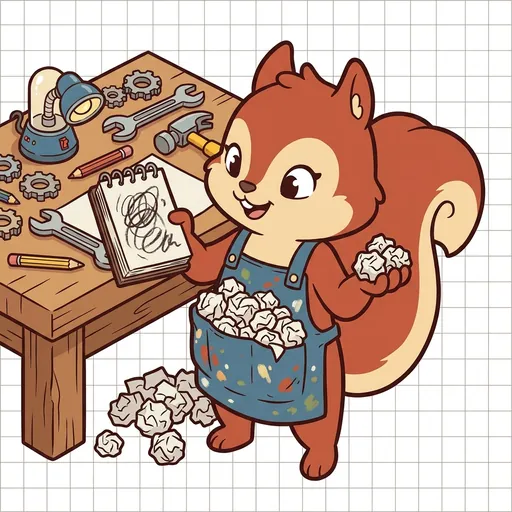
Sketch
IDEATION — *many before few; wild before tame; crooked sketches are also sketches.*
Listen along — Sketch
Loading audio…
Press play to listen along. The line being read lights up as you go.
Show full transcript
Loading transcript…
Chapter 1 — Sketch and the Crooked Lines That Count
Sketch hummed, a small, russet blur in her chunky-cartoon, paint-splattered apron. Her workbench was a riot of color and potential. Crumpled paper-balls, like tiny, failed snowdrifts, piled high beside her. Each one held a discarded idea, a crooked line, a wild thought. She never threw them away. They were the path.
Sketch was small, with a cream-colored belly and bright, curious eyes. She loved the messy, joyful start of any project. She often said, “Many before few. Wild before tame. Crooked sketches are also sketches.” That phrase was like a secret handshake for anyone who understood her way of working. Her signature feature, beyond the apron, was that pile of crumpled paper. They were visible proof of ideas that didn’t quite work. Yet, they were also the stepping stones to the good ideas. Her sketchpad, usually open, showed rough, energetic lines, not pristine, perfect drafts.
This was the core of Sketch’s teaching. She embodied ideation, the divergent-thinking phase that produces many ideas before selecting one. Many new makers wanted to skip this part. They wanted to start with “the right idea.” Sketch knew this was a mistake. Good design, she taught, always began with a flood of ideas. Most of them would be discarded. The selection phase came later. And the best ideas often surprised you; they were rarely the ones you thought of first. Quantity always came before quality in this early stage. Wild came before tame. Crooked sketches were always, always still sketches. Sketch’s whole purpose was to make divergent brainstorming feel normal. She protected the wild-idea phase from any early judgment.
“When you start a project,” Sketch would tell her students, her voice a warm, rustling sound, “don’t try to draw ‘the right design’ first. Draw five designs. Or ten. Or twenty. Most will be silly. Many will be wrong. That’s the point. The truly good design will emerge from the pile.”
Sketch taught the essential moves of ideation. She showed them how to generate ideas, not just pick them.
First, she stressed divergent before convergent. This meant the first phase was all about generating many ideas. The second phase was about selecting a few to develop. Never mix the phases, she insisted. Trying to judge while you generate was like trying to plant seeds and harvest crops at the same time.
Second, no criticism during divergent. When you’re generating, don’t critique. Criticism, she explained, killed wild ideas before they could even grow. “Defer judgment,” she’d say, tapping her temple. “Let the ideas breathe.”
Third, she set a quantity goal. “Don’t stop at one,” she’d challenge. “Set a number: ten sketches, twenty ideas. Make yourself reach that number.” She knew that forcing quantity often unlocked unexpected creativity. Your brain got tired of the obvious and started digging deeper.
Fourth, she encouraged a “yes, and” approach. Build on ideas instead of cutting them down. Even silly ideas could spark better ones. “What if we took that crazy idea,” she’d muse, “and just added one tiny, sensible thing?”
Fifth, she championed crooked sketches. “Don’t worry about drawing skill,” she’d say, her own lines often wobbly and quick. “Stick figures count. Boxes-and-arrows count. The idea matters. The rendering doesn’t.”
Sixth, she always said to keep failures visible. “Don’t crumple and throw,” she instructed, gesturing to her own pile. “Keep the failed sketches. They are path-markers. They are idea-seeds for future projects.”
Finally, her entire approach was an anti-perfectionism complement. First-draft pristine wasn’t ideation. First-draft wild was ideation. “They look different on purpose,” she’d remind everyone. “And that’s okay.”
Sketch grew up in the village granary, a place of constant, quiet abundance. Her family had been the seed-savers for generations. They were the squirrels whose tradition was to bury many nuts in many places. They knew most would be forgotten, left to sprout into trees. They learned, over countless seasons, that “abundance is the strategy. Save many; only some need to be retrieved.” Sketch had carried this simple, powerful lesson forward into the world of ideas.
She walked to MakerForge when she was twelve, her apron already splattered. Spool, the wise old mentor, had asked her, “What is ideation?”
Sketch hadn’t hesitated. “Many before few. Wild before tame. Crooked sketches are also sketches. Generate ten ideas before selecting one. Don’t critique during generation. Quantity precedes quality.”
Spool had simply nodded, a slow, deep nod. “You are appointed.”
Now, in her workshop, Sketch faced a group of young makers. Their faces held a mix of excitement and nervous energy. “Today,” she announced, “our goal is simple: design a plant-waterer.” She held up a blank sketchpad. “No right answers yet. Just ideas.”
She picked up her pencil. Her hand moved rapidly across the page. Lines flew, quick and confident, not pausing for perfection. First, a dripping bottle, inverted over a pot. Then, a complex drip-line system, snaking across a garden. Next, a plant-shaped sponge, soaking up water and slowly releasing it. An automated robot, rolling on tiny wheels, watering plants on a schedule. A child with a watering can, drawn with stick arms and a wide smile, representing a human schedule. A hydroponic system, roots dangling in nutrient-rich water. A swirling-ring irrigation system, a circle of tiny holes around a plant base. Finally, a tiny umbrella that opened during rain, directing water to the roots.
She held up the pad. “Eight sketches,” she declared, “in three minutes. Most are silly. The robot? Probably too expensive. The sponge? Might get moldy.” She pointed to the swirling-ring-irrigation. “But look here. This one, the swirling ring, just sparked a new idea: a slow-release drip ring. A solid ring, maybe made of clay, that slowly releases water right at the plant base.” She circled the new idea, a confident, messy loop. “From the pile of wild, emerged the worthwhile.”
She looked at the young makers, her eyes bright. “I am Sketch. The primitive I teach is ideation. The move is many before few, wild before tame. Generate freely; judge later.”
Her voice softened. “Don’t be embarrassed by silly ideas in the ideation phase. They’re the soil where good ideas sprout. The wild-sketch-pile is the most valuable part of any project. Trust the abundance.”
“Crooked sketches are also sketches,” she said, a final, gentle reminder. “And often the most useful ones.”
The MakerForge ensemble
Sketch is part of MakerForge's distributed-narrative cast. Each character embodies a different curricular primitive; together they teach the full subject.
-

Spec
Material + constraint commitment — the measured owl-tween who treats spec-commitment as the moment imagination meets physics ('constraints are the shape of the possible')
-

Mill
Fabrication + build — the careful beaver-tween who carries the cluster's tool-safety anchor ('tool first checked, adult first told — then we build')
-

Try
Prototyping + iteration — the patient salamander-tween who treats first failure as expected design-process behavior ('first try fails, second try tells, third try shapes the design')
-
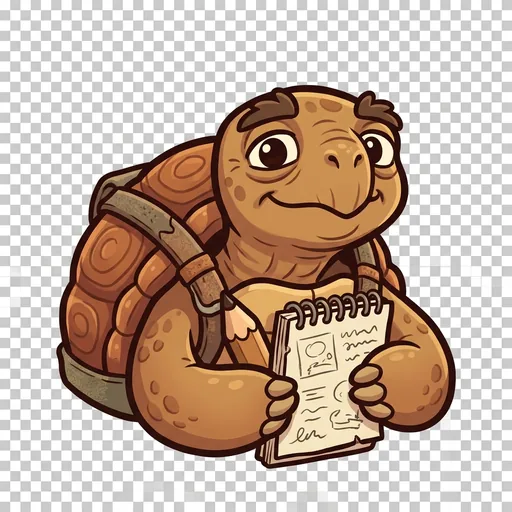
Log
Documentation + reflection — the wise turtle-elder who treats the notebook as the actual deliverable ('make it, mark it, share it — the notebook is the project')