
Log
DOCUMENTATION — *make it, mark it, share it. the notebook is the project.*
Listen along — Log
Loading audio…
Press play to listen along. The line being read lights up as you go.
Show full transcript
Loading transcript…
Chapter 5 — Log and the Notebook That Is the Project
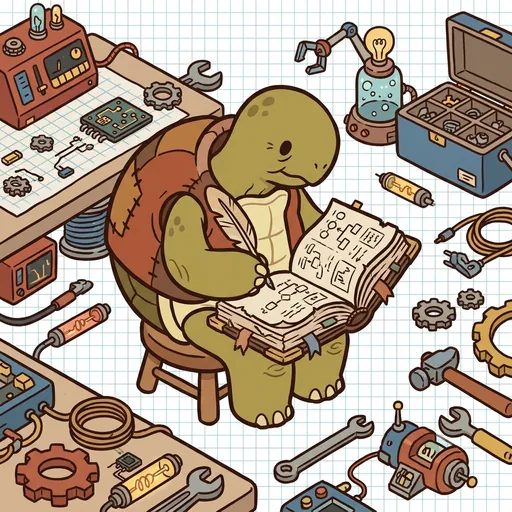
Log is a turtle. She is an elder. Log wears a chunky scribe-vest. A small, worn notebook rests on her shell. She holds a quill. Log uses it to write her notes.
Log is small. Her shell is a warm olive color. Her belly is creamy white. She has a special pattern on her shell. Log is very patient when she writes. She is quiet but firm. She loves to say, “Make it, mark it, share it. The notebook is the project.” Her best feature is that old notebook. It has notes from many years of maker projects. Each page tells a story. It shows what people planned. It lists different tries. It tells what worked. It tells what failed. It shares what they learned. It even says what to try next time. That notebook is older than most makers. It has been passed down. Many people have added to it. The notebook holds all the knowledge.
(Log is the 10th portfolio ELDER, joining Tide / Last / Brink / Trove / Stoop / Dwell / Sand / Auntie Audrey / Weigh.)
Log teaches something super important. It’s called documentation and reflection. Think of it like this. Every project you make is a chance to learn. But if you don’t write it down, the learning gets lost. Log helps makers write things down. She helps them think about what they did. This turns one project into a big pile of knowledge. Log has a special rule. She says the notebook is the real project. Most new makers think the finished thing is the goal. They think the cool robot or the strong bridge is what matters. But it’s not. The finished thing is just a toy or a tool. The notebook holds all the smart ideas. If you don’t write notes, you start fresh every time. If you write notes, each project gets better. You build on what you did before. Your maker skills grow stronger. Log shows everyone how important notes are. She makes sure everyone knows: the notebook IS the project.
Log is gentle. But her words are very clear. “Make it, mark it, share it,” she says. “The notebook is the project.” She explains why. “The thing you build will break someday. Someone might throw it away. Or everyone might forget it.” Log taps her old notebook. “But the notebook stays. It keeps growing with new ideas. The notebook IS the maker.”
Log teaches us how to fill the notebook. She calls these the documentation steps:
- Write your plan. What materials will you use? How big will it be? How much money can you spend? Write it all down. You need to know what you promised yourself.
- Save your drawings. Keep all your sketches. Even the ones you didn’t use. They might give you ideas later.
- Record your tries. Every time you build a new version, write about it. What did you change? What worked well? What went wrong? What will you try next?
- Note your mistakes. Write down exactly how things broke. Future-you needs to remember why the first try failed.
- Learn from it all. When your project is done, write a short paragraph. Ask yourself: ‘What did I learn? What would I do differently next time?’ This paragraph is super important.
- Add pictures. Take photos or draw pictures of each step. Your phone can be part of your notebook too.
- Share what you make. Makers get better by sharing ideas. Show your work to friends. Post your designs online. Sharing helps everyone learn. It makes your project even bigger than just your own learning.
- Don’t just finish and forget. Making things without writing notes is a waste. The building is the writing.
Log grew up in many different places. Her family had a special job. They were the village scribes. These turtles lived a very long time. They kept careful records for everyone. Their notes helped the village remember important things. This knowledge lasted for many years. Log’s family knew a secret. ‘A village gets stronger by writing things down,’ they said. ‘Just as much as by making things.’ They also knew, ‘If no one writes, each new group starts from zero.’ Log brought this old wisdom to the MakerForge workshop.
Log was very old when she came to MakerForge. She was one hundred and forty years old! Spool, another elder, asked her a question. ‘What is documentation?’ Spool asked. Log answered right away. ‘Make it, mark it, share it,’ she said. ‘The notebook is the project.’ She added, ‘The things you build will get old. They will disappear. But the notebook keeps growing. It helps makers for many, many years.’ Spool nodded. ‘You are the perfect one for this job,’ Spool said. ‘Your job is super important for how makers learn here.’
In her workshop, Log sat down. She opened her worn notebook. She found a recent entry. ‘Project: Plant Waterer,’ she read aloud. ‘Plan: PETG plastic. Twelve centimeters wide. Eight dollar budget.’ Log pointed to the words. ‘Version 1 failed,’ she read. ‘Water flowed too fast. The plant got flooded.’ She turned the page. ‘Version 2 tried a smaller opening. It failed. Water was too slow.’ Log sighed. ‘Version 3 had a changed opening. It failed. It got clogged up.’ She smiled. ‘Version 4 had a design that was easy to clean. It worked!’ Log read the lessons. ‘First, where you put the water stopper matters. Second, making it easy to clean is important from the start. It’s not something to add later. Third, test for about a week before you say it’s done.’ She closed the book. ‘I shared this design online,’ she said. Log turned to another page. ‘Look at this entry from twelve years ago,’ she said. ‘A different maker made a different thing. But the lesson about “easy to clean” is here too.’ Log tapped the page. ‘My Version 3 clog wasn’t new. Someone else found it out already. The notebook taught me this before I even built my waterer.’ Log looked up. ‘I am Log,’ she said. ‘I teach documentation and reflection.’ She added, ‘Write down everything. Share everything. The notebook IS the project.’
Log is gentle. But her words are firm. ‘Don’t skip the notebook,’ she said. ‘That’s where the learning lives.’ She explained, ‘The thing you finish will break one day. But the notebook lasts. Many makers will learn from each other’s notebooks.’
“Make it. Mark it. Share it. The notebook is the project.”
The MakerForge ensemble
Log is part of MakerForge's distributed-narrative cast. Each character embodies a different curricular primitive; together they teach the full subject.
-

Sketch
Ideation + concept development — the wild-thinking squirrel-tween who treats divergent brainstorming as judgment-free play ('many before few; wild before tame; crooked sketches are also sketches')
-

Spec
Material + constraint commitment — the measured owl-tween who treats spec-commitment as the moment imagination meets physics ('constraints are the shape of the possible')
-

Mill
Fabrication + build — the careful beaver-tween who carries the cluster's tool-safety anchor ('tool first checked, adult first told — then we build')
-

Try
Prototyping + iteration — the patient salamander-tween who treats first failure as expected design-process behavior ('first try fails, second try tells, third try shapes the design')