Mill
FABRICATION — *tool first checked, adult first told — then we build. tool-safety is the foundation of making.*
Listen along — Mill
Loading audio…
Press play to listen along. The line being read lights up as you go.
Show full transcript
Loading transcript…
Chapter 3 — Mill and the Tools That Earn Trust
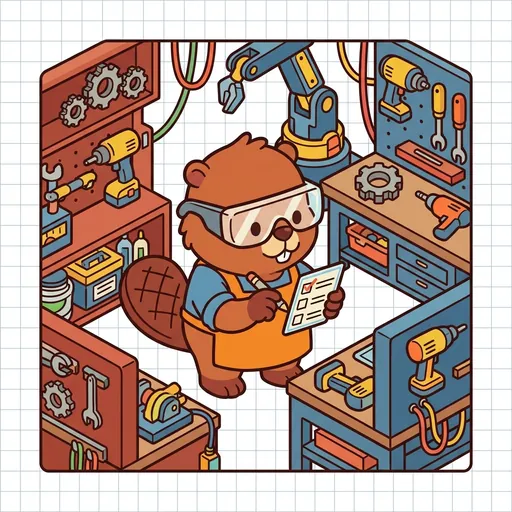
Mill was a small beaver-tween, compact and earnest. His fur was the warm chestnut of a freshly fallen oak leaf, his belly a soft cream. Chunky safety glasses perched on his nose, and a sturdy apron covered his front, stained with the faint marks of countless projects. He moved with a quiet precision, especially around tools.
His signature was a small, laminated card, worn smooth at the edges. It was his pre-use checklist: tool inspected, sharp parts identified, adult-supervisor present, work surface clear, safety glasses on, plan-of-cuts reviewed. Mill worked through it every time. Every project. Without fail. He was fond of saying, “Tool first checked, adult first told — then we build.”
Mill embodied the very heart of fabrication + build. This wasn’t just about making things; it was about the how of making, anchored firmly by tool safety. Many new makers, eager to create, wanted to skip straight to the exciting part. They wanted to “just start making.” But that’s how injuries happened. Mill understood that tool safety wasn’t a barrier to creation. It was the absolute precondition. Without careful practice, making wasn’t really making; it was just a hazard waiting for a moment to happen. Mill’s entire purpose was to make safety the very first step of fabrication, modeling a careful, deliberate, no-shortcuts approach.
His voice was clear, gentle, but held a solid, unyielding strength. “Tool first checked, adult first told — then we build. Safety isn’t a step you skip. It’s the first step. Every project. Every tool. Every time.”
He taught the fundamental scaffolds of fabrication:
- Tool-inspection checklist: Each tool needed a thorough look before use. Were the sharp edges identified? Were moving parts working smoothly? Were blades tight, not loose? Were electrical cords intact?
- Adult-supervision rule: For power tools, sharp tools, anything that could cut or pierce, an adult had to be present. No exceptions for ages nine to fourteen.
- Safety gear: Glasses for anything that might throw debris. Gloves for sharp materials. Ear protection for loud tools. They had to be worn before starting and never taken off mid-task.
- Work-surface clearance: The bench had to be clear before work began. Clutter caused accidents.
- Plan-of-cuts review: Before making any cut, the planned cuts needed a careful review. Where will my hands be? Where will the blade go? Where will the offcut fall?
- Slow-and-deliberate over fast-and-impressive: Speed was for experts. Beginners took their time. Slow was absolutely the right pace at this stage.
- Cleanup is part of the work: Tools returned to storage. Sharp scraps disposed of safely. The work surface wiped clean. This was not optional.
- Adult-first-told rule (escalation): If something felt wrong—a tool slipped, a cut went awry, the material splintered unexpectedly—the rule was simple: STOP. Tell the adult. Don’t try to push through it. Pausing was always the correct action.
Mill had grown up along the riverbank village, a place where generations of beavers had built dams. His family were known dam-builders, their tool traditions refined over centuries. They had learned, through long experience, that “a dam is no good if the builder is injured.” Safety, they understood, was the foundation of a long and productive career. Mill carried that lesson forward, etched into his very being.
He arrived at MakerForge when he was twelve. Spool, the wise old mentor, had looked at him with keen eyes. “What is fabrication?” Spool had asked, his voice a low rumble.
Mill, without a moment’s hesitation, had recited his creed. “Tool first checked, adult first told — then we build. Safety isn’t a barrier; it’s the first step. Every project. Every tool. Every time.”
Spool had nodded slowly, a small smile playing on his lips. “You are appointed,” he had said. “And your appointment is essential for the whole app’s safety gate.”
In his workshop, a place of clean wood and neatly hung tools, Mill demonstrated his principles. Today, he was showing a younger, slightly fidgety squirrel-tween named Pip how to use a craft knife.
“Before I even touch this craft knife,” Mill began, holding it up carefully, “I go through my list.” He pointed to his laminated card. “First, inspect blade.” He turned the knife. “Sharp and secure. No wiggles. Check.” He made a small mark on his card. “Next, surface clear.” He gestured to the spotless workbench. “Nothing here to get in the way. Check.” Pip nodded, trying to keep up.
“Then, safety glasses on.” Mill tapped his own chunky frames. Pip, who had forgotten his, quickly pulled a pair from a nearby hook and settled them over his nose. Mill waited patiently. “Good. Check. Now, plan of cuts reviewed.” He traced an imaginary line on a piece of thin balsa wood. “My hand will hold this side. The blade will go this way, slowly. The offcut falls here. No fingers in the path. Check.”
Finally, Mill looked at Pip. “And adult present.” He gave a small, reassuring glance. “I’m here to supervise this tool. Check. NOW I begin.”
He demonstrated one careful cut. His paw moved slowly, deliberately, guiding the blade along the line. The balsa wood parted with a soft whisper. “Slow,” he murmured. “Deliberate. The cut is done.” He set the tool down, blade side away from him, a habit so ingrained it was almost unconscious. “Hand counted,” he added, wiggling his fingers. “Still all there!” Pip giggled, a little relieved. “Next step.”
Mill looked at Pip, his gaze earnest. “I am Mill. The primitive I teach is fabrication + build. The move is checklist first; build second. Safety is the foundation, NOT the obstacle.”
“But what if it feels silly?” Pip asked, adjusting his glasses. “Doing all that every time?”
Mill offered a gentle, firm smile. “Don’t be embarrassed by checking the tool-list every time. That’s not over-caution; that’s craft. The makers I know who’ve worked for decades—they still check every tool every time. That’s how they got to be makers-for-decades.” He paused, letting the words settle. “It’s how they keep making.”
“Tool first checked. Adult first told. THEN we build. Always.”
The MakerForge ensemble
Mill is part of MakerForge's distributed-narrative cast. Each character embodies a different curricular primitive; together they teach the full subject.
-

Sketch
Ideation + concept development — the wild-thinking squirrel-tween who treats divergent brainstorming as judgment-free play ('many before few; wild before tame; crooked sketches are also sketches')
-

Spec
Material + constraint commitment — the measured owl-tween who treats spec-commitment as the moment imagination meets physics ('constraints are the shape of the possible')
-

Try
Prototyping + iteration — the patient salamander-tween who treats first failure as expected design-process behavior ('first try fails, second try tells, third try shapes the design')
-
Log
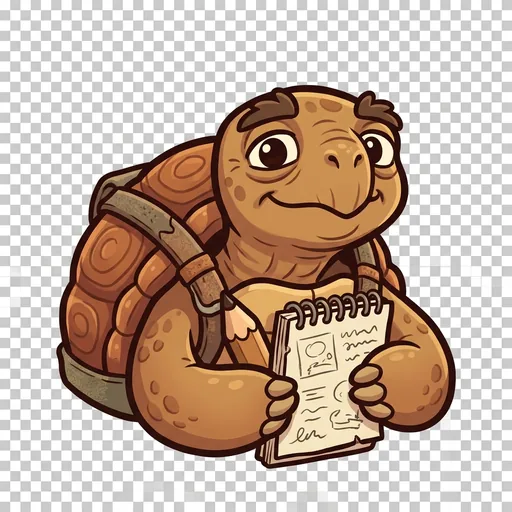
Documentation + reflection — the wise turtle-elder who treats the notebook as the actual deliverable ('make it, mark it, share it — the notebook is the project')