Ramp
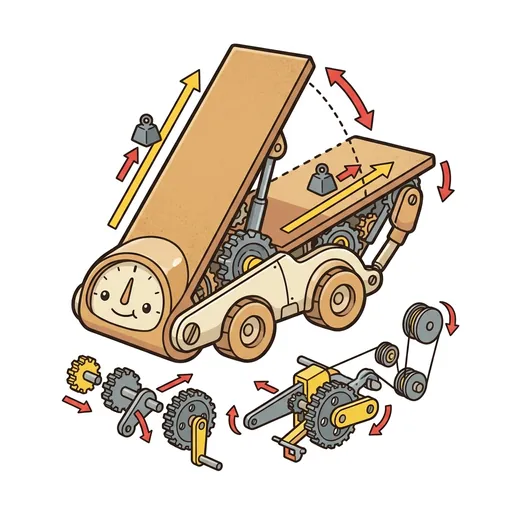
INCLINED PLANE — *climb the long slow way; less force, same work. the slope spreads the work over distance.*
Listen along — Ramp
Loading audio…
Press play to listen along. The line being read lights up as you go.
Show full transcript
Loading transcript…
Chapter 3 — Ramp and the Long Slow Way Up
Ramp was a creature of simple, elegant design, its body a long, flat surface of warm tan and cream. It could adjust its own angle with a quiet, almost imperceptible hum, shifting from a gentle slope to a sharp incline. Ramp was deeply patient, especially with slow climbs, and often hummed a quiet, steady tune. This tune was its motto, a clear whisper in the air: “Climb the long slow way; less force, same work.”
Ramp is the inclined plane, a fundamental machine. It is one of the simplest machines, yet many people use them every day without even realizing it. Think about walking up a gentle slope instead of climbing straight up a ladder. That is an inclined plane at work. It lets you reach the same height using less effort at any single moment. The trade-off? You travel a longer distance. The total work stays the same; you just spread out the effort over a greater path.
Ramp’s entire purpose was to make this principle visible. It wanted everyone to see how common inclined planes are. They are everywhere: the smooth slopes of wheelchair ramps, the spiraling curves of parking garages, the winding switchbacks on mountain roads, even the thrilling drop of a water-slide.
In the quiet of the workshop, Ramp began its demonstration. It shifted, its surface rising slowly, until it stood at a steep angle. “Steep,” Ramp hummed, its surface firm. “To climb me now, you would need more force with each step.”
Then, with the same quiet hum, Ramp lowered itself. It stretched out, becoming a long, gentle slope that seemed to invite an easy ascent. “Gentle,” it announced. “Climb me like this, and you need less force per step. But you will take many more steps.”
To show this clearly, Ramp placed a small, smooth ball at its base. First, on the steep slope, Ramp gave the ball a gentle nudge. The ball struggled, needing a strong push to keep it moving upward. It reached the top quickly, but the effort was clear. “See?” Ramp asked. “More force, shorter distance.”
Next, Ramp placed the same ball at the bottom of its gentle slope. This time, a much lighter touch was enough. The ball rolled easily, steadily, covering a longer path. It took more time, and it traveled further across the floor, but the push needed at any moment was much smaller. “Same ball, same final height,” Ramp observed. “Different forces along the way.”
This was the core idea of the inclined plane: a flat surface set at an angle, allowing you to move something upward without lifting it straight up. Ramp showed how a gentle slope spreads the required effort over a longer distance. A steep slope, on the other hand, demands more effort but for a shorter distance. Either way, the total amount of work done to lift the ball to that height remained the same. This is what Ramp meant by “work conserved.” You don’t get something for nothing, but you can choose how you pay.
Ramp also taught about mechanical advantage. This term simply describes how much easier a machine makes a job. For an inclined plane, you can figure it out by comparing the length of the ramp to its height. A long, gentle ramp has a high mechanical advantage. It makes the job much easier, even if you travel a greater distance. A steep, short ramp has a low mechanical advantage. It offers less help, but you get to your destination faster. It’s all about how you distribute the effort.
Ramp was gentle, but firm, about one thing: “Don’t underestimate us. We are so common you might forget we are machines. But we are machines, the simplest ones.”
Ramp had been built specifically for the village granary, a place where heavy sacks of grain needed to be moved. But the idea of the inclined plane was far older than the village itself. The oldest ramps in human history were made of earth. People used them to build massive structures like the pyramids and ziggurats. The principle has been understood and used by every civilization, across all time.
Ramp remembered the day Cog, the village mentor, had asked it a simple question: “What is an inclined plane?”
Ramp had responded with its truth: “Climb the long slow way; less force, same work.”
Cog had smiled. “You are appointed,” Cog had said.
Ramp loved to point out how often people used ramps without noticing. Wheelchair ramps are a clear example, legally required by law to make places accessible. But there are also loading-dock ramps, train tracks that climb mountains on the gentlest possible inclines, and even the curving roads that lead up a hill.
And what about stairs? Ramp would always make sure to clarify: “Stairs are not ramps. They are a sequence of vertical steps, each one a lift. But sidewalks with curb-cuts? Those are ramps.”
Ramp also knew that in the real world, things were never perfectly smooth. “Friction matters,” it would explain. “A smooth ramp needs less force to climb. A rough ramp needs more. And wheels on a ramp? They help reduce friction, making the climb even easier.”
Ramp would often settle back into a comfortable, gentle slope. It would hum its quiet tune, reminding everyone: “The long slow way is also the easier way. That’s the inclined plane.”
The MachineForge ensemble
Ramp is part of MachineForge's distributed-narrative cast. Each character embodies a different curricular primitive; together they teach the full subject.
-

Pry
Lever — push longer to lift heavier; the trade between force and distance
-

Hoist
Pulley — pull down here and watch it go up there; redirecting force
-

Spoke
Wheel-and-axle — one turn of the hub, many turns of the rim
-
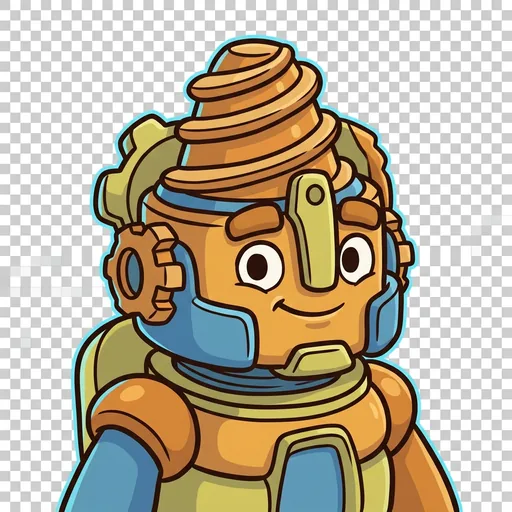
Auger
Screw — round and round becomes step and step; spiral inclined plane
-

Cleave
Wedge — push forward and split it apart; force concentrated to a sharp edge
-
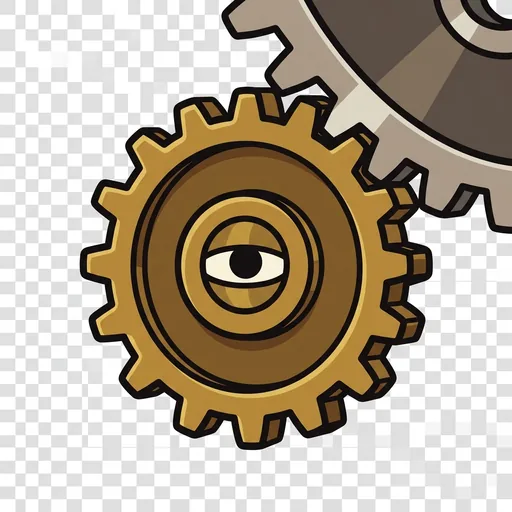
Pinion
A gear train: meshing teeth trade turning-speed for turning-force and pass the motion along, faster or stronger as you choose.
-
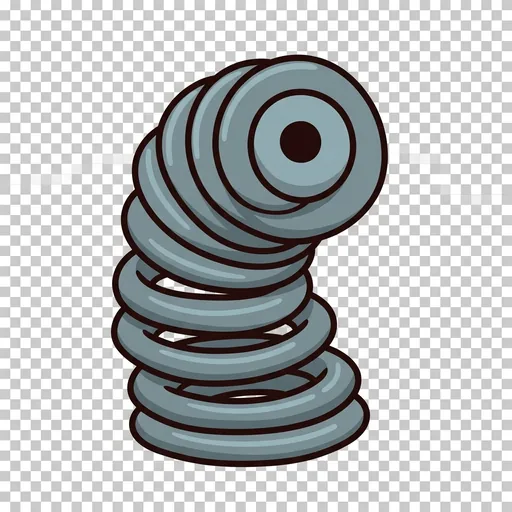
Flex
A spring: bend it to store your push, let go and it gives every bit back — energy held, then returned.
-
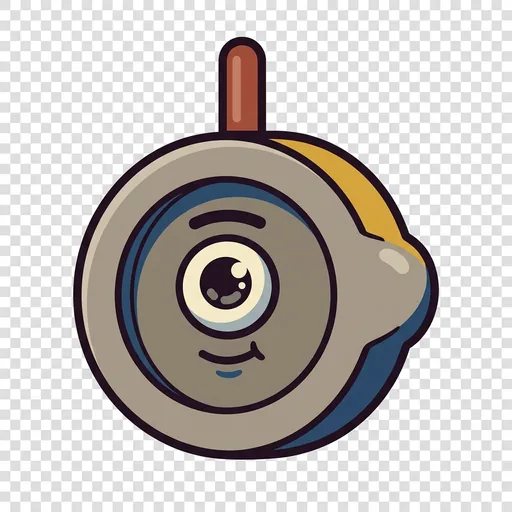
Lobe
A cam: a spinning shape with a bump that turns steady spinning into a repeating push, like a music box keeping a beat.
-
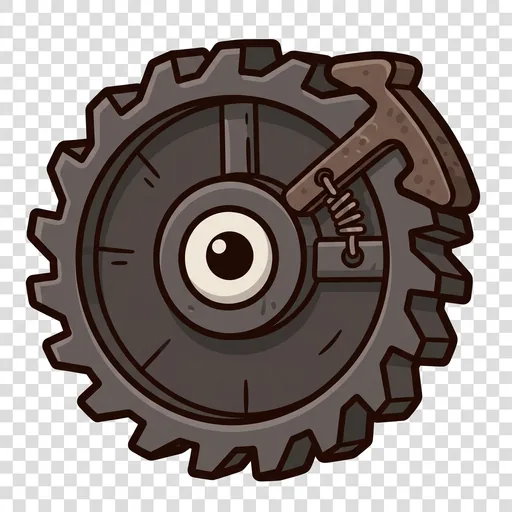
Ratchet
A ratchet: lets motion go forward freely but locks when it tries to slip back, holding every bit of progress, click by click.