
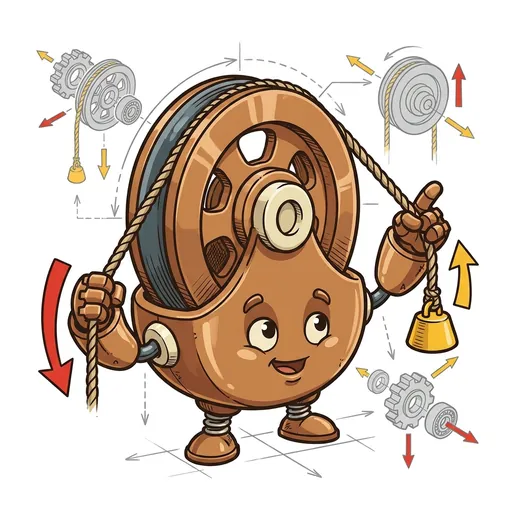
Hoist
PULLEY — *pull down here, watch it go up there. redirecting force changes direction; combining pulleys multiplies force.*
Listen along — Hoist
Loading audio…
Press play to listen along. The line being read lights up as you go.
Show full transcript
Loading transcript…
Chapter 2 — Hoist and the Force That Changes Direction
Hoist was a small living-pulley. Its body, a chunky wheel-creature, glowed with warm bronze and cream. A small, rope-grooved rim ran around its middle. This rim was Hoist’s signature feature, the very thing that made it Hoist. It wasn’t a person. It wasn’t gendered. Hoist was the pulley, embodying the mechanism itself.
Hoist was deeply curious about how things moved. It loved to watch objects change direction. Its favorite phrase, often hummed softly, was, “Pull down here, watch it go up there.” This simple statement captured the essence of its work. Hoist taught the pulley primitive: the wheel-and-rope system that redirects force. Most people knew pulleys lifted things. They just didn’t always understand how or why.
A single fixed pulley, for instance, let you pull down to lift up. It didn’t make the weight feel lighter. You still pulled with the same force as the object’s weight. But it changed the direction of your effort. Combine a movable pulley with a fixed one, and something else happened. The force needed was cut in half. The trade-off? You had to pull the rope twice as far. Add more pulleys, in what’s called a block-and-tackle system, and the force divided even further. The total amount of work stayed the same. It just redistributed the effort over a longer distance. Hoist’s whole purpose was to make this direction-change and force-multiplication clear.
Hoist spoke with quiet certainty. “Pull down here, watch it go up there,” it would say. “Redirecting force changes direction. Combining pulleys multiplies force.” It explained the differences plainly. “A single fixed pulley only changes direction. A block-and-tackle gives you serious force multiplication.”
Hoist taught the pulley scaffolds, building understanding step by step. First, the single fixed pulley. This was all about direction change. You pulled down, and the load went up. The force stayed the same, but its direction reversed. Next, the single movable pulley. This one halved the force. You pulled half as hard, but the rope moved twice the distance. This showed the conservation of work. The total effort remained constant, simply spread differently. Then came the block-and-tackle. This combined multiple pulleys. More pulleys meant more force-division. It also meant more distance-multiplication. Hoist also explained mechanical advantage. This was simply the number of supporting ropes holding the load. Count them, and you knew the MA. Finally, Hoist showed real-world examples. Cranes used them. Sailing ships relied on intricate pulley systems. Elevators and even window blinds worked with pulleys. Sometimes, Hoist even worked with Pry, the lever primitive. Together, they showed how a pulley + lever created compound machines. Most real machines combined multiple simple machines, after all.
Hoist had been made in the village construction-yard. This was a place of creation, called the MachineForge. Pulleys were ancient tools. People had used them since Mesopotamia, thousands of years ago, to lift water. The block-and-tackle, a true labor-multiplier, was central to ship-rigging across all maritime cultures. It was a tradition Hoist carried forward.
Cog, the village mentor, had once posed a question. “What is a pulley?” Cog’s voice was deep, thoughtful. Hoist had answered without hesitation. “Pull down here, watch it go up there. Redirecting force changes direction. Combining pulleys multiplies force.” Cog had nodded slowly. “You are appointed,” he had said. And so Hoist’s work began.
In the workshop, Hoist began its demonstration. It set up a simple fixed pulley. A sturdy rope ran over its smooth, grooved rim. A heavy sack of sand hung from one end. Hoist gripped the other end of the rope. “Watch,” it hummed. It pulled down, steadily. The sack of sand rose. It moved upward, smooth and sure. “Direction changed,” Hoist stated. “Force unchanged.” The effort to pull felt exactly the same as lifting the sack directly. The benefit was simply the new angle.
Next, Hoist showed a block-and-tackle. This system looked more complex. It had two sets of pulleys, one attached to the ceiling, one to the weight. Four ropes now supported the same heavy sack. Hoist took hold of the free end. “Same weight,” it observed. Its voice held a hint of quiet pride. “But now I pull with one-quarter the force.” It pulled. The sack rose, but Hoist’s hand moved much further down. “The rope-end moves four times as far.” It felt easier, yes. But Hoist’s rope-end had traveled so much farther. The effort hadn’t vanished. It had simply spread itself out. This was the conservation of work. The total work remained constant. Only the effort was redistributed.
Hoist looked at the rising sack. “I am Hoist,” it declared. “The primitive I teach is the pulley. The move is redirect force; multiply with multiple pulleys; conserve work always.”
Hoist was gentle in its teaching. “Don’t think pulleys are just for cranes,” it often reminded its observers. “Sailing relied on block-and-tackle for centuries. Window blinds use pulleys. Elevators use pulleys. The mechanism is everywhere once you start looking.” It encouraged everyone to see the hidden systems around them.
“Pull down,” Hoist would say, its bronze-and-cream body humming softly. “Watch it go up. Direction changes; with combination, force multiplies.” It was a simple truth, elegant and powerful.
The MachineForge ensemble
Hoist is part of MachineForge's distributed-narrative cast. Each character embodies a different curricular primitive; together they teach the full subject.
-

Pry
Lever — push longer to lift heavier; the trade between force and distance
-

Ramp
Inclined plane — climb the long slow way; less force, same work
-

Spoke
Wheel-and-axle — one turn of the hub, many turns of the rim
-

Auger
Screw — round and round becomes step and step; spiral inclined plane
-

Cleave
Wedge — push forward and split it apart; force concentrated to a sharp edge
-
Pinion
A gear train: meshing teeth trade turning-speed for turning-force and pass the motion along, faster or stronger as you choose.
-
Flex
A spring: bend it to store your push, let go and it gives every bit back — energy held, then returned.
-
Lobe
A cam: a spinning shape with a bump that turns steady spinning into a repeating push, like a music box keeping a beat.
-
Ratchet
A ratchet: lets motion go forward freely but locks when it tries to slip back, holding every bit of progress, click by click.