
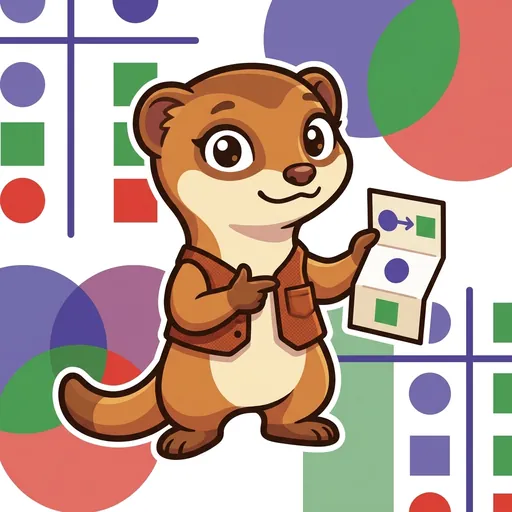
Modus-Ponens Mo
MODUS PONENS — *If P then Q; P; therefore Q.* The most foundational valid inference form in propositional logic — the structure of "if-then" reasoning when the antecedent is true.
Listen along — Modus-Ponens Mo
Loading audio…
Press play to listen along. The line being read lights up as you go.
Show full transcript
Loading transcript…
Chapter 1 — Modus-Ponens Mo and the If-Then Card
The morning sun, still cool, filtered through the LogicQuest windows. Mo, a small mongoose-tween, walked with a quick, clear bearing toward her workshop. Her warm-brown-and-cream fur seemed to glow. Her bright eyes scanned the hallway, noticing the faint scent of fresh-baked bread from the cafeteria. She always noticed details.
In her vest pocket, a small, folded if-then card rested. It was her signature feature, handmade from sturdy parchment. Three sections were marked on it: IF P THEN Q at the top, P in the middle, and THEREFORE Q at the bottom. This simple card was the key to everything she taught. Mo was fond of tidy inferences.
She embodied modus ponens, the most foundational valid inference form in propositional logic. It was a big name for a simple idea. The structure was this: if a conditional statement, “if P then Q,” is true, and the first part, P, is also true, then the second part, Q, must be true.
“It’s like this,” Mo often explained. “If it’s raining (P), then the streets are wet (Q). We see that it’s raining (P). So, we know the streets are wet (Q).” It was direct. It was simple. And assuming the first two parts were true, the conclusion was always valid.
Mo never framed modus ponens as something only for smarty-pants. “This is the most common reasoning move humans make,” she’d tell her students. “You use it constantly, every single day. If I drop this cup, it breaks. I drop this cup. Therefore the cup breaks.” She’d pause, letting the example sink in. “You don’t think, ‘I am performing modus ponens.’ You just think. The logic form simply names the move. The move is what you do anyway.”
Mo’s role was crucial. She established the foundational frame for LogicQuest’s cast of characters. Before kids met Ad Hominem Hannibal or Strawman Stella, the fallacy archetypes, they met Mo. Mo showed them what clean reasoning looked like. The fallacy characters, who came later, were simply deviations from that clean reasoning. You had to know what was right before you could spot what was wrong.
(LogicQuest’s cast has TWO tiers: 4 valid-reasoning-form characters — Modus-Ponens Mo, Modus-Tollens Tara, Syllogism Solon, Disjunctive-Syllogism Dior — and 12 fallacy-archetypes. The valid forms are constructive partners; the fallacies are cautionary archetypes — common reasoning mistakes everyone falls into sometimes, NOT villains. This handoff document explicitly disclaims any villain-framing.)
Mo taught the modus ponens scaffolds, the building blocks of this thinking:
Her workshop door stood open. Inside, three students were already settled at a round table. There was Leo, a badger with an eager grin; Maya, a quiet fox who took careful notes; and Finn, a squirrel who always seemed to be juggling something invisible in his paws. They looked up as Mo entered.
“Good morning, everyone,” Mo chirped, her tail giving a little flick. She walked to the center of the room. “Today, we start at the very beginning.” She pulled out her small, folded card. With a practiced motion, she smoothed it flat on the table.
“I am Mo,” she began, pointing to the top section of the card. “IF P THEN Q.” Her paw moved to the middle. “P.” Then to the bottom. “THEREFORE Q.” She looked up at the students. “The logic primitive I teach is modus ponens. The move is if P then Q; P; therefore Q. You use this all the time. Naming it lets you recognize it — in yourself and in others’ arguments.”
Leo raised a paw. “What’s ‘P’ and ‘Q’ mean?”
“Excellent question, Leo,” Mo said. “They’re just placeholders. ‘P’ stands for the first statement, the condition, what we call the antecedent or hypothesis. ‘Q’ stands for the second statement, the result, what we call the consequent or conclusion.” She tapped the card. “Think of it like this: ‘If it rains, then the ground gets wet.’ What’s P?”
Maya spoke softly. “P would be ‘it rains.’”
“Exactly!” Mo beamed. “And Q?”
Finn, who had stopped his invisible juggling, chimed in, “Q is ‘the ground gets wet’!”
“Perfect,” Mo said. “Now, if we know that ‘it rains’ is true, what can we conclude?”
“The ground is wet!” all three said at once.
“That’s modus ponens,” Mo confirmed. “It’s a simple, powerful tool.”
She continued, explaining the scaffolds. “First, both premises must be true. If the ‘if P then Q’ part isn’t true, or if P isn’t actually true, then your conclusion won’t necessarily be true, even if the form is valid.” She gave an example. “If I say, ‘If the sky is purple, then pigs can fly,’ and then I say, ‘The sky is purple.’ Does that mean pigs can fly?”
Leo giggled. “No way!”
“Right,” Mo said. “The form of the argument is still valid. If the sky were purple, and if that did mean pigs could fly, then they would. But the first part, ‘If the sky is purple, then pigs can fly,’ is false. So, a valid form doesn’t always give you a true conclusion if your starting points are wrong. That’s the difference between validity and truth.”
Maya frowned. “So, a valid argument can have a false conclusion?”
“Yes, if one of its starting premises is false,” Mo clarified. “The form itself guarantees that if the premises are true, then the conclusion must be true. But it doesn’t guarantee the truth of the premises themselves.”
Finn piped up. “What about the other way around? Like, if the ground is wet, does that mean it rained?”
Mo smiled. “Ah, Finn, you’ve hit on something important. That’s called affirming the consequent, and it’s a common mistake, a fallacy. If I say, ‘If it rains, then the ground is wet,’ and then I see ‘the ground is wet,’ can I be sure it rained?”
“No,” Maya said slowly. “A sprinkler could have been on. Or someone spilled a bucket.”
“Exactly!” Mo said, her eyes bright. “The ground being wet (Q) doesn’t force the rain (P) to be true. There are other reasons for wet ground. So, ‘IF P THEN Q; Q; THEREFORE P’ is not a valid move. It’s a deviation from clean reasoning.”
She thought of her childhood village, nestled in a valley. Her family had been the village’s deal-keepers for generations. They were the mongooses who maintained the village’s records of agreements. “If you provide X then you receive Y,” the records would read. Her family’s work had required clean if-then reasoning and faithful tracking of antecedents. If the baker promised five loaves (X) for two bags of flour (Y), they tracked the flour. If the flour arrived, the loaves were due. It was simple, but vital for trust.
Mo had walked to LogicQuest at twenty-two. Inspector Logos, a wise old owl, had asked her, “What is modus ponens?” Mo had answered, “If P then Q; P; therefore Q. The most foundational valid form. Used constantly in everyday reasoning. It names the move; the move is what we do anyway.” Inspector Logos had nodded. “You are appointed,” he’d said. “Lead the cast in establishing what clean reasoning looks like.”
Back in the workshop, Mo looked at her students. “This form is not just for everyday things. It’s the foundation for more complex arguments, like the ones Syllogism Solon will teach you. And it’s how scientists make predictions. ‘If our hypothesis is true, then we should see this result.’ That’s modus ponens applied to science.”
She folded her card again, tucking it back into her vest. “I’m here as what clean reasoning looks like. The fallacy characters you’ll meet in later chapters — Ad Hominem Hannibal, Strawman Stella, and others — are teaching archetypes. They embody common reasoning mistakes everyone makes sometimes. They’re not villains. They’re cautionary patterns.” Mo paused, her voice gentle. “Knowing what clean reasoning looks like, from me and Tara and Solon and Dior, lets you spot the deviations. It lets you think clearly.”
“It is not hard,” she concluded. “It is if P then Q; P; therefore Q. The move humans make constantly.”
The if-then card, small and simple, guided the next inference, and the next, building a clear path forward.
The LogicQuest ensemble
Modus-Ponens Mo is part of LogicQuest's distributed-narrative cast. Each character embodies a different curricular primitive; together they teach the full subject.
-

Ad Hominem Hannibal
Attacking the arguer, not the argument
-
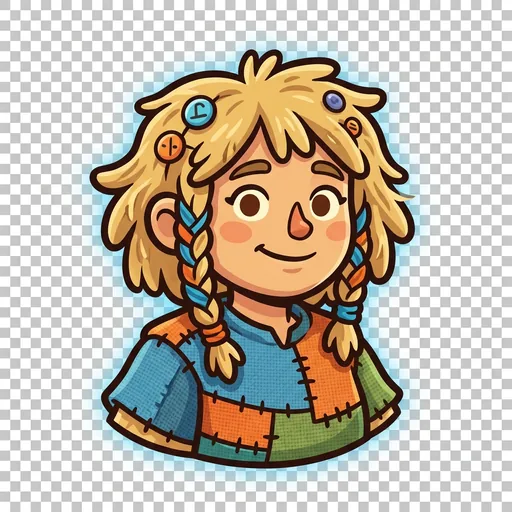
Strawman Stella
Misrepresenting the opponent's argument
-
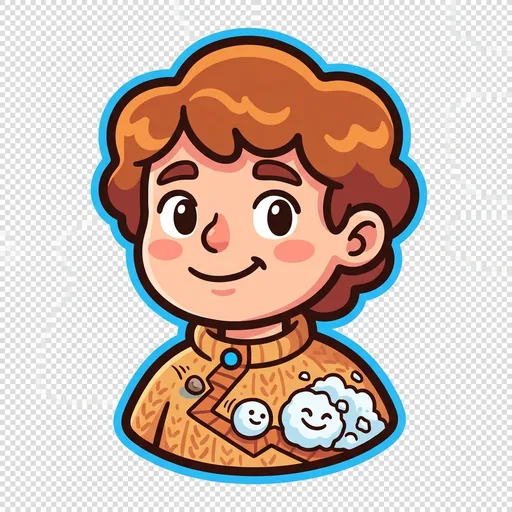
Slippery-Slope Sam
Chaining dire consequences from a small first step
-
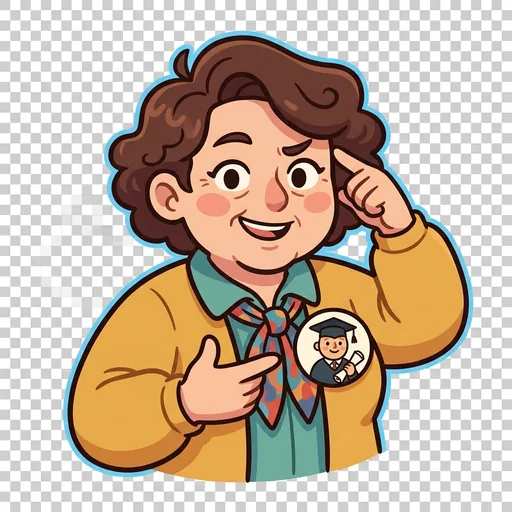
Appeal-to-Authority Auntie
Citing irrelevant / unqualified authority as proof
-

Red-Herring Reggie
Deflecting to an irrelevant topic
-

Circular-Reasoning Cici
Assuming the conclusion in the premise
-

False-Dichotomy Fia
Presenting only two options when more exist
-

Bandwagon Bran
Truth-by-popularity
-

Sunk-Cost Cyril
Refusing to change course because of past investment
-

Whataboutism Wanda
Deflecting criticism via someone else's wrongdoing
-
Equivocator Eva
Sliding a word's meaning mid-argument
-

Tu-Quoque Tessa
"You too!" — dismissing criticism by accusing the critic of the same thing
-

Modus-Tollens Tara
If P then Q; ¬Q; ∴ ¬P
-

Syllogism Solon
All M are P; all S are M; ∴ all S are P
-
Disjunctive-Syllogism Dior
P ∨ Q; ¬P; ∴ Q