
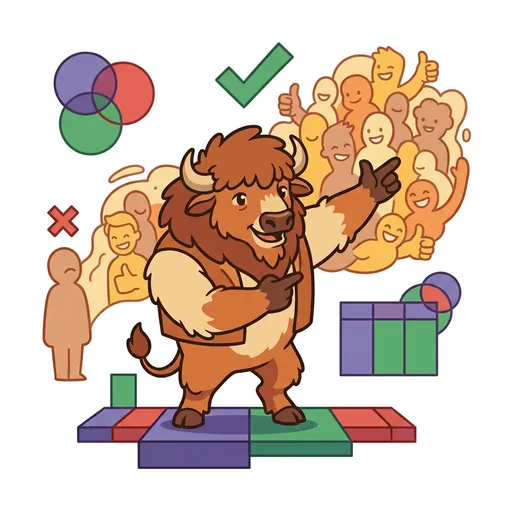
Bandwagon Bran
BANDWAGON — *truth-by-popularity.* The fallacy of *claiming something is true because many people believe it.*
Listen along — Bandwagon Bran
Loading audio…
Press play to listen along. The line being read lights up as you go.
Show full transcript
Loading transcript…
Chapter 12 — Bran and the Everyone-Says
Bran was a small buffalo, not fully grown, but with a confidence that felt much older. His fur was a warm mix of brown and cream, and he moved with a quick, almost impatient energy. Bran had a habit. When he wanted to prove something, he’d lean forward, his eyes bright, and say, “Everyone thinks X.” Or, “X is what most people believe.” For Bran, popularity was the best kind of evidence.
This was his signature move. He truly believed that if enough people thought something, it had to be true. It just made sense. He was a cautionary archetype, not a villain. He wasn’t trying to trick anyone. He just found comfort in agreeing with the crowd. It felt safe. We all do this sometimes. The trick is learning to separate popularity from real evidence.
Take, for example, the class project. Ms. Elara, their teacher, a wise old owl with spectacles perched on her beak, had asked them to research the history of their town. They needed to pick one major historical event. Then they would present their findings to the whole class.
“Easy,” Bran declared, thumping his hoof on the table in their group cluster. “Everyone knows the biggest thing was the Great Flood of ‘88. Everyone talks about it.” He looked around, expecting immediate agreement. He loved it when everyone nodded along.
Maya, a quick-witted squirrel with a knack for digging up old facts, tilted her head. “But is it the most important? Or just the one people remember best because it was so dramatic?” She tapped her pencil against her notebook. “Those aren’t always the same thing, Bran.”
Bran shrugged, a ripple going through his thick fur. “Same thing, right? If everyone remembers it, it has to be important.” He liked things simple. If a lot of people thought it, it saved him the trouble of thinking too hard. It was like a shortcut to the right answer. Why bother with complicated research when the answer was already out there, agreed upon by so many?
Leo, a quiet badger who thought carefully before speaking, cleared his throat. “My grandma says the founding of the first library was actually more important. It changed things for everyone, not just one year of bad weather.” He pushed his glasses up his nose, adjusting them. “She says it brought books and learning to every family, for generations.”
Bran scoffed. “Nobody talks about the library like that. The flood was huge. It was on TV. My uncle still tells stories about how the water reached the second floor of the old bakery.” He gestured dramatically with his hoof, trying to paint a vivid picture. “Everyone knows the flood. It’s what everyone thinks of when you say ‘town history’.”
Ms. Elara watched them from her desk, her gaze gentle but sharp. She let the discussion simmer for a moment, observing the different ways her students approached a problem. She saw Bran’s quick assertions, Maya’s thoughtful questions, and Leo’s quiet, fact-based points. Then she spoke softly. “Bran, you’re right, the flood was a major event. Many people remember it. It certainly had a big impact. But let’s think about the kind of evidence we use to support our claims.”
Bran puffed out his chest, ready with his favorite argument. “The evidence is everyone talking about it! It’s popular!”
“Is popularity the same as proof?” Ms. Elara asked, her voice calm. “Think back to when people believed the sun revolved around the Earth. For centuries, almost everyone thought that was true. They saw the sun move across the sky every day. It seemed obvious, didn’t it?”
A hush fell over the group. They knew the answer. The sun didn’t revolve around the Earth. The Earth revolved around the sun. That was a fact discovered by careful observation, scientific instruments, and deep study, not by a simple show of hands. Not by what “everyone knew.”
“So,” Ms. Elara continued, her eyes sweeping over each student, “even if most people believe something, it doesn’t automatically make it true. History is full of widespread beliefs that turned out to be wrong. Sometimes, a new discovery or a different way of looking at things can change everything.” She paused, letting the idea sink in. “Your job as researchers is to check whether the evidence for your claim is just popularity, or something else entirely. Something solid and verifiable.”
Bran shifted, a little less confident now. His ears drooped slightly. He hadn’t thought about it that way. It felt so comfortable to agree with everyone. It made decisions easy, and it felt good to be part of the group. But Ms. Elara was right. Comfort wasn’t the same as truth. He could see how easy it was to fall into that trap, to just go along with what felt familiar and widely accepted, especially when he didn’t want to do the extra work of finding real proof.
This was the bandwagon fallacy. It happens when you argue that something is true because “everyone else” believes it. It’s an appeal to the people, or argumentum ad populum, as some old logic books called it. You see it everywhere. It’s often used in advertising: “Everyone is buying this new phone! Don’t be the last one!” But just because everyone is buying it doesn’t mean it’s the best phone for you, or even a good one at all. It might just be the one with the most clever commercials, making you feel like you’ll miss out if you don’t join the crowd.
The trick was to resist this “herd-think.” That comfortable feeling of agreeing with everyone wasn’t a substitute for real evidence. A good researcher, like Maya, knew to always ask: Is the evidence for X popularity, or something else? She would dig deeper, looking for facts, data, or expert opinions, not just echoing what others said.
It was different from the consensus of experts. When scientists, after years of study and countless experiments, all agreed on something, that was evidence. They had data. They had methods. They had tested their ideas, often trying to prove themselves wrong before they declared something right. They weren’t just going by what felt popular. That was a key difference, like comparing a whisper in the hallway to a carefully written report from a trusted source. This was the kind of authority ResearchQuest Vet talked about – the CRAAP test for authority. Was the source an expert? Did they have real evidence?
Bran was learning. He was a teaching archetype, not a villain. He was there to show them: Popular doesn’t equal true. Separate popularity from evidence. It wasn’t always easy to do. It often meant standing apart from the crowd, or doing extra work to find the real facts. But it was important. It was how they would learn to think for themselves, to truly understand the world, and to make their own informed decisions. He still liked the feeling of being part of the crowd, but now he knew to ask for more.
The LogicQuest ensemble
Bandwagon Bran is part of LogicQuest's distributed-narrative cast. Each character embodies a different curricular primitive; together they teach the full subject.
-

Ad Hominem Hannibal
Attacking the arguer, not the argument
-

Strawman Stella
Misrepresenting the opponent's argument
-

Slippery-Slope Sam
Chaining dire consequences from a small first step
-

Appeal-to-Authority Auntie
Citing irrelevant / unqualified authority as proof
-

Red-Herring Reggie
Deflecting to an irrelevant topic
-

Circular-Reasoning Cici
Assuming the conclusion in the premise
-

False-Dichotomy Fia
Presenting only two options when more exist
-

Sunk-Cost Cyril
Refusing to change course because of past investment
-

Whataboutism Wanda
Deflecting criticism via someone else's wrongdoing
-

Equivocator Eva
Sliding a word's meaning mid-argument
-

Tu-Quoque Tessa
"You too!" — dismissing criticism by accusing the critic of the same thing
-

Modus-Ponens Mo
If P then Q; P; ∴ Q
-

Modus-Tollens Tara
If P then Q; ¬Q; ∴ ¬P
-

Syllogism Solon
All M are P; all S are M; ∴ all S are P
-

Disjunctive-Syllogism Dior
P ∨ Q; ¬P; ∴ Q