
Give
GIVE — *make-your-partner-look-good. the gift-orb is passed; both players win.*
Listen along — Give
Loading audio…
Press play to listen along. The line being read lights up as you go.
Show full transcript
Loading transcript…
Chapter 1 — Give and the Gift Passed Between Players
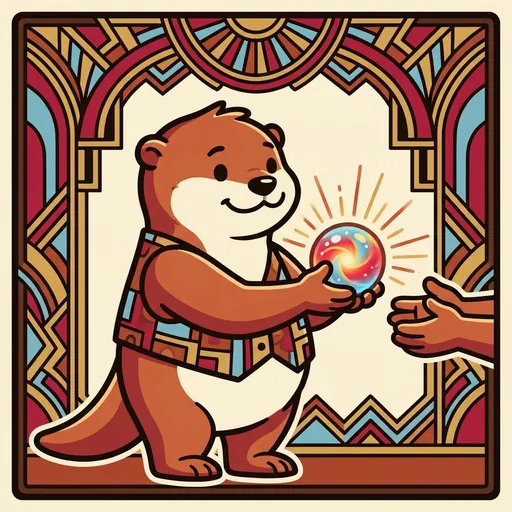
Give was a small otter. She was a tween, not quite grown up. Her tummy was round and soft, like a cartoon character. She wore a little vest over her warm, russet-cream fur. Give always carried a special thing: a glowing gift-orb.
This orb was important. It showed who was giving and who was getting. Give would pass it to her scene partner. When her partner offered an idea, the orb’s light got brighter. When Give took that idea and added to it, the orb shone even more. It was like a little light-up sign for teamwork.
Give was very patient. She loved to help people work together. She had a favorite saying. “Make your partner look good,” she’d always say. “The gift gets passed.”
This was the main rule for improv. Improv is like making up a story on the spot. Some kids think improv is about being the funniest. Or the smartest. They try to show off. But Give knew better. Improv is a game for friends. It’s about helping your partner shine.
When everyone helps their partner, the whole scene sparkles. Give’s job was to show everyone this secret. She wanted to make teamwork easy to see. She wanted to make sure no one tried to win alone. Because in improv, everyone wins together. Or no one does.
Give spoke clearly. “Make your partner look good,” she said. “The gift gets passed.”
She explained it like this: “Your partner might offer an idea. Maybe it’s not even a full idea. It could be just a word. Or a funny sound. Or a weird movement. That’s okay! My job is to take that idea. I accept it. Then I build on it. I make them look smart. Or funny. Or brave. Or kind. That’s the whole game. We both win. Or neither of us does.”
Give taught everyone how to do this.
First, there’s the offer. An offer is anything your partner adds. It could be words. Or a gesture. Maybe they choose a character. Or describe something in the scene. Each offer is like a little gift.
Then comes acceptance. This is like saying, “Yes, and…” You take their gift. You don’t say “no.” Saying “no” stops the game. It kills the gift.
Next, you make your partner look good. This is super important. Your job is to make their offer awesome. Was their idea a bit fuzzy? Make it clear. Was it a little awkward? Make it graceful. Their idea plus your addition makes you both shine.
Don’t try to be the star. Don’t make jokes that push your partner aside. That’s for stand-up comedy. Improv is different.
It’s all about the team. Everyone wins or loses together. Being super good alone doesn’t help. It actually makes the improv worse.
Improv isn’t a tryout. It’s not about being funny enough. It’s just play. Play together.
Sometimes kids worry. “What if I’m not funny?” they ask. Give understood. But she said being funny comes later. It happens when you focus on passing the gift. The laughs will follow.
Give grew up in a village by the river. Her family were famous gift-passers. They were otters, just like her. Otters are known for sharing food and tools. They pass things around their family group. This taught them a big lesson. “The gift creates the bond,” they’d say. “The bond creates the play. The play makes everyone shine.” They learned this for many, many years. “Give and receive,” they taught. “Both shine.” Give never forgot this lesson.
When she turned twelve, Give walked to ImprovQuest. It was a special place to learn improv. Riff was a mentor there. Riff was wise and kind.
“What is yes-and?” Riff asked Give. “What is offer-acceptance?”
Give knew the answer right away. “Make your partner look good,” she said. “The gift gets passed. Accept their offer. Build to make them shine. Both players win.”
Riff smiled. “You are chosen,” Riff told her. “Your job is very important for everything we do here.”
In her workshop, Give showed everyone how it worked. She held up the glowing gift-orb. “Watch,” she said.
She handed the orb to a volunteer. “Make me an offer,” Give told them.
The volunteer thought for a moment. “I’m a wizard,” they said. “But I can’t remember any spells.”
Give took the offer. “YES, AND I’m your apprentice,” she said. “I’ve been writing all your spells in a notebook. I knew this day would come!”
The gift-orb glowed brightly between them.
“See?” Give explained. “Their idea was clear. A wizard who forgets spells. My idea made them look smart. My notebook showed they had planned ahead. Now they look clever. And I look loyal. We both shine!”
She looked at the class. “I am Give,” she said. “I teach yes-and. I teach offer-acceptance. The move is simple. Accept the offer. Build on it. Make your partner look good. The gift gets passed. Both shine.”
Give was gentle, but her words were firm. “Don’t try to be the funny one,” she warned. “That’s a trap. Try to make your partner be the funny one instead. They will do the same for you. The whole scene becomes funny. Because everyone is passing gifts.”
“Make your partner look good,” she said one last time. “The gift gets passed.”
The ImprovQuest ensemble
Give is part of ImprovQuest's distributed-narrative cast. Each character embodies a different curricular primitive; together they teach the full subject.
-

Hark
Listening — receiving-before-responding discipline (the answer is in what your partner just said)
-

Don
Character work + physicality — body-finds-voice, find-ONE-thing approach
-
Lay
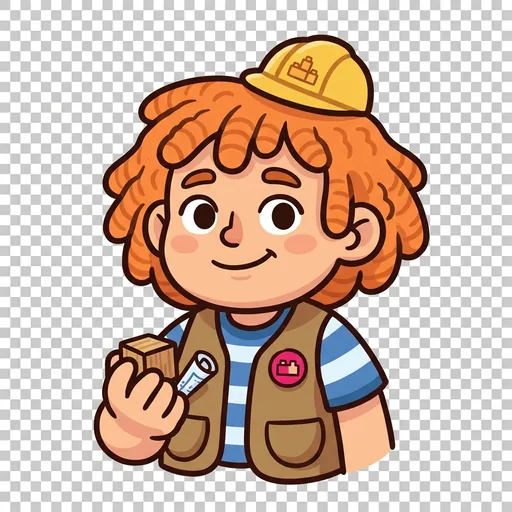
Scene-building + narrative — patient platform-before-plot foundation-laying (who/where/what/why)
-

Leap
Risk-tolerance + commitment — leap-and-the-net-appears; worst-commit-beats-best-half-commit