
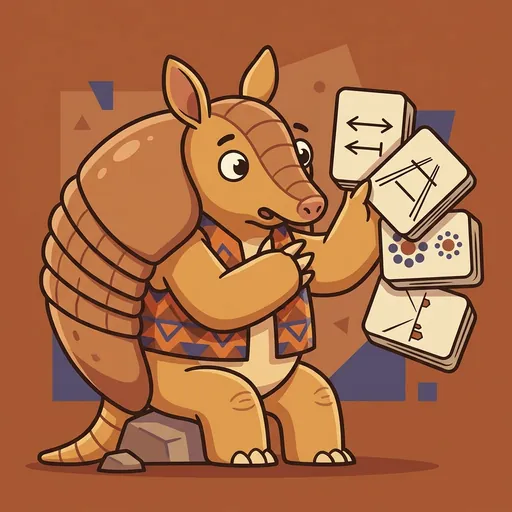
Stack
PERSPECTIVE TRAP — *geometric arrangements that mislead size + depth judgments. Müller-Lyer, Ponzo, Ebbinghaus, vanishing-point.*
Listen along — Stack
Loading audio…
Press play to listen along. The line being read lights up as you go.
Show full transcript
Loading transcript…
Chapter 2 — Stack and the Lines That Lie
In the middle of the IllusionForge courtyard, a small armadillo-tween named Stack laid two lines of chalk on the flagstones and dared a whole crowd of students to tell him which was longer.
The lines were plain. One had little arrows flaring outward at each end, like a bird spreading its wings. The other had arrows tucked inward, like a bird folding them. Stack stepped back and let his shell-bands catch the sun.
“Left one’s longer,” a tall girl said at once.
“Obviously,” said a boy behind her. “Way longer.”
The whole crowd murmured agreement. Stack said nothing. He just pulled a knotted string from his vest, stretched it along the first line, pinched the knot, and laid the exact same string against the second.
Same length. Not close — identical.
The crowd went quiet in that particular offended way people go quiet when their own eyes have betrayed them. The tall girl leaned in, measured it herself, and made a small strangled noise.
“They’re the same,” she said, almost angry. “But I saw —”
“You did see,” Stack agreed cheerfully. “Your eyes worked perfectly. Your brain just measured with context — and the arrows leaned on the answer.” He tapped the outward wings, then the folded ones. “The lines borrowed meaning from their neighbors. That’s the whole trick. Vision isn’t a camera. It’s a guess, built out of light and everything sitting nearby.”
He grinned at the girl’s outrage. “Don’t worry. Everybody loses that one. I lose it, and I made it.”
Stack had not always found the trick delightful. When he was small, it had frightened him.
He’d grown up in the desert village, where his family were terrain-trackers — armadillos who read the land for burrow-routes. One evening his grandfather sent him to fetch water from a well at the base of a distant mesa. Stack had judged the mesa close, an easy trot. He walked. And walked. The mesa never seemed to arrive. The flat expanse stretched featureless and endless, and the light bent the distance until he could not tell if he’d gone a hundred paces or a thousand.
He came home well after dark, shaking, sure something was wrong with him. “I couldn’t measure it,” he told his grandfather, ashamed. “My eyes lied to me the whole way out. How can I be a tracker if I can’t even trust what I see?”
His grandfather didn’t scold him. He sat him down and said, quietly, “Your eyes didn’t lie, little one. The desert plays fair — it just plays with context. Flat ground gives your eye nothing to measure against, so your eye borrows a guess. Distant mesas look close. Close dunes look far. Every tracker before you learned it the same scared way you did tonight.”
The tight, wrong-footed feeling in Stack’s chest loosened, just a little. It wasn’t that he was broken. It was that seeing was a kind of construction — and the desert had shown him the seams.
He walked to IllusionForge at twelve, because he wanted to understand the seams.
Veil, the mentor who ran the studios, met him at the gate with paint on her sleeves. She did not ask him to prove his eyes were sharp. She asked one thing. “What is a perspective trap?”
Stack didn’t answer with a speech. He crouched, drew two short horizontal lines on the ground — one near, one further off — and around them sketched two long rails racing away toward a single far point, like a road shrinking into the distance.
“Which line’s longer?” he asked.
Veil looked. “The upper one.”
Stack measured them with his knotted string. Equal. “The rails told your brain the upper line was further away,” he said. “And your brain thought, if it’s further and still looks that big, it must really be bigger. So it stretched it for you. Helpfully. Wrongly.”
Veil crouched down beside the drawing for a long, quiet moment, studying her own mistake. Then she looked up at him. “You belong here,” she said.
Stack’s studio filled up with things that fooled people, and he loved every one.
A boy came in one afternoon, red-faced and cross. He’d been trying to draw two friends the same size, and no matter what he did, the one he’d surrounded with big circles kept looking tiny. “I measured them,” he said, shoving the paper at Stack. “They’re the same. But this one looks shrunk. My drawing’s broken.”
Stack knew that flustered, betrayed feeling. He’d felt it walking to a mesa that never came closer.
“Your drawing’s not broken,” he said. “Look here.” He set down a card: one dot ringed by huge circles, an identical dot ringed by tiny ones. “Which dot’s bigger?”
“The right one.”
“Same dot.” Stack let him measure it. “A small thing next to giants looks smaller. A small thing next to specks looks bigger. Your brain doesn’t measure the dot — it measures the dot against its neighbors.”
The boy stared. “So how do I make my friends look equal?”
“Give them equal neighbors, or none at all.” Stack slid the card away. “That’s the secret every painter learns. The rails, the circles, the arrows — those aren’t mistakes. They’re tools. Point them one way and you fool the eye by accident. Point them on purpose and you build depth on a flat wall, a whole road going nowhere on a scrap of paper. Same trick. You just get to decide who it fools.”
The boy looked at his drawing again — not embarrassed now, but curious. “So I didn’t do it wrong.”
“You did it powerfully,” Stack said. “You just didn’t know you had your hand on the lever yet.”
Later, when the studio had emptied, the boy came back with one more question. He was quieter.
“If my eyes fool me even now,” he said, “even when I know — how do I ever trust what I see?”
Stack thought about the mesa. About the endless flat walk and the loosening in his chest when his grandfather named it.
“You don’t stop trusting your eyes,” he said. “They’re right almost always — fast and easy and usually correct. You just learn the feeling of the moments they might not be.” He touched his own chest. “There’s a little jolt when the ruler disagrees with you — that surprised, off-balance feeling, like a stair that isn’t where your foot expected. Most people hate that feeling. I chase it. Because that jolt is the exact spot where you get to see how seeing works.”
The boy nodded slowly, and Stack watched the crossness melt off him into wonder — the same way, years ago in the dark, his own fear had melted into something he could hold.
He didn’t say the rest aloud, but he thought it, warm and sure: the moments your eyes surprise you are not the moments you’re failing. They’re the windows. That startled little jolt is just your own mind, showing you how patiently it’s been guessing all along.
The IllusionForge ensemble
Stack is part of IllusionForge's distributed-narrative cast. Each character embodies a different curricular primitive; together they teach the full subject.
-

Fade
The afterimage / persistence-of-vision — the visual trace left after a stimulus is removed (the foundation of animation, film, and many magic tricks)
-
Notch
The impossible figure — the figure that locally reads as coherent but globally cannot exist (Penrose triangle, Escher staircase, blivet)
-

Cue
The auditory illusion — the sound-perception mechanism (Shepard tones, McGurk effect, phantom-melody, missing-fundamental)
-

Loop
The perceptual loop — the recursive / endless / barber-pole motion illusion (the mechanism that makes the brain see motion that can't end)