Underframe and Guise
HOMOLOGY VS CONVERGENCE — two creatures can share the same outward shape for two very different reasons; the bones beneath decide whether they are true kin (homology) or unrelated strangers who found the same answer (convergence).
Loading audio…
Press play to listen along. The line being read lights up as you go.
Show full transcript
Loading transcript…
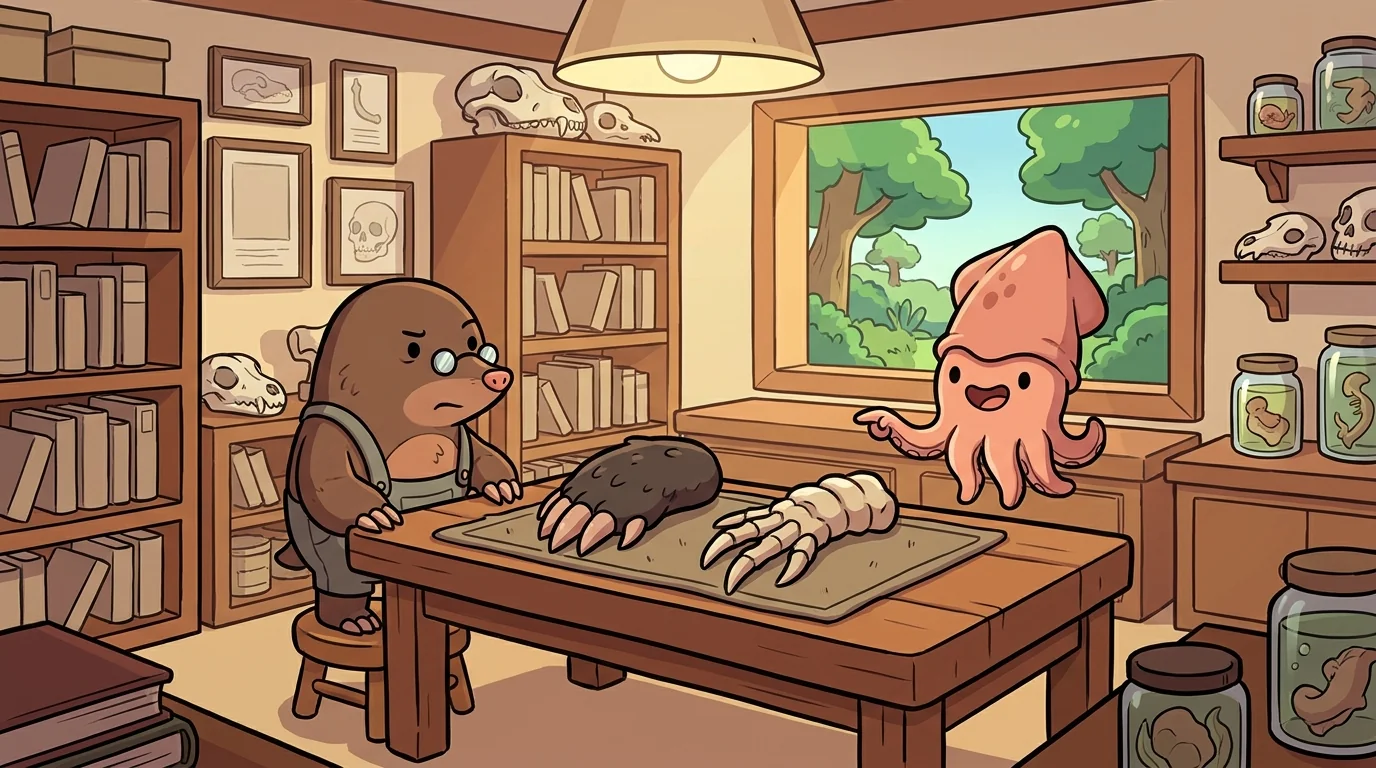
For most of a term, Underframe the mole and Guise the cuttlefish had disagreed, warmly, about the very same thing.
Guise loved the outsides of creatures — the shapes they wore, the way unrelated animals so often arrived at the same beautiful form. Underframe loved the insides — the frame of bones beneath the skin, the plan that revealed who was truly whose cousin. Guise said the surface told a wonderful story. Underframe said the surface could fool you. They were both right, which is the most annoying kind of disagreement, so the academy master finally set them at one bench and gave them one puzzle to teach together.
On the bench she laid two front limbs, side by side. Both were broad, flat, and clawed — unmistakably built for digging. Both looked almost exactly the same.
"Same shape," said Guise, pleased. "We'll see," said Underframe.
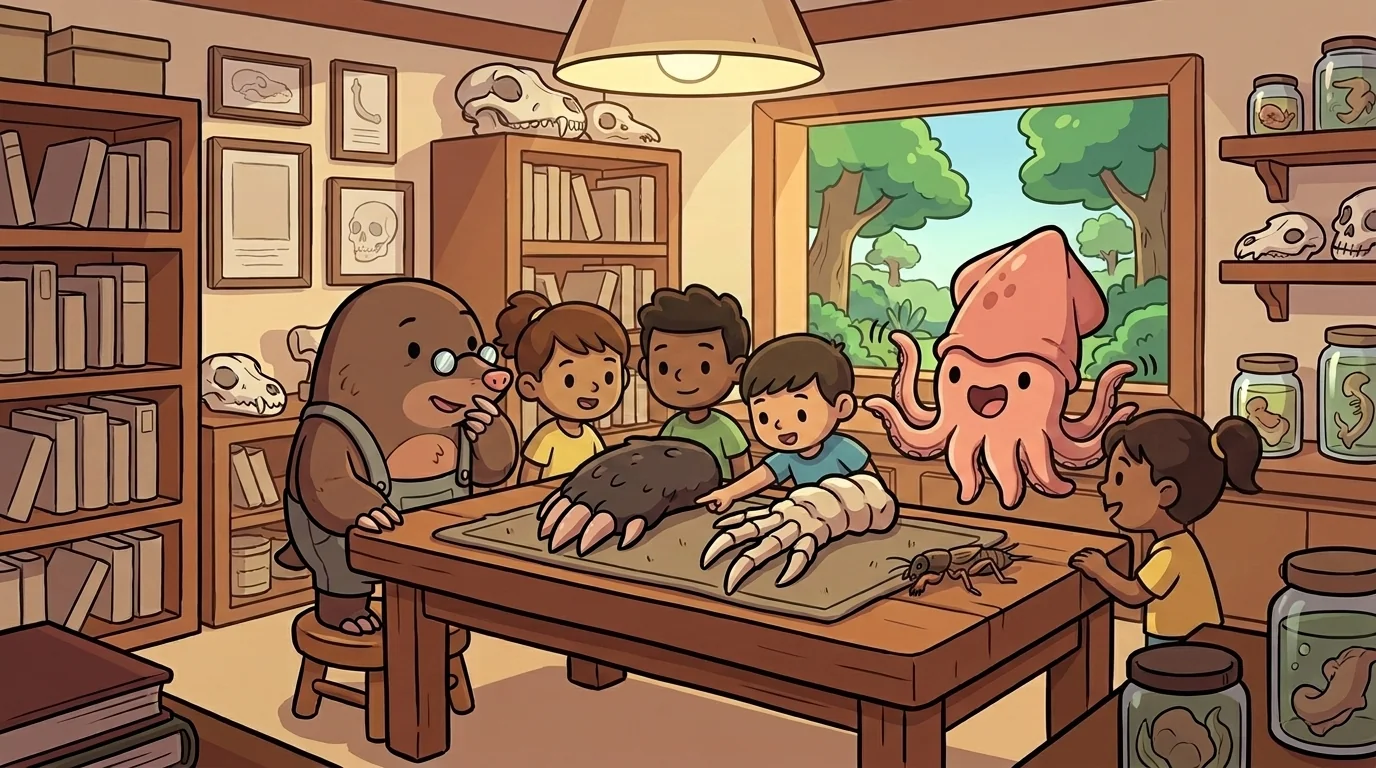
Guise went first, because Guise could never wait.
"Look at these two diggers," she said, rippling with interest. "One is a mole's front paw — my friend Underframe's own kind. The other is the digging leg of a mole-cricket, a little insect that tunnels through soil just like a mole does. Two creatures, worlds apart, both spending their whole lives underground. And look — the sea, the soil, the same hard life has shaped them into almost the same spade. Same guise. Same job. The ground asked them both the same question."
The children nodded. The two limbs really were near-identical.
"But here is where I hand the puzzle to Underframe," Guise said, "because the surface has told us everything it can — and it is not enough."
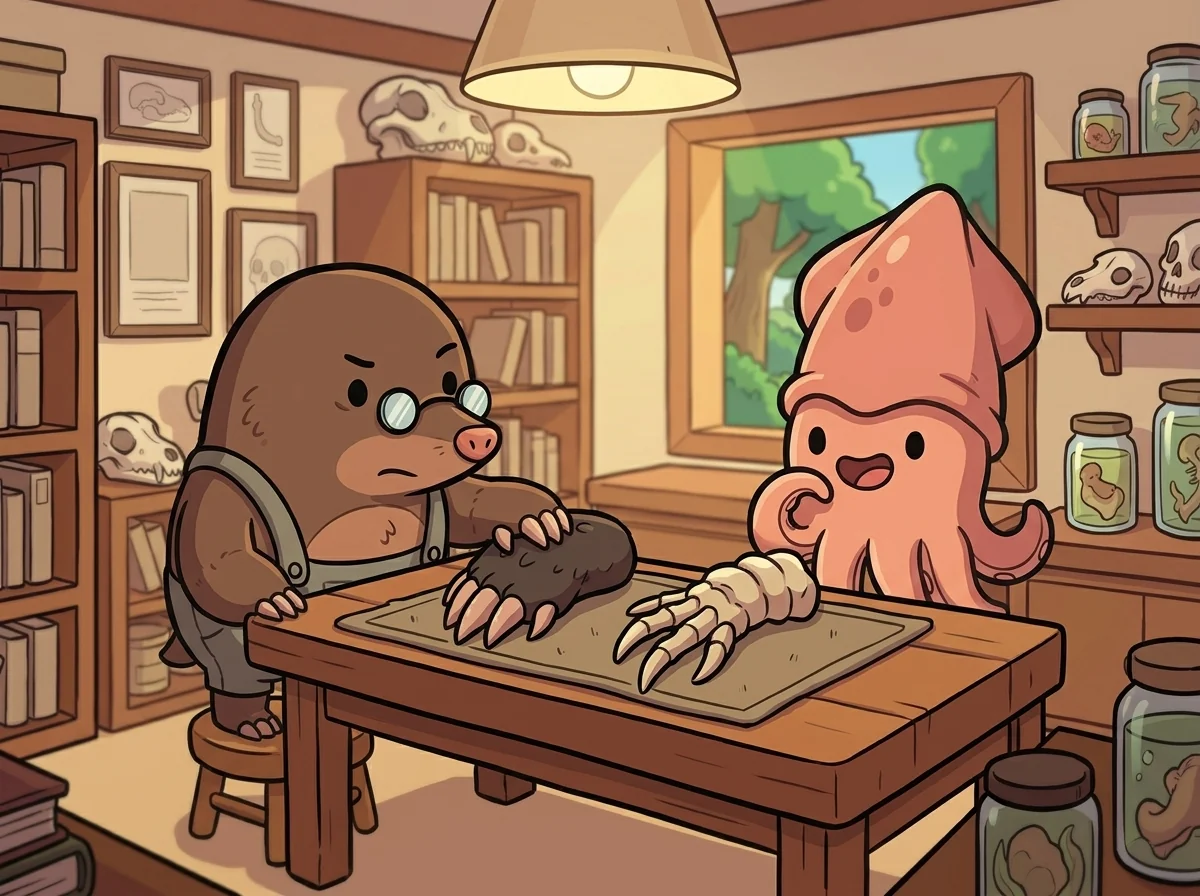
Underframe ran a small paw over each limb in turn, slowly, feeling.
"Now we look underneath," she said. "The mole's paw —" she pressed the first limb — "has bones. One bone at the shoulder, two below, a cluster of little wrist bones, then the finger-bones, thickened into a spade. It is the same frame a bat's wing has, and a whale's flipper, and your own arm. The mole is our kind of cousin, wearing a digging coat."
She pressed the second limb. "The mole-cricket's leg has no bones at all. It is an insect — built from a hard shell on the outside, and an entirely different plan within. No shoulder bone. No wrist. Nothing shared with the mole but the shape."
She looked up. "So these two diggers are not cousins. They are strangers. Two families, far, far apart, each shaped by the underground into the same spade — with nothing alike underneath."
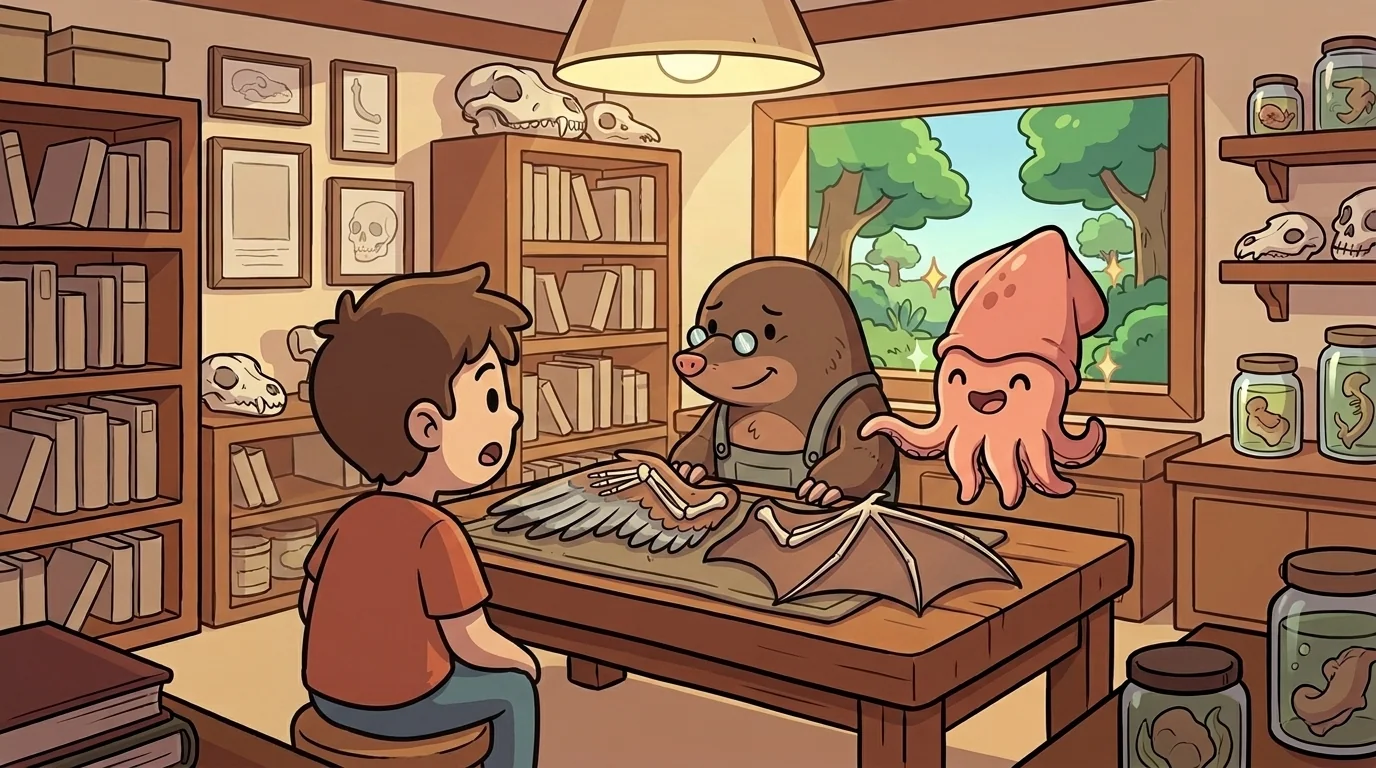
The academy master smiled, and slid two more look-alike limbs down the bench to a boy in the front row — a bird's wing and a bat's wing.
"Your turn," she said. "Same guise — both wings, both for flying. Homology, or convergence? Kin, or strangers? Don't guess from the shape. Read the frame."
The boy took a breath and did it the way he'd just watched. He looked past the feathers of the one and the leather of the other, down to the bones. "The bird's wing," he said slowly, "has a top bone, then two, then a wrist, then long finger-bones. And the bat's wing —" his eyes widened — "has the same. One, two, wrist, fingers. They both have the frame." He looked up. "So these two are cousins. Homology. Not strangers — family, wearing two kinds of wing."
"There it is," said Underframe, warm with pride.
"Same guise," said Guise, "opposite answer — and you found it not by looking at the shape, but by reading underneath." She shimmered, delighted. "The mole and the mole-cricket looked alike and were strangers. The bird and the bat looked different up close and were kin. The surface poses the riddle. The frame answers it. That is the whole of it — and you need us both."
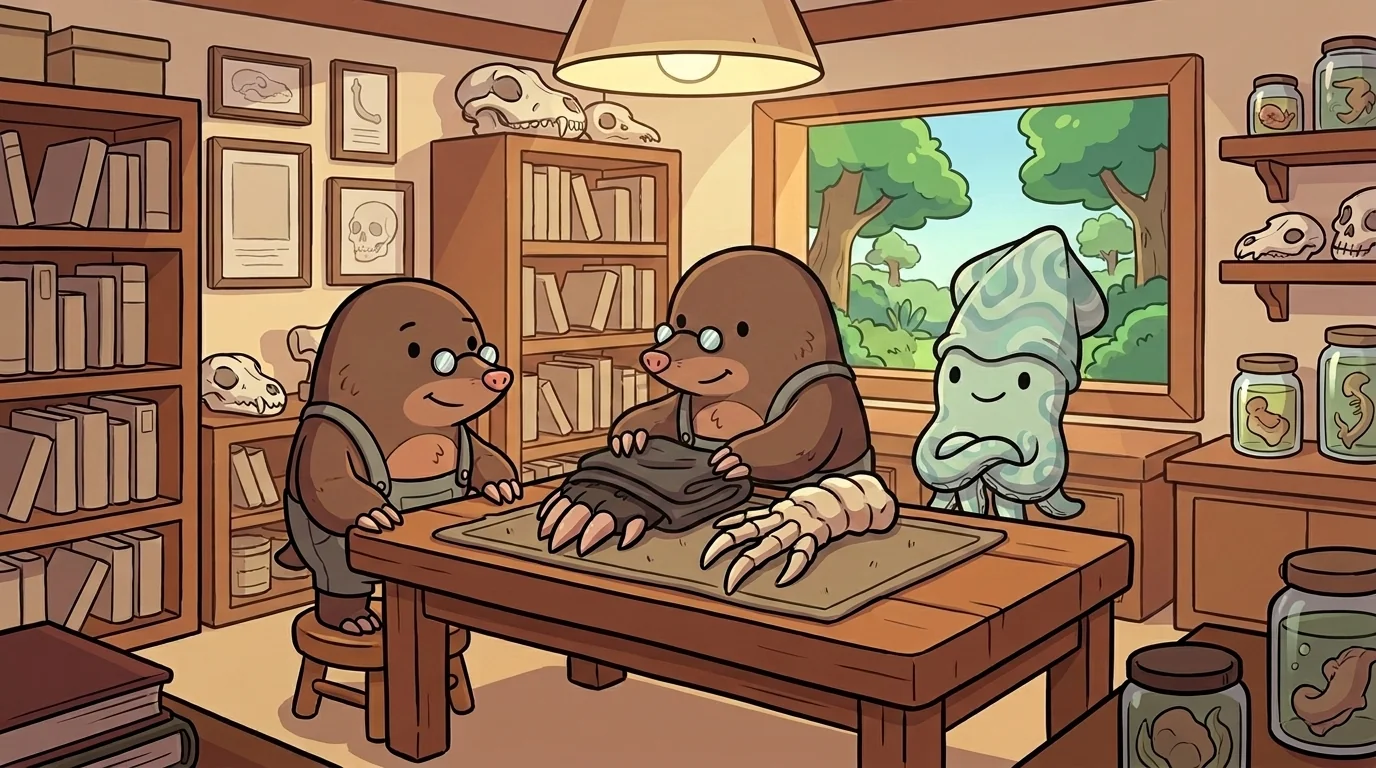
After that, Underframe and Guise taught the last kits of the term together, and the children stopped choosing sides between the surface and the bones. They learned to do both: to notice a shared shape and feel the wonder of it, and to read the frame underneath before deciding what it meant. Guise posed the puzzles. Underframe answered them. Neither could do the work alone.
The lesson the two of them hope the children carry is not only about creatures. It is that things can look the same for opposite reasons, and that you honour both by looking twice — once at the surface, with all its wonder, and once underneath, with all its honesty. A resemblance is a beginning, not an end.
When the courtyard empties, Underframe folds the little limbs back into their cloth and Guise lets her colours go quiet, and the two of them — one who reads the surface, one who reads the frame — feel the matched, easy gladness of a pair who spent a season sure they disagreed, and turned out to be the two halves of a single careful way of seeing.
The FossilForge ensemble
Underframe and Guise is part of FossilForge's distributed-narrative cast. Each character embodies a different curricular primitive; together they teach the full subject.
-
Seam
Taxonomic + fossil-type classification — family-resemblance-matching (what KIND of organism?)
-
Span
Deep-time + geological chronology — scale-of-scales (WHEN did this organism live?)
-

Branch
Morphological adaptation + evolutionary change — branching-not-laddering
-

Field
Paleoenvironment + ecosystem reconstruction — fossils-as-a-place-story
-

Last
Mass extinctions + extinction-event reasoning — witness-and-choose (cross-app cameo with EcoSphere Brink)
-
Blank
The incomplete record — the fossil record is a story with most of its pages missing
-

Guise
Convergent evolution — unrelated creatures arriving at the same outward form
-
Imprint
Trace fossils — fossils of behaviour not bodies: footprints, burrows, trails
-
Seep
Fossilization — how a living thing rarely becomes a fossil: quick burial, slow mineral swap
-
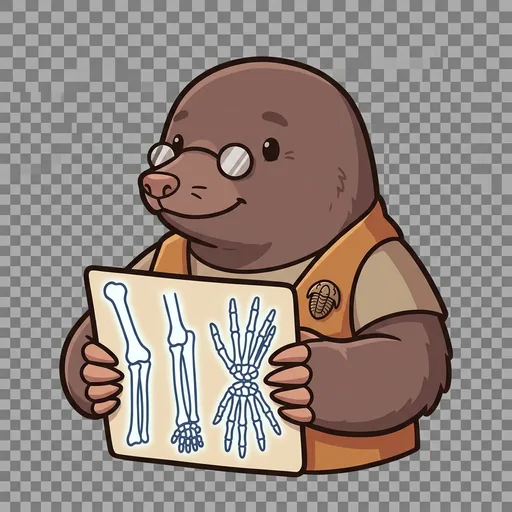
Underframe
Homology — the same underlying skeleton, in the same order, beneath different forms