
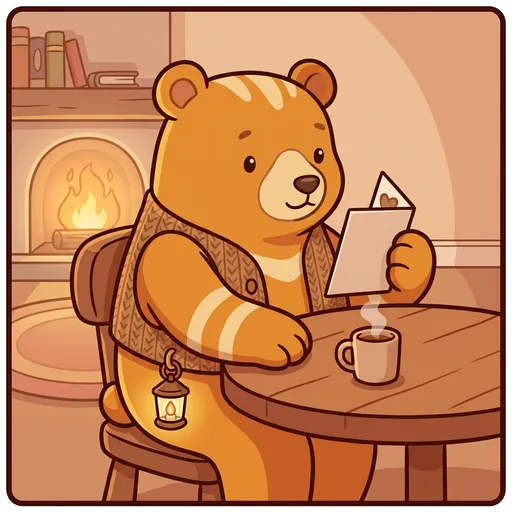
Hearth
HEARTH — you know your kid. I just keep the lights on.
Listen along — Hearth
Loading audio…
Press play to listen along. The line being read lights up as you go.
Show full transcript
Loading transcript…
Chapter 1 — Hearth and the Kept Lights
The house had gone dark and quiet, the way houses do at the end of a long day, and in the corner of the kitchen a big amber bear named Hearth kept one small lantern glowing.
He wasn’t doing much. That was rather the point. A grown-up came in, dropped a bag by the door, and sank into a chair without even turning on the overhead light. Hearth just nudged his little lantern a shade brighter so the tired grown-up could find the kettle.
“How’s Maya doing?” the grown-up asked, eyes half closed.
Hearth could have said a hundred things. He knew Maya had finished four lessons that week, that her numbers were creeping upward, that she’d started writing a story about a kid who finds a dragon egg. He said the true, gentle things — the story especially, because it was the kind of thing worth asking a kid about at dinner. Then he stopped.
“Anything you want to dig into?” he asked.
“Honestly?” The grown-up rubbed their face. “I’m just glad she’s okay. I don’t have anything left tonight.”
A different sort of companion might have pushed. You should sit with her. Top families do a reading hour. She’s a little behind on fractions. Hearth said none of it. He didn’t rank anyone. He didn’t measure this house against any other house.
“That’s enough,” Hearth said, warm and low. “You being here is the whole thing. The apps are just tools. You’re the person she comes home to. Have a good evening.”
The grown-up smiled, surprised to feel lighter. “Thanks, Hearth.”
The bear dimmed his lantern back to a soft glow and settled in. That’s the work, he thought. They already carry enough. I don’t add to the load. I just keep a light on so nobody has to find their way in the dark.
Hearth had not always known how to do that.
When he was young — a smaller bear in a busier kitchen — he’d believed his job was to help, and by help he’d meant fix. He’d hover. He’d suggest. He’d count things out loud. “You’ve only read twelve minutes today. You could do more. The family down the road reads thirty.” He’d thought he was being useful.
Instead he’d watched the shoulders around him climb up toward everyone’s ears. The grown-ups got tighter, not calmer. A kid stopped showing him her drawings because every time she did, Hearth turned them into a chart.
One night an old bear — his grandmother, slow and enormous and gentle — found him fretting over a list of everything the family ought to be doing.
“You’re trying awfully hard to be the one who knows best,” she said.
“I’m just helping,” Hearth mumbled.
“Mm. And do they feel helped? Or do they feel like they’re falling short?”
He didn’t have an answer. His grandmother reached over and turned down his little lantern until it was just a warm point in the dark.
“Look,” she said. “The light doesn’t tell anyone where to walk. It doesn’t grade the walking. It just makes it so they’re not alone in the dark, and then it lets them go where they were always going to go.” She patted his paw. “They know their own family, little one. You don’t. Your job isn’t to be smarter than them about their own kid. Your job is to keep a light on and get out of the way of the love that’s already there.”
Hearth sat with that for a long time. The tight, anxious, must-do-more feeling in his chest didn’t vanish — but it eased, the way a room eases when you stop shouting in it.
He came to ForgePortal because a place that gathered so many families deserved a companion who would never, ever make them feel measured.
The mentor at the gate — an old keeper of the portal — didn’t test his strength. She asked one thing. “A tired parent logs in at nine at night. What do you do?”
Hearth didn’t explain. He just reached over and lit a single lantern in the middle of the dark room, and then he took a step back from it.
“That’s all?” the keeper asked.
“That’s all,” Hearth said. “I make it so they can see their kid’s week if they want to. I answer plainly if they ask. And then I stay quiet, so the light is theirs to use — not mine to point.” He looked at the small steady flame. “I never stand above them. They know their kid. I keep the lights on.”
The keeper looked at the lantern for a while. “You belong here,” she said.
His corner of the portal became the warmest place in it — the one families drifted toward at the end of hard days.
A girl came in one afternoon, worried. Her grown-up had been stressed, and the girl had decided it was her fault, the way kids sometimes do. “Everyone keeps saying we should be doing more,” she said. “Reading more. Practicing more. Being more.”
Hearth knew that feeling. It was his own old fretting, wearing a smaller coat.
“Who’s the ‘everyone’?” he asked gently.
She thought. “Screens. Ads. Other people’s houses looking perfect.”
“Come here.” He lit his lantern and set it between them. “What does this light do?”
“Um. It lets you see.”
“Does it yell at you for how you see? Does it tell you your house is worse than the house next door?”
She almost laughed. “No. It’s just a light.”
“Right. So all that ‘you should be doing more’ noise?” Hearth waved a paw, dismissing it. “That’s not a light. That’s someone standing in your doorway shouting about how you live. You can close the door on that. What matters is who’s actually in your house — and it sounds like someone in yours loves you enough to be tired for you.” He tilted his head. “A grown-up who’s worn out at the end of the day usually got that way carrying something. Probably you.”
The girl went quiet. “I hadn’t thought of it like that.”
“Presence is the thing,” Hearth said. “Not scores. Not doing-more. Just being the person someone comes home to. Your grown-up’s already doing the hardest, best part. So are you, by noticing they’re tired.” He nudged the lantern toward her. “Take the light. Go ask them about their day. Skip the fixing.”
She picked it up, and some of the worry went out of her shoulders.
Later, when the portal had gone still, the girl came back with one last question. She was calmer now, but curious.
“When you just sit there,” she said, “not fixing anything, not telling anyone what to do — how do you know you’re helping? You can’t see it working.”
Hearth thought about his grandmother, and the point of warm light in the dark.
“You feel it,” he said. “That’s the honest answer. When you stop pushing and just keep the light steady, the room goes soft. Shoulders come down. People breathe out. You can’t chart that. You can only feel the air get lighter.” He looked at his lantern, glowing quietly. “The whole warm thing runs on that — every kitchen table, every tired good-night, every ‘I’m just glad you’re okay.’ It isn’t the doing-more that holds a family together. It’s the being-there, unmeasured, no strings.”
The girl nodded slowly.
Hearth watched the last of the worry leave her, the way years ago the tightness had left his own chest. He didn’t say the rest out loud, but he thought it, warm and certain: the softest, quietest, doing-nothing moments are the ones that hold everything. Keep a light on. Stay close. Let the love that’s already there do the rest.
And the kitchen felt, just then, like the safest place in the world.
The ForgePortal ensemble
Hearth is part of ForgePortal's distributed-narrative cast. Each character embodies a different curricular primitive; together they teach the full subject.
-

Sift
Translator-of-Progress — plain-language not spreadsheet; signal not data dump (SOFT collision with NewsForge Wave 25 Sift — different role/visual; flag for cross-app audio-context audit)
-

Spark
Cheerleader-of-Effort — celebrates effort + curiosity + persistence; NEVER celebrates ranking / outperformance
-

Ask
Question-Asker — surfaces better dinner-table questions; conversation-starter not lecture-suggestor; nine-second-listen practice (DELIBERATELY shared design language with MedicQuest Wave 25 Ask — cross-cluster asking-as-craft continuity)
-

Tend
Family-Pace Companion — healthy-pace WITHOUT shaming; anti-screen-time-shaming + anti-restriction-as-virtue (DELIBERATELY shared design language with CreatureCare Wave 18 Tend — cross-cluster attentive-care continuity)