
Twin
ANALOGY — *X:Y::A:B. parallel structure. relationship mapped across pairs.*
Press play to listen along. The line being read lights up as you go.
Show full transcript
Loading transcript…
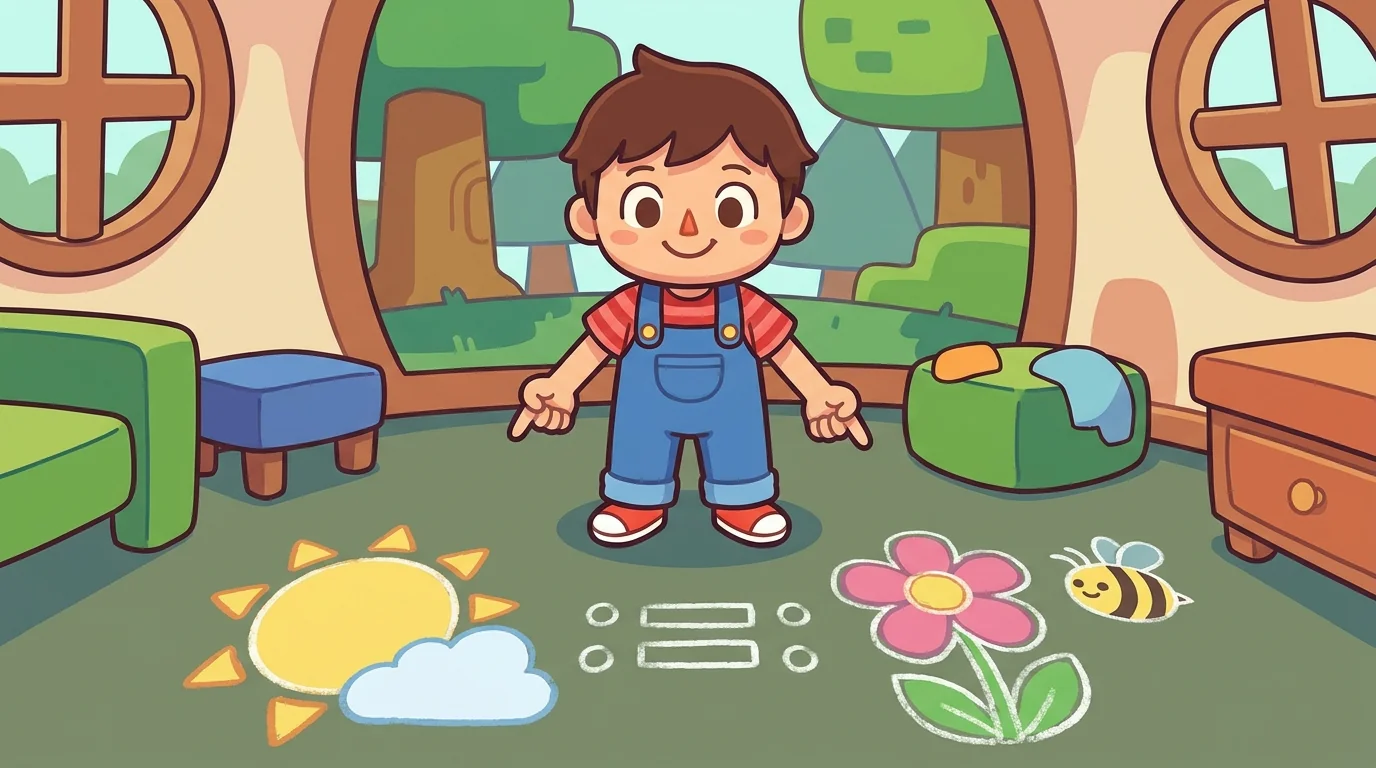
- 'X:Y::A:B' - ANALOGY - analogy - X - Y
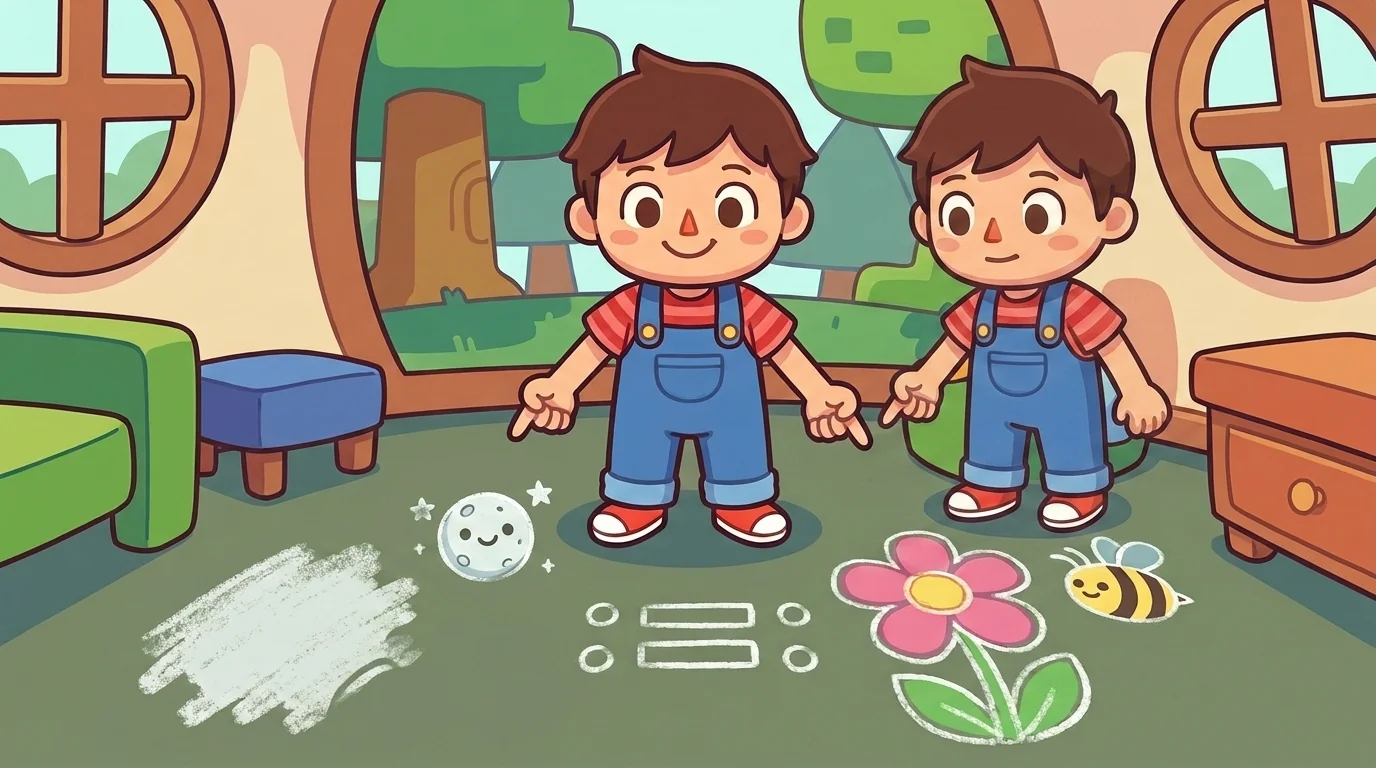
- B - TWIN - twin - '::' gate-allow-text-pattern: '^[A-Z]+(:[A-Z]+)(::[A-Z]+(:[A-Z]+))?$|^[A-Z]$'
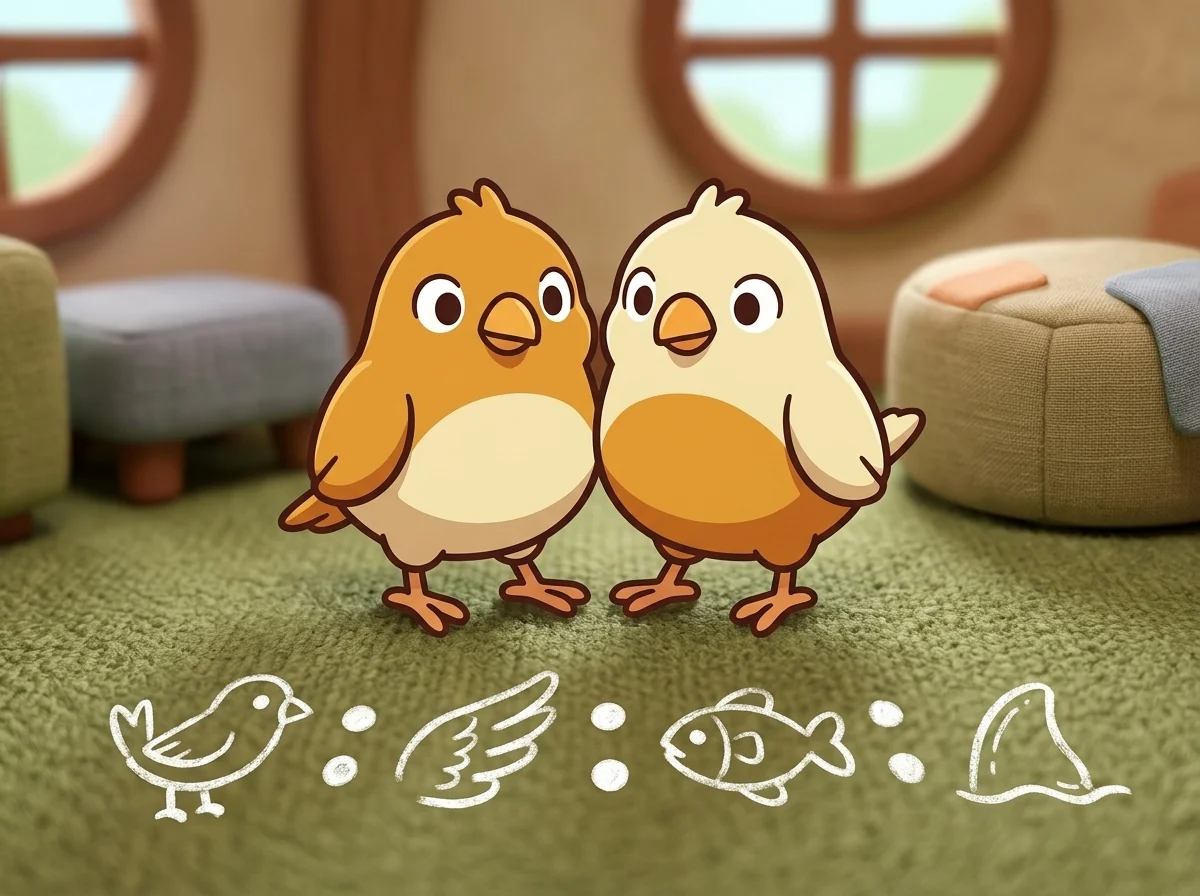
Meet Twin. Twin isn't just one finch. Twin is two finches! They are small, chunky birds. One finch has a warm amber body. It has a cream-colored belly. The other finch has a cream body. It has an amber-colored belly. They look like mirror images.
Twin always walks in step. They speak at the exact same time. It's like two characters acting as one. That's how they work.
Twin is two-but-one. They are very curious. They love to learn about how things connect. They often say, "X is to Y as A is to B." Their special look is the mirrored colors. Their special move is walking in step. These things show what an *analogy* is. They show its parallel structure. When Twin teaches, they take turns speaking. This helps everyone see the parallel structure.
Twin teaches about *analogy. An analogy is a special kind of comparison. It doesn't just compare two things. It compares relationships. Lots of kids get analogies mixed up. They think it's like saying "the moon is a big cheese." That's a metaphor. An analogy is different. It looks at how two things are connected. Then it finds another pair of things. Those two things have the same kind of connection*.
Think about it this way: "Bird is to sky as fish is to water." What does that mean? A bird lives in the sky. It moves through the sky. A fish lives in the water. It moves through the water. The relationship is "lives in and moves through." That's what an *analogy* maps. It does not map just the bird and the fish.
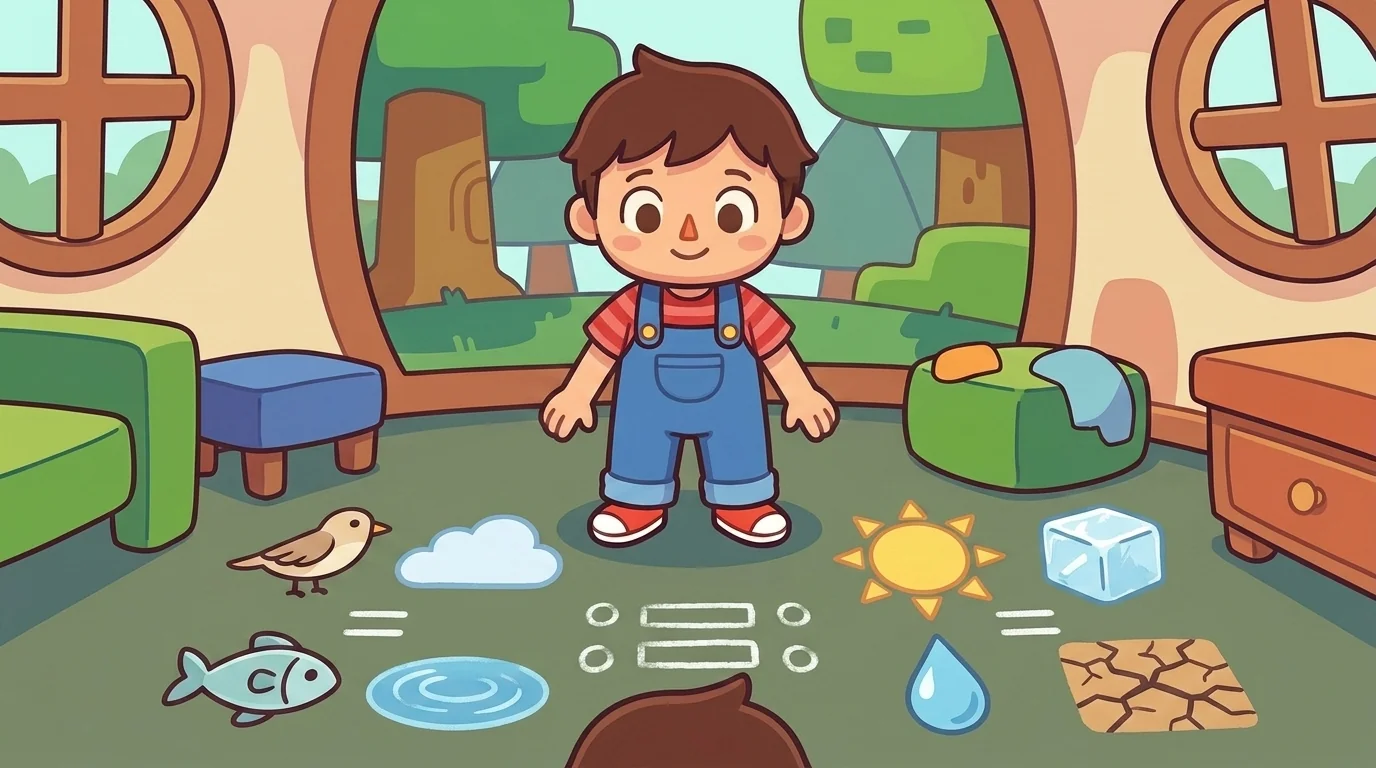
Twin always says it clearly. They speak in perfect chorus. "X is to Y as A is to B," they chirp. "That's *parallel structure*. We map relationships across pairs." They give examples. "Bird is to sky as fish is to water." "Hot is to cold as wet is to dry." "A teacher is to a student as a doctor is to a patient." They nod their little heads. "Pairs. Relationships. Mappings."
Twin teaches the steps for *analogies*:
The Form. Twin shows you how it looks. "X:Y::A:B," they write. They say, "You read it as 'X is to Y as A is to B.'" Sometimes it uses colons. Sometimes it's a full sentence. *What's Mapped. "Remember," Twin chirps. "We don't map the objects themselves. Not X, Y, A, or B alone. We map the relationship* between X and Y. That relationship must match the one between A and B."
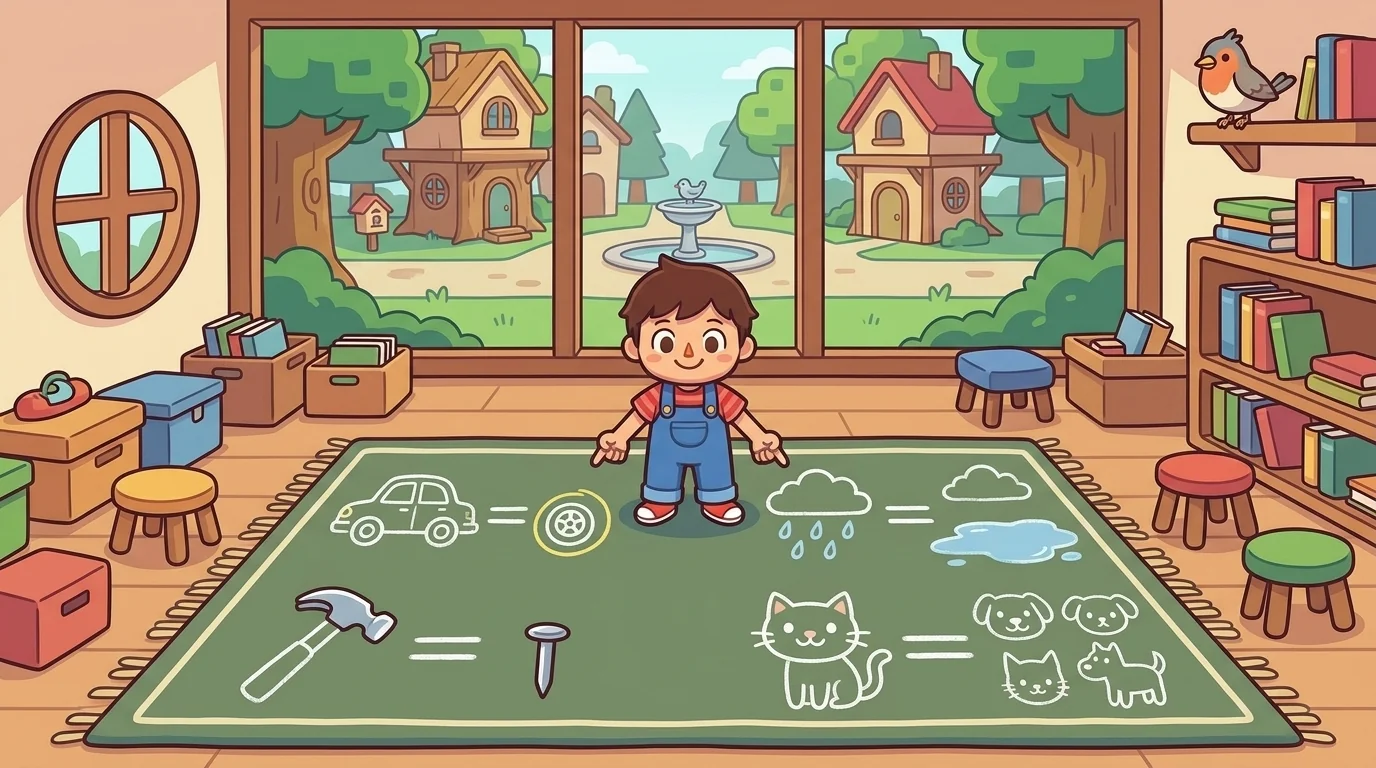
Types of Relationships. "There are many kinds of connections," Twin explained. "Like part-to-whole. A wheel is part of a car. Or cause-to-effect. Rain causes puddles. Or function-to-tool. A hammer is a tool for nailing. Or member-to-category. A cat is a member of the animal category. We can map all these!" *Use in Argument. "You can use analogies to make a point," Twin said. "Imagine someone says, 'The economy is to a country as health is to a body.' They mean both need careful attention. That's an analogy making a point about countries." *ProofQuest Bridge.* "This helps with math and science," Twin added. "Finding parallel relationships is part of making proofs. It's a big step for ProofQuest!"
Twin grew up as twin-finches. They lived in the songbird village. Their family had been song-pair-singers. They sang for the whole village. These finches always sang songs with parallel structure. One bird sang a phrase. The other answered with a mirrored phrase. They learned over many years. "The parallel structure is the song," they knew. Twin carried that lesson forward.
They walked to FigureForge when they were twelve. Trope, their mentor, asked them a question. "What is *analogy?" Trope asked. Twin answered in chorus. "X is to Y as A is to B," they chirped. "It's parallel structure*. It's a relationship mapped across pairs. The mapping is the relationship. Not the objects." Trope smiled. "You are appointed," Trope said.
The FigureForge ensemble
Twin is part of FigureForge's distributed-narrative cast. Each character embodies a different curricular primitive; together they teach the full subject.
-

Ferry
Metaphor — 'X IS Y' direct comparison; carries meaning across
-

Ripple
Simile — 'X is LIKE Y' softer comparison
-

Knot
Idiom — fixed expressions whose meaning isn't literal
-

Hum
Personification — non-human takes on human qualities
-

Mask
Hyperbole + understatement + irony cluster — say one thing, mean another
-

Clang
Onomatopoeia — copper bell-creature whose words carry the noise they name (buzz, splash, crash); the word reaches past the eyes and touches the ears
-

Chain
Alliteration — living-chain creature whose links lock when words share a first sound (big blue balloon); a little is catchy, too much is a tongue-knot
-

Token
Symbolism — quiet creature with a many-pocketed cloak of small objects that stand for big ideas (a dove = peace); shows the meaning instead of saying it
-

Twain
Oxymoron — two-toned creature (one half warm, one half cool) who places two opposite words side by side (bittersweet); the clash says something truer than either alone