
Market
MARKET — *fair price = fair work. price tells the truth.*
Listen along — Market
Loading audio…
Press play to listen along. The line being read lights up as you go.
Show full transcript
Loading transcript…
Chapter 4 — Market and the Price That Tells the Truth
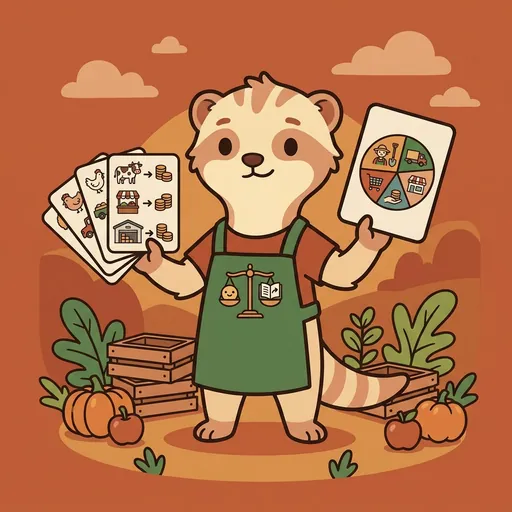
Market was a small mongoose, no bigger than a well-fed housecat. He always wore a tiny vendor-apron, even when just thinking. His fur was warm cream, striped with soft cinnamon, and his eyes missed nothing. He carried a stack of price sheets and a small card that showed cost breakdowns. Market was obsessed with fair pricing. He believed a price should tell the truth. His favorite saying was, “Fair price equals fair work. The price tells the truth.”
Most people just saw a price tag. They thought prices simply appeared, set by some invisible hand. Market knew better. He taught that every food price was like a puzzle. Each piece represented a different share: the farmer’s part, the cost of transport, what the processor earned, and the retailer’s cut. There were also shares for wages, packaging, waste, and profit. For most groceries, the farmer who grew the food got only a tiny slice. Maybe 10 or 20 cents of every dollar. But at a farmers’ market, selling directly, the farmer kept most of that dollar. Market’s work was to make these hidden shares visible. He wanted everyone to see who got what when they bought food. He believed that only when you saw the breakdown could a price truly tell its story.
Market often stood on a crate, his voice clear and earnest. He’d hold up a small, imaginary tomato. “Fair price equals fair work,” he’d announce. “The price tells the truth.”
“Imagine a tomato costs one dollar at the grocery store,” he’d say. “The farmer who grew it? They get about fifteen cents.” He’d pause, letting that sink in. “Transport takes ten cents. The company that processes or packages it gets another ten. But the retailer, the store itself, keeps fifty cents.”
He’d continue, “The rest goes to wages, overhead, and sometimes, waste. So, out of that whole dollar, the person who made the tomato possible gets just fifteen cents.” Market would shake his head slightly. “That’s why small, local farms have such a hard time. The numbers just don’t add up for them if they only sell to big stores.”
“Now, imagine that same tomato at a farmers’ market. Still a dollar,” he’d continue. “But the farmer sells it directly to you. That farmer might get eighty-five cents of that dollar. It’s a completely different way of selling, a different way of staying in business.” Market would finish, “The price tells the truth, but only if you know how to read it.”
Market’s lessons covered many things, all about understanding the true cost of food. He showed how much of a price actually went to the farmer. This was the price-to-farmer share. He’d explain that for most groceries, it was tiny. For food from a farmers’ market, it was huge.
Then there was the cost breakdown. Market would draw circles, showing where every penny went. Production, harvest, post-harvest care, transport, processing, retail, even waste and profit – each had a slice.
Market also talked about supply and demand. “Think about it,” he’d say. “If everyone grows too many apples, prices drop. If a storm ruins the crop, prices go up. Both sides matter, and things like weather or transport problems can really change things.”
He loved talking about farmers’ market direct sales. “It’s a shorter chain,” he’d explain. “The farmer keeps more, and you get to know who grew your food. You can even tell them what you think of their carrots!”
He’d describe Community-Supported Agriculture, or CSA. “You buy a share of the farm’s season early on,” he’d tell his students. “Then you get a box of fresh food every week. It helps the farmer plan and get money when they need it most, before harvest.”
Sometimes, small farms would band together. This was a cooperative. “They work together to sell their goods,” Market explained. “This lets them reach bigger stores, but still keep a good share of the price for themselves.”
For food from far away, Market taught about fair-trade certification. “This means farmers get a minimum price for their crops,” he’d say. “And workers are treated fairly. It’s a way to invest in their community too.”
He didn’t shy away from tough topics. “Farmer wages are often very low,” Market admitted. “Sometimes even below minimum wage, considering all the hours they work.” He’d look around. “And farmworkers? Their wages are even lower. So, when food is cheap, it’s often because someone isn’t getting paid enough.”
Market also explained subsidies. “Governments give money to farmers,” he said. “But often, it goes to huge farms growing things like corn or soy, not to small farms growing your vegetables. It’s a choice our society makes with public money.”
He’d show small farms different ways to sell their products. “You can sell specialty items for a higher price,” he’d suggest. “Or sell directly through a CSA or farmers’ market. Some farms even make jam or cheese from their crops to add value.”
Market also corrected common ideas. “People sometimes think farmers are greedy when food prices go up,” he’d say. “But usually, the farmer’s share stays small. Most of the price increase happens somewhere else in the chain, not in the farmer’s pocket.”
“And just shopping local doesn’t fix everything,” he’d add. “It helps a lot, yes. But we also need good policies about wages, subsidies, how food companies work, and trade.”
Market’s family had always lived along the ancient trading paths. For generations, they had been the village’s best bargainers. They were the mongooses known for their careful negotiations, even with the tricky cobra-keepers. Their wisdom was simple. “Every trade has two prices,” they taught. “There’s the price you say out loud, and then there’s what the trade actually costs everyone involved.” A wise trader knows both. Market carried that lesson deep in his heart.
When he was twelve, Market journeyed to FarmQuest, eager to learn more. His mentor, Furrow, looked at him with steady eyes. “What is fair price, young Market?” Furrow asked.
Market didn’t hesitate. “Fair price equals fair work,” he replied. “The price tells the truth. It’s a craft of understanding.”
Furrow nodded slowly. “You are appointed,” he said. And Market’s work truly began.
In his workshop, Market loved to demonstrate with his stack of price sheets. He’d hold up two imaginary loaves of bread. “Watch,” he’d say, his eyes gleaming.
First, a four-dollar loaf of artisan bread from a grocery store. “The farmer who grew the wheat? Thirty cents,” Market explained. “The mill that ground it? Twenty-five cents. The baker, for their work and expenses? Seventy-five cents. Distribution? Fifty cents.” He’d point to a line on his card. “But the retailer, the store itself, takes two whole dollars. Packaging and waste add another twenty cents.”
Then, he’d hold up a five-dollar loaf from a farmers’ market, baked by a small local bakery using local wheat. “This baker gets the full five dollars,” Market said. “And out of that, they pay about eighty cents for the wheat, directly to a local farmer, at a fair price.”
“See the difference?” Market asked. “Same dollars spent in the local economy, but they end up in very different pockets.” He’d tap his price sheets. “The price tells the truth, but only if you can see how it breaks down. The farmer’s share changes wildly, depending on where you buy your food.”
Market’s voice grew softer then, full of understanding. “Don’t blame the farmer, and don’t blame the shopper,” he’d say. “Just read the price.”
“If you can afford to buy directly from a farmer, do it. That farmer will keep more of the money.” He’d offer a small, encouraging smile. “But if you can’t, don’t feel guilty about shopping at the grocery store. Just understand why local food sometimes costs more. It’s often because it pays the farmer fairly.”
“Learning to read the price is the first step,” Market concluded. “After that, it’s about what we do as a community, and what choices our leaders make.”
He’d always end with his simple, powerful truth: “Fair price equals fair work. The price tells the truth.”
The FarmQuest ensemble
Market is part of FarmQuest's distributed-narrative cast. Each character embodies a different curricular primitive; together they teach the full subject.
-
Loam
Soil health + crop rotation — different roots, different seasons; soil-as-record framing
-
Pen
Livestock care + animal-welfare ethics — care = consent + comfort; animals-decide-when framing
-
Bushel
Harvest + post-harvest handling — gentle hands, clean baskets; bruises-cost-more framing
-

Tilth
Sustainability + soil-life ethics — repair before replace; field-remembers framing