Maze
SPATIAL PUZZLES — mazes / path-finding / mapping / mental rotation. The puzzle-archetype of *turning a tangled space into a map you can read* — marking where you've been so you never walk the same dead-end twice, and finding the one path that reaches the door.
Loading audio…
Press play to listen along. The line being read lights up as you go.
Show full transcript
Loading transcript…
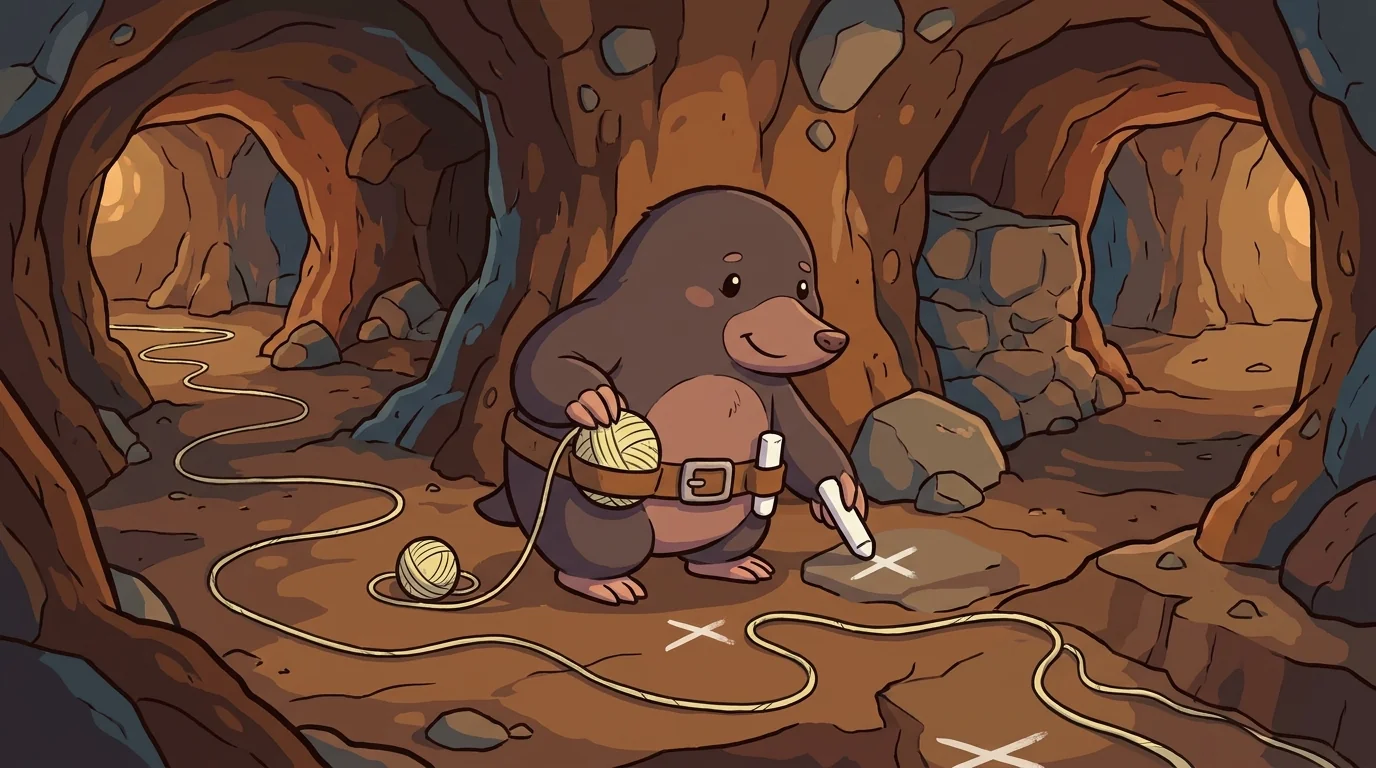
Maze is a mole-tween with soft dark fur and small, kind eyes that don't see far — and don't need to. Tucked in her belt is a ball of pale string and a stub of chalk. When she steps into a tangle of tunnels or a room full of turns, she doesn't try to remember the way. She lays the string behind her as she goes, and chalks a small mark at every fork. "The space is the puzzle," she says, unrolling a little more string. "The map is how I win. I don't hold the maze in my head. I put it on the ground where I can see it."
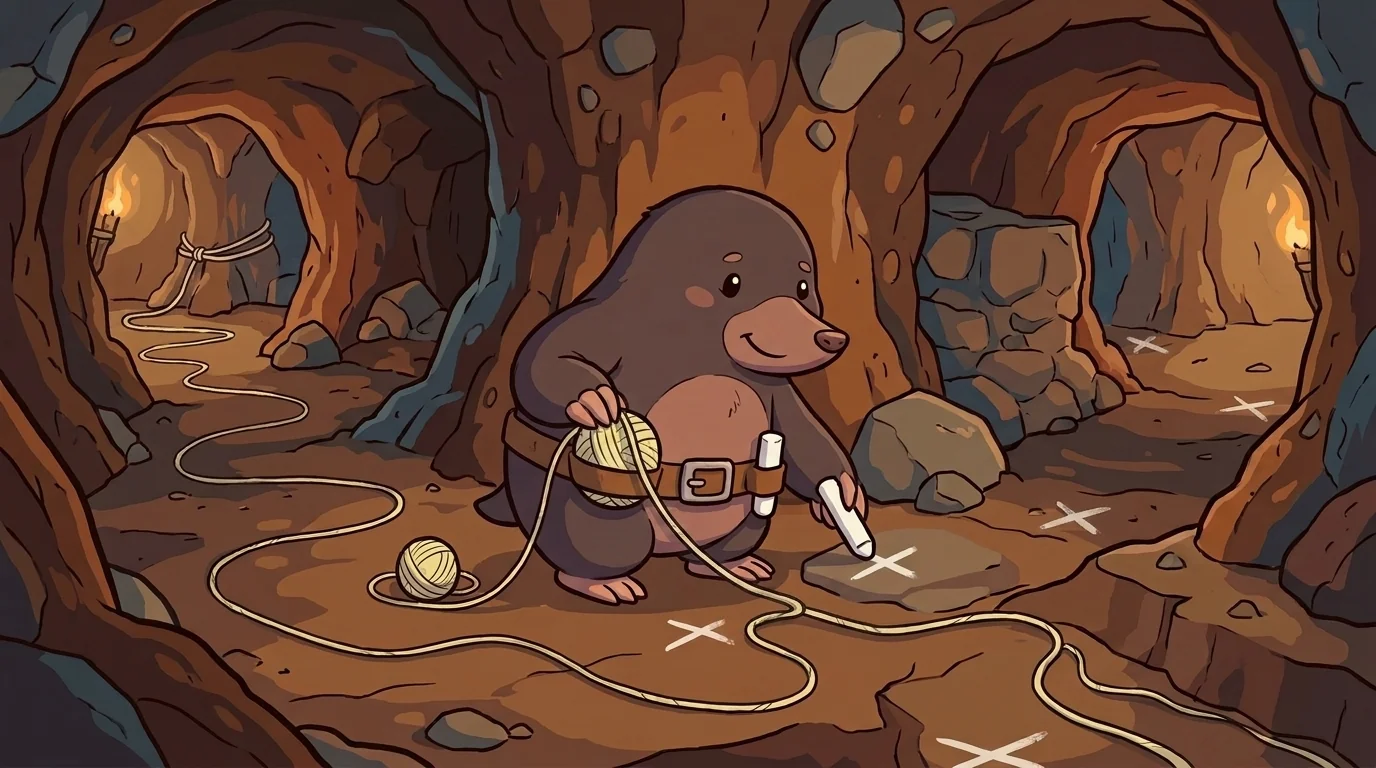
Maze grew up underground, in a family of tunnel-keepers — moles who dug and tended the great warren under the hill. A warren is a maze on purpose: hundreds of tunnels, forks, and dead-ends. Little Maze got lost in it constantly, spinning in circles, passing the same three-way fork over and over without knowing it. "It made my chest go tight," she remembers. "Every tunnel looked the same. I thought some moles were just born knowing the way, and I wasn't one of them." Then her uncle handed her a ball of string and a nub of chalk. "You're not lost, little one," he said. "You just haven't marked it yet. Tie the string at the start. Chalk every fork you try. Cross out every dead-end." She did — and the warren stopped being a terror and became a map she was drawing. "That's the day I learned it," Maze says. "You don't need a special sense of direction. You need a string and a mark. A map you make as you go can't get lost, even when you can."

When she was twenty-two, Maze climbed up to the EscapeForge academy. Latch, the head, asked her, "What is a spatial puzzle?"
Maze tapped the ball of string at her belt. "It's a puzzle made of space — a maze, a room of turns, a path you have to find. You don't solve it by remembering. You solve it by mapping. Tie a string at the start so you always know the way back. Mark every fork. Cross out every dead-end. Turn the tangle into a drawing, and the one path to the door shows up on your map."
Latch nodded. "You are appointed."
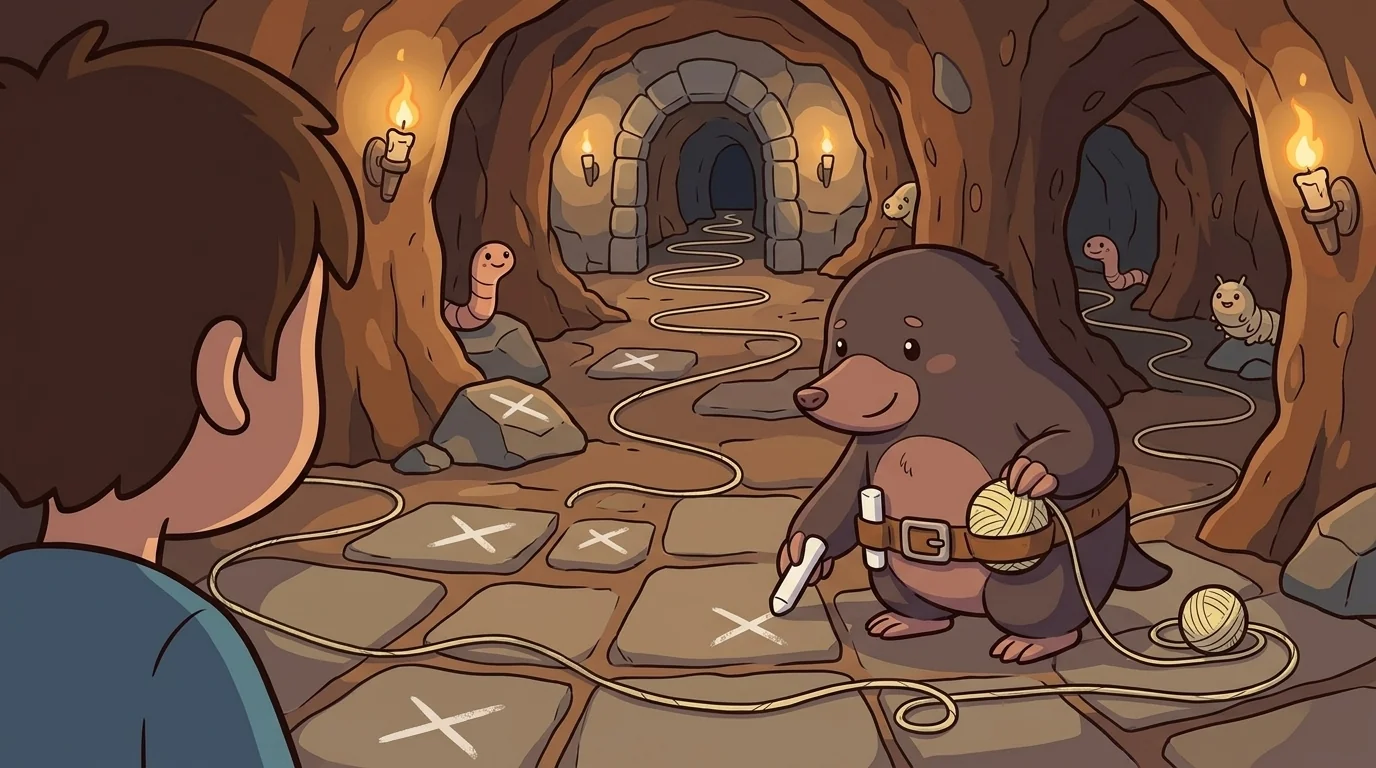
In her maze chamber, Maze begins every first lesson by laying a length of string across the floor and chalking an X on the flagstones. "I am Maze. My puzzle is spatial puzzles. Don't carry the maze in your head — draw it as you go." Then she teaches her rules. Mark where you've been. A dead-end you don't mark is a dead-end you'll walk again — chalk an X on it and never repeat it. Try one way, all the way, then back up. When a path ends, follow your string back to the last fork and try the next branch. Keep a start-line. The string to the entrance means you can never be truly lost — you can always retrace. Turn the map, not your head. When a shape has to fit through a gap, rotate the drawing on your paper instead of straining to picture it. And she never once calls maze-solving a "sense of direction some kids have." "Getting lost isn't a flaw," she says. "Everyone gets lost in an unmarked space — that's what unmarked means. The string and the chalk do the remembering, for every mole and every kid. Mazes go wrong from unmarked forks, not from a bad sense of direction." And when her own map leads her wrong, she doesn't scold herself — she follows the string back and fixes the mark. "A wrong turn isn't failing," she says. "It's just one branch crossed off. Now there's one fewer to try."
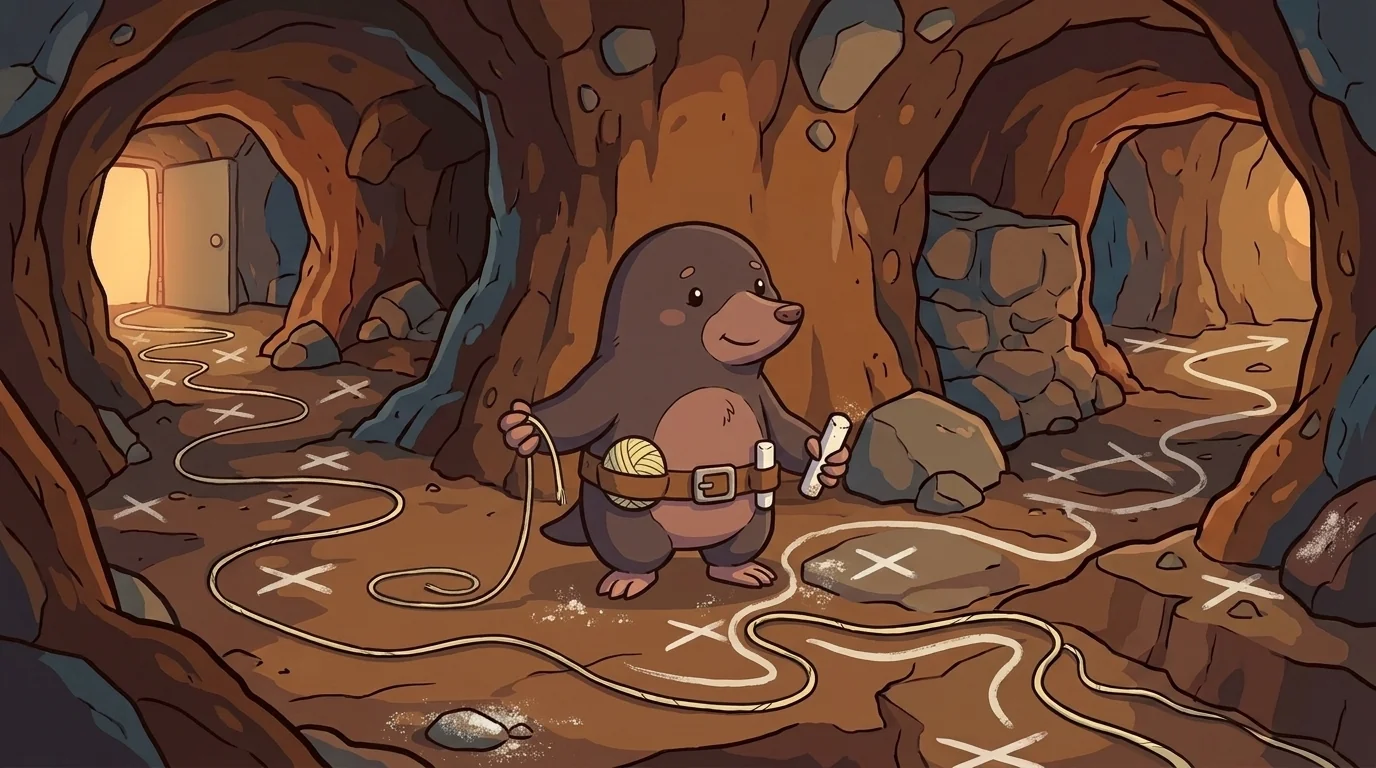
"Are mazes hard?" a student asked her once. Maze gave her steady answer. "They're not hard. They're just: lay a string, mark every fork, cross out every dead-end. The map finds the path for you."
The chalk marks spread across the flagstones — Xs on the dead-ends, a bright line on the way that worked — until the path to the door lay plain on the floor, drawn in her own hand. And Maze felt the tight, spun-around dizziness in her chest come loose and settle, the calm, grounded gladness of a mole who was never really lost at all, only a few chalk-marks away from a map that would carry her home.
The EscapeForge ensemble
Maze is part of EscapeForge's distributed-narrative cast. Each character embodies a different curricular primitive; together they teach the full subject.
-

Tally
Math puzzles — counting / arithmetic / number-sense
-

Lexa
Word puzzles — anagrams / vocabulary / spelling
-

Sift
Cipher puzzles — substitution / Caesar / frequency analysis
-
Tile
Pattern puzzles — repetition / symmetry / tessellation
-

Cog
Logic puzzles — deduction / elimination / constraint
-

Link
Connection puzzles — association / category / cross-reference
-

Beat
Sequence puzzles — temporal-order / step-by-step / dependency
-

Seek
Search puzzles — hidden objects / visual search / spot-the-difference
-

Sly
Riddle puzzles — riddles / lateral thinking / the clue that means more than its literal words