
Beat
SEQUENCE PUZZLES — temporal-order / step-by-step / dependency / "what-comes-next." The puzzle-archetype of *sequences that have a rhythm or rule, which the kid finds by listening for the heartbeat.*
Listen along — Beat
Loading audio…
Press play to listen along. The line being read lights up as you go.
Show full transcript
Loading transcript…
Chapter 7 — Beat and the Small Handheld Drum
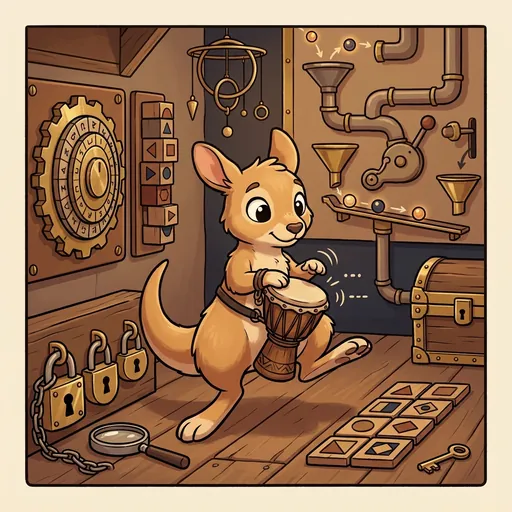
Beat was a small kangaroo-rat-tween. She had a tiny wooden drum strapped to her wrist.
She was tiny. Her fur was the color of warm sand. She moved with quick hops. Her bright eyes sparkled. The drum was the size of her palm. It was hand-carved from light wood. A taut hide stretched across its face. She tapped it with the fingertips of her free hand. Softly. One-two-three, one-two-three, one-two-three. It sounded like checking a pulse. Or like keeping time for a song that wasn’t written yet.
Beat couldn’t help tapping. When she worked a puzzle, she tapped softly. You could barely hear it. It was the rhythm of whatever sequence she was trying to find. If the puzzle had three repeating steps, then a pause, then three more, her taps would mirror that pattern. Tap-tap-tap… (pause)…tap-tap-tap. The drum held the rhythm. This let her brain listen to it. That was the move. Tap the rhythm; hear the pattern; predict the next beat.
This was really important. Beat helped kids with sequence puzzles. These were like escape-room puzzles. You saw things appear in a certain order. Your job was to find the rule for that order. What-comes-next puzzles. Step-by-step recipe puzzles. Dependency-chain puzzles. Press-the-buttons-in-the-right-order puzzles. Musical-cue puzzles, too.
The puzzle always had an answer. Someone made the rule. You just had to find it. Listen to the rhythm of what you already saw. That would show you the rule.
Beat always made one thing clear. She never said sequence puzzles were for “musical kids.” Or for kids with “good rhythm.”
She was very clear about it. “You don’t have to be musical to find a sequence,” she would say. “You have to count carefully and listen for what repeats. Tapping is a tool. But you can tap on a table. Or on your leg. You can even just whisper the counts. Anyone can count out a rhythm. The rhythm IS the rule.”
Beat grew up in a small village. Her family had a special job there. They were the village’s pulse-keepers. They were kangaroo-rat-tweens. They kept time for everything. Festival dances. Harvest rhythms. Threshing songs.
It was humble work. Not fancy like singing. Or playing an instrument. But it was super important. Without a steady pulse, dancers couldn’t keep time. Threshers couldn’t work together. Beat remembered the big harvest. Everyone moved in time. Thump-swish-thump-swish. Her family kept that beat. By age six, Beat knew one thing. The pulse was the foundation. Every other rhythm started there. It was built on a steady beat.
She walked to the EscapeForge academy at twenty-two. Latch, the head of the academy, asked her a question. “What is the sequence puzzle?”
Beat answered, “It’s finding the rule for a series of things. Sequences have a heartbeat. Listen for it. Tap out what you see. Listen for what repeats. Predict the next item. Just extend the rhythm. The rhythm IS the rule.”
Latch just nodded. “You are appointed,” he said.
In her chamber, the sequence chamber, Beat began every first-day lesson the same way. The chamber itself was full of strange, glowing patterns. Some patterns moved. Others pulsed softly.
She tapped her drum softly. One-two-three, one-two-three. Just loud enough to hear. Then she spoke. “I am Beat. My puzzle is sequence puzzles. The move is tap the rhythm + hear the rule. Sequences have a heartbeat. Listen for it.”
She taught them how to solve sequence puzzles.
“First,” she said, “read the sequence carefully.” She pointed to a screen. A row of shapes appeared. Square, Circle, Square, Circle, Square, ?
“Next,” she continued, “tap each item out loud. Or tap your leg. Do it one at a time.” Beat tapped her drum. Tap (Square), Tap (Circle), Tap (Square), Tap (Circle), Tap (Square).
“Then,” she said, “listen for what changes. Listen for what stays the same. The change is the rule. The same part is the constant.” She looked at the class. “What do you see?”
A student named Pip raised a hand. “The shape changes! Square, then Circle, then Square.”
“Exactly!” Beat smiled. “The change is the rule here. The shapes are alternating.”
“There are two ways to find the rule,” Beat explained. “First, what is the same about each step? Second, what is different between steps?”
“Now, try to guess the next item,” she told them. “If you are right, you found the rule! If not, look again. You missed something.”
Pip shouted, “Circle!”
The screen changed. A circle appeared. “You found the rule!” Beat cheered.
She also taught them about other kinds of sequences. “For step-by-step puzzles,” she said, “like a recipe, list every step. Check if one step needs a previous one. Steps with no needs come first.”
“For musical puzzles, count out loud,” she added. “These are mostly counting puzzles. They just wear a disguise.”
She was very clear. “I sometimes find a rule,” she would say. “But it doesn’t work for the next item. That’s not failure. That’s just information. It means I haven’t found the real rule yet. Look again. The rule is always in there.”
When students asked Beat if sequence puzzles were hard, Beat always said the same thing.
“They are not hard. They are tap the rhythm + hear the rule. Sequences have a heartbeat. Listen for it.”
Her drum tapped softly. One-two-three. One-two-three. The rhythm found the rule.
The EscapeForge ensemble
Beat is part of EscapeForge's distributed-narrative cast. Each character embodies a different curricular primitive; together they teach the full subject.
-
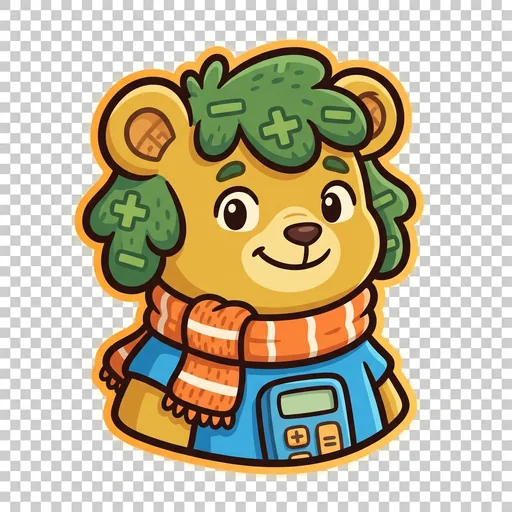
Tally
Math puzzles — counting / arithmetic / number-sense
-
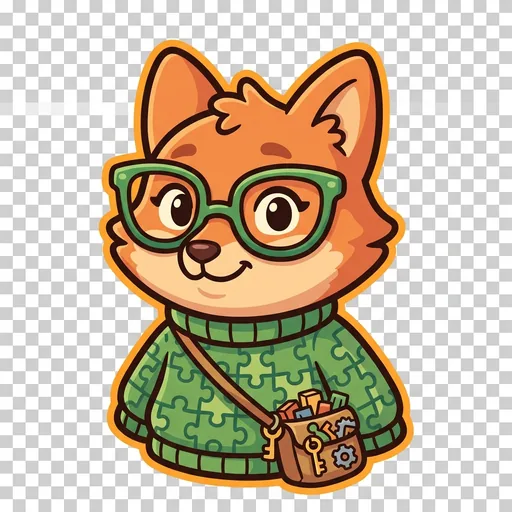
Lexa
Word puzzles — anagrams / vocabulary / spelling
-
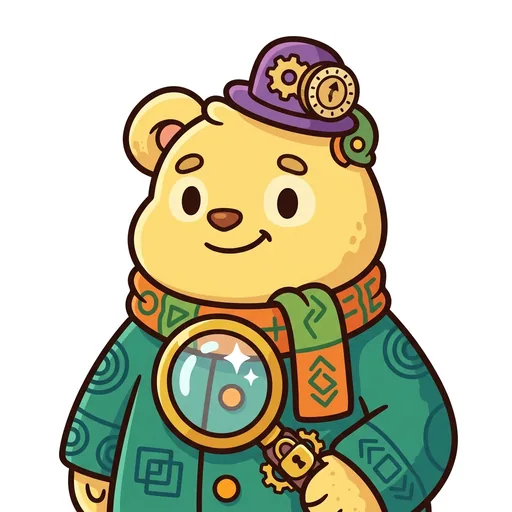
Sift
Cipher puzzles — substitution / Caesar / frequency analysis
-
Tile
Pattern puzzles — repetition / symmetry / tessellation
-
Cog
Logic puzzles — deduction / elimination / constraint
-
Link
Connection puzzles — association / category / cross-reference