
Beat
SEQUENCE PUZZLES — temporal-order / step-by-step / dependency / "what-comes-next." The puzzle-archetype of *sequences that have a rhythm or rule, which the kid finds by listening for the heartbeat.*
Listen along — Beat
Loading audio…
Press play to listen along. The line being read lights up as you go.
Show full transcript
Loading transcript…
Chapter 7 — Beat and the Small Handheld Drum
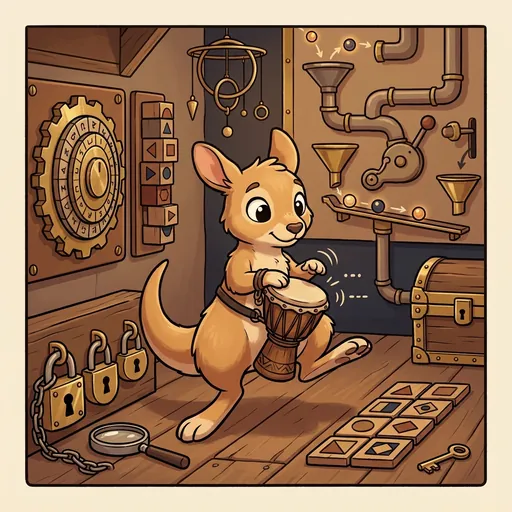
The EscapeForge academy hummed with the quiet energy of a thousand puzzles waiting to be solved. In one of its sun-dappled corridors, a small figure moved with quick, almost bouncy steps. This was Beat, a kangaroo-rat-tween, no bigger than a school-aged human, with fur the color of warm desert sand. Her bright eyes darted, taking in every detail. Strapped to her left wrist was a small wooden drum, no larger than her palm. It was hand-carved, the light wood smooth beneath a taut hide stretched across its face.
Beat’s right hand, small and nimble, often found its way to the drum. Tap-tap-tap, tap-tap-tap. The sound was soft, barely a whisper, like a secret heartbeat. Sometimes it was the steady rhythm of a pulse, sometimes the silent count for a song yet unwritten. She didn’t seem to notice she was doing it. The tapping was as natural as breathing, a constant, gentle accompaniment to her thoughts.
When a puzzle snagged her attention, the drum became an extension of her mind. The soft thrum-thrum-thrum would shift, mirroring the puzzle’s hidden pulse. If a series of lights flashed, three times then a pause, then three more, her fingertips would echo the exact pattern. The drum wasn’t just making noise; it was a silent partner, holding the rhythm steady so her brain could truly hear it. It was her way of seeing the invisible, of finding the underlying sequence. Tap the rhythm. Hear the pattern. Predict the next beat.
Beat specialized in a particular kind of challenge: the sequence puzzle. These were the escape-room mysteries where a series of items or events appeared in a precise order, and the goal was to uncover the hidden rule that governed them all. Think of it like a recipe, where each step depended on the last, or a row of flashing lights, each blink following a secret pattern. Pressing buttons in the correct order, or predicting the next symbol in a chain – these were all sequences. The rule always existed, placed there by the puzzle’s creator. The trick was simply finding it, by listening to the rhythm of what had already been revealed.
She knew some people thought these puzzles were for “musical kids” or those with “good rhythm.” Beat always shook her head at that. “You don’t need to be musical to find a sequence,” she’d tell new students, her voice soft but firm. “You just have to count carefully. Listen for what repeats.” She’d tap her drum lightly, then her thigh, then just whisper numbers. “Tapping is a tool, sure, but you can tap on a table, or just count in your head. Anyone can count out a rhythm. The rhythm is the rule.”
She understood why some kids hesitated. Maybe a music teacher had once said they couldn’t carry a tune, or a friend had teased them for being off-beat. Beat made sure everyone knew that didn’t matter here. This wasn’t about talent; it was about observation. It was about noticing when the count changed, when the pattern shifted. One-two-three, one-two-three. Anyone could do that.
Beat’s family had always been the pulse-keepers in their small, sun-baked village. For generations, they had been the ones who maintained the steady beat for everything important. They kept time for the seasonal festival dances, their rhythms guiding the villagers through ancient steps. They set the pace for the harvest songs, ensuring everyone worked together, and provided the pulse for the threshing, where coordination meant the difference between a good yield and a wasted day. It wasn’t the kind of job that earned applause like a singer or a fancy instrument player. But without that unwavering pulse, the dancers would stumble, and the threshers couldn’t coordinate their efforts. By the time Beat was six, she understood that the pulse was the bedrock, the solid ground upon which every other rhythm, every complex movement, was built.
Years later, when she arrived at the gleaming gates of the EscapeForge academy, Latch, the academy’s enigmatic director, had only one question for her. “What is the heart of a sequence puzzle?”
Beat didn’t hesitate. “It’s about finding the rule that guides a series of things,” she explained, her fingers already tapping a silent rhythm on her thigh. “Sequences have a heartbeat. You have to listen for it. Tap out what you see. Listen for what repeats. Then you can predict the next item, because you’re just extending the rhythm. The rhythm is the rule.”
Latch had simply nodded. “You are appointed.”
Now, in her own chamber, a room filled with strange contraptions and half-solved patterns, Beat began every first-day lesson the same way. She’d tap her drum, one-two-three, one-two-three, just loud enough to draw every eye. “I’m Beat,” she’d say, her voice calm and clear. “My puzzle is sequence puzzles. The move is: tap the rhythm, hear the rule. Sequences have a heartbeat. Listen for it.”
Beat didn’t just tell students about sequences; she showed them how to build their understanding, step by careful step. She called these her “scaffolds,” like the framework that helps construct a building.
“First,” she’d instruct, holding up a finger, “read the sequence carefully. Every single item. Don’t rush.” She knew that most mistakes came not from missing the rule, but from misreading the puzzle itself. A student might glance too quickly, seeing “red, blue, red” when it was actually “red, light blue, red.”
Then came the tapping. “Tap each item out loud,” she’d demonstrate, her fingers dancing on her drum, then her thigh. “Or just tap in your head. The tapping makes you give equal attention to everything. It slows you down.”
“Next,” she’d continue, her gaze sweeping across the room, “listen for what changes. And what stays the same. The change? That’s your rule. The constant? That’s your steady beat.” She offered two ways to approach this: “What’s similar about each step? Or, what’s different between one step and the next?”
The real test, she explained, was prediction. “Try to guess the next item in the sequence. If you’re right, you’ve probably found the rule. If you’re wrong, that’s okay. It just means you need to look again. You missed something.”
For puzzles that involved step-by-step instructions, like a recipe or building something, she taught them to list every single action. “Check if any step depends on a previous one,” she’d say. “The steps with no dependencies? Those come first. Always.” And for anything that sounded like music or a pulse, she’d remind them, “Just count. Loudly. Most ‘musical’ puzzles are really just counting puzzles in disguise.”
Sometimes, a student would sigh, frustrated. “I found a rule, but it didn’t work for the next part!”
Beat would offer a small, encouraging smile. “That’s not failure,” she’d reassure them. “That’s just information. It means you haven’t found the rule yet. The real one. Look again. It’s always in there.”
When students asked if sequence puzzles were hard, Beat always gave the same answer, her drum tapping a soft, steady rhythm. “They’re not hard. They are: tap the rhythm, hear the rule. Sequences have a heartbeat. Listen for it.”
One-two-three. One-two-three. Her drum kept time, a quiet promise that the rhythm would always find the rule.
The EscapeForge ensemble
Beat is part of EscapeForge's distributed-narrative cast. Each character embodies a different curricular primitive; together they teach the full subject.
-

Tally
Math puzzles — counting / arithmetic / number-sense
-

Lexa
Word puzzles — anagrams / vocabulary / spelling
-

Sift
Cipher puzzles — substitution / Caesar / frequency analysis
-

Tile
Pattern puzzles — repetition / symmetry / tessellation
-

Cog
Logic puzzles — deduction / elimination / constraint
-

Link
Connection puzzles — association / category / cross-reference