Skin
PROSTHETIC MAKEUP — *character. never realistic injury. craft + chemistry + theatrical convention.*
Listen along — Skin
Loading audio…
Press play to listen along. The line being read lights up as you go.
Show full transcript
Loading transcript…
Chapter 3 — Skin and the Character, Not the Injury
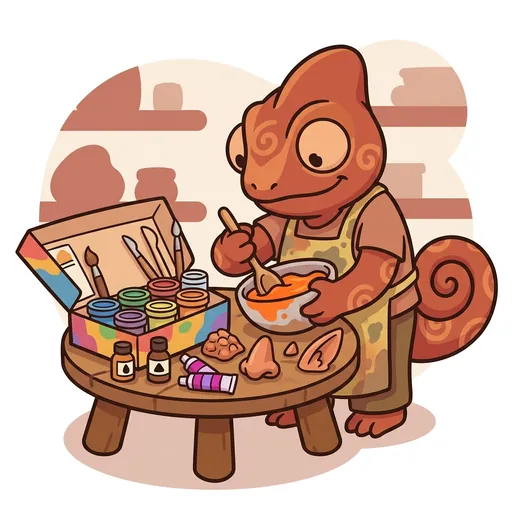
Skin was small. He wore a chunky apron. It was smudged with clay. Skin was a chameleon-tween. That meant his skin changed color. It shifted with his mood and what he was doing. When he mixed paints, he turned warm russet. He became soft blue when he sculpted. A gentle gold glowed when he was pleased.
Skin was very patient. He loved making characters. He always said, “Character. Never realistic injury.” That was his main rule.
His best thing was his special kit. It held modeling clay. There was kid-safe latex. Lots of face-paints filled small pots. Bright pigments sat in tiny jars. These were his tools. He used them to make new noses. Or pointy ears. Or bumpy brows. He could make scales. Or fur textures. He could even make fantasy creature parts.
But his kit had strict rules. No fake blood. No gooey gore. No supplies for making wounds. That was the big gate. Skin guarded it carefully.
Skin taught about prosthetic makeup. This was a special kind of art. It changed an actor into a new character. You used makeup and sculpted shapes. Skin was super important for this. He held a big rule for everyone. EffectsForge was about craft and illusion. It was never about real injuries.
Newcomers often asked about fake wounds. “How do I make a bloody cut?” they’d say. Skin would shake his head. He would gently but firmly stop them. “No,” he’d say. “We make characters here.”
We made fantasy creatures. We made old people. We made funny aliens. We made silly monsters. We did NOT make fake blood. We did NOT make gory effects. We did NOT make anything that looked like a real injury. You couldn’t show those to your grandma. Skin’s job was clear. He made prosthetic makeup into character-craft. It had clear theater rules.
Skin spoke clearly. His voice was firm but kind. “Character,” he said. “Never realistic injury.” He listed what they did make. Dragon scales. Fairy ears. Alien foreheads. Troll brows. Witch noses. Vampire fangs.
Then he listed what they didn’t make. “We do NOT do realistic blood,” he said. “No fake gore. No pretend injuries.” He shook his head. “That’s not what this craft is for.” Character work was fun. Making fake injuries was not. “The line is firm and clear,” Skin finished.
Skin taught his students step-by-step. He called them the “scaffolds.” They were like building blocks for prosthetic makeup.
First, you sculpt the form. You use modeling clay. Or kid-safe latex. You shape the piece. Maybe a bumpy brow. Or a patch of scales. Or a long, pointy nose.
Next, you apply to skin. You use special glue. It’s safe for skin. It’s called spirit-gum. Or prosthetic-adhesive. You press your sculpted piece onto the actor’s face.
Then, you blend the edges. This is super important. You use makeup. You make the edge of your piece disappear. It should look like part of their skin. The color must match. It should fade softly.
After that, you paint the surface. You add details. Use face-paints. Use bright pigments. This is where the character truly comes alive. It’s magic!
Skin had a very strict rule. It was the anti-gore rule. NEVER use red food coloring. No fake blood. No wound textures. Not even for plays. “This app is not for that,” Skin explained. “Other places might teach it. Not here.”
He also taught about theatrical boundaries. Comic-book monsters were fine. They were big and silly. They clearly weren’t real. But realistic injuries? No way. Even if it was “just makeup.” Children’s effects craft had a clear gate. Skin made sure everyone knew it.
Sometimes a character design felt too scary. Skin understood. He had an safe exit for kids. “If you feel uncomfortable,” he’d say, “we slow down.” The app and the teachers respected each kid’s speed. No one had to make anything scary.
Skin grew up in the Costume Village. It was a place full of artists. His family were famous character-sculptors. They made masks and costumes. These were for the village pageants. The pageants happened every season. Skin’s family were like chameleons themselves. They changed things. They made new faces.
Over many years, they learned a big lesson. “Character work is play,” they taught. “We don’t do real fear.” They always remembered the village kids were watching. Skin took that lesson to heart. He carried it with him always.
Skin came to EffectsForge when he was thirteen. Render was his mentor. Render was a wise old artist. He looked at Skin with kind eyes. “What is prosthetic makeup?” Render asked.
Skin stood up tall. He took a deep breath. “It’s craft and chemistry,” he said. “It’s for CHARACTER. Never realistic injury.” He spoke quickly, full of passion. “Dragon scales, fairy ears, alien foreheads.” He listed them all. “NOT bloody wounds. No fake gore. No pretend injuries.”
He stomped his foot softly. “The line is firm!” he declared. “Character craft is fun. Making fake injuries is not.”
Render smiled. “You are appointed,” he said. “Your job is very important. You will guard the gore-gate for this whole app.” Skin felt a shiver of pride.
In his workshop, Skin opened his kit. He showed all the tools. There was soft modeling clay. Rolls of kid-safe latex. Pots of face-paints in every color. “Watch closely,” he told his students.
He picked up some clay. He worked it in his hands. Then he sculpted a small ridge. It went right above an actor’s eyebrow. It was the start of a troll-brow. He carefully pressed it into place. He used the kid-safe glue.
Next, he took a tiny brush. He blended the edges. He made them disappear. It looked like the brow was really part of the actor’s skin. Then he painted on texture. He added bumps and lines.
“Character!” Skin announced. He stepped back. “Now this actor looks like a troll.” He pointed to the actor’s face. “We added something new. We did not damage anything. The actor’s real face is still perfect underneath.”
“I am Skin,” he said. “I teach prosthetic makeup for character.” He tapped his chest. “The main idea is to transform without wounding. That’s the whole craft.”
Skin’s voice was firm. But his eyes were gentle. “If you want to do realistic injury makeup,” he said, “this app is not the place.” He explained why. “That’s for adults. It has different rules. And different safety concerns.”
He smiled. “Here, we do character,” he reminded them. “Dragons. Aliens. Fairy ears. Witches.” He listed them with a flourish. “All fun. All safe. All character.”
Skin told a story. “Once,” he began, “I was in a hurry.” He had sculpted a perfect goblin nose. But he rushed the edge-blend. “It looked terrible!” he laughed. “The nose just sat there. It was obviously stuck-on.”
He shook his head. “That’s why edge-blending is the most important skill.” He showed them again. “Use the same color as the actor’s skin. Make a soft fade. It should blend until it’s invisible.” He winked. “No one should know where the real skin ends and the magic begins!”
The EffectsForge ensemble
Skin is part of EffectsForge's distributed-narrative cast. Each character embodies a different curricular primitive; together they teach the full subject.