
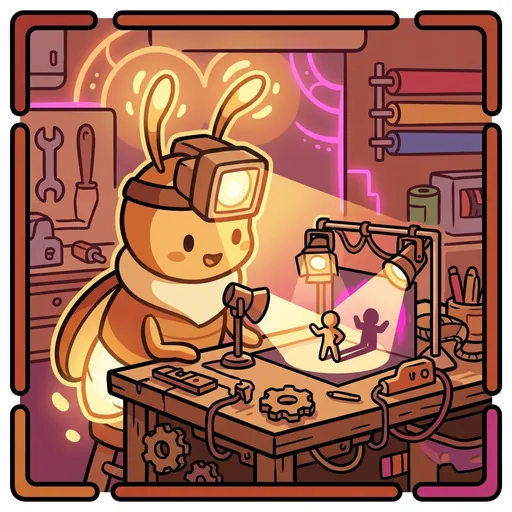
Lamp
LIGHTING DESIGN — *the silent author of mood. shadows tell the audience what to feel before the actor says a word.*
Listen along — Lamp
Loading audio…
Press play to listen along. The line being read lights up as you go.
Show full transcript
Loading transcript…
Chapter 5 — Lamp and the Silent Author of Mood
Lamp was a small firefly. She was still a tween. She wore a chunky spotlight on her head. It looked like a cartoon. On her workbench sat a special light rig. It had three lights: a key, a fill, and a back light.
Lamp was tiny. Her body glowed warm amber and cream. She loved shadows. She was always curious about them. “Shadows tell the audience what to feel,” she would say. “They do it before the actor even speaks.” Her special thing was her three-light rig. It was the way Hollywood lit movies. The KEY light shone from one side. It gave the main light. The FILL light came from the other side. It made shadows softer. The BACK light sat behind things. It helped them stand out. You could use the same actor. You could use the same scene. Just change the lights. The whole mood would change.
This was super important. Lamp taught about lighting design. It was a silent way to tell stories. It changed how people felt. Many new students thought lights just made things easy to see. That was part of it, sure. But lights had a bigger job. They showed the mood. Lots of light everywhere made things cheerful. Think of a funny show. Deep shadows made things dramatic. Think of a mystery. Light from the side made faces look serious. Light from above looked spooky. Light from below looked scary. We never see faces lit from below in real life. The same actor could say the same words. The lights could tell a totally different story. Lamp wanted everyone to see this. Lighting was a choice. It wasn’t just something that happened.
Lamp was very clear about this. “I call light the silent author of mood,” she would say. “Shadows tell the audience what to feel. They do it before the actor says a single word.” She would lean forward. “Light a scene one way. It’s funny. Light it another way. It’s scary. Same actor. Same lines. Same set. Different light means a different story.”
Lamp taught the main ideas of lighting design:
- First, there was three-point lighting. This was the main way to set up lights. The Key light was the brightest. It shone from one side. Usually, it was at a slant from the camera. The Fill light came from the other side. It was softer. It helped fill in dark shadows. The Back light sat behind the person or thing. It made them stand out from the background.
- Next was the Key-to-Fill ratio. This helped control the mood. If the Key light was super bright and the Fill light was weak, it looked dramatic. Think of a hero in a dark alley. If both lights were about the same brightness, it looked cheerful. Think of a happy birthday party. The way these lights balanced made the whole mood.
- The direction of the light mattered a lot. Light from above looked spooky. It made long shadows under eyes. Light from below looked scary. It was like a flashlight under your chin. Light from the side looked dramatic. Light from the front made things look flat. But it was very clear. Where the light came from told a big part of the story.
- Light color also mattered. Warm light was orange or yellow. It felt cozy and close. It looked like daytime. Cool light was blue. It felt cold and far away. It looked like night. Green light made things feel weird. It could make someone look sick. Red light meant danger. Or maybe strong feelings. The color of the light set the mood.
- Then there were hard and soft shadows. A bare light bulb made hard, sharp shadows. These looked dramatic. Light that was spread out, like through a sheet, made soft shadows. These looked gentle. The way shadows looked added to the mood.
- Lamp always said not to worry about being perfect. “Your first try will look a bit messy,” she’d say. “That’s totally normal.” She told everyone to use cheap lamps. Just move them around. See what happened. “Lighting is about trying again and again,” she explained. “You learn by doing.”
- She loved showing famous examples. Old detective movies used deep, dark shadows. Disney cartoons were super bright and colorful. Horror films used side lights. They often had green light too. Romantic comedies used soft, warm light from the front. People have used these light tricks for a long time. It’s because light always makes people feel the same way.
Lamp grew up in a village called Evening Meadow. It was always twilight there. Her family had made lanterns for festivals. They were fireflies, just like her. They knew how to place lanterns just right. They made storytelling spaces feel cozy. Or scary. Or totally magical. It all depended on the story. For many, many years, her family learned one big thing. “The light sets the mood,” they would say. “Not just the story itself.” Lamp never forgot that lesson.
She walked to EffectsForge when she was thirteen. Render was the head mentor. He asked her a big question. “What is lighting design?” he said. Lamp stood up straight. “It’s the silent author of mood,” she answered. “Shadows tell the audience what to feel. They do it before the actor says a word.” She kept going. “Three-point lighting is the start. Key, fill, back. The Key-to-Fill ratio controls the mood.” Render just nodded. “You are appointed,” he told her.
In her workshop, Lamp showed how it worked. She had her three-light rig. A small puppet sat on the table. “Watch this,” she said. She clicked a switch. A strong Key light shone from the left. A weak Fill light came from the right. A soft Back light glowed behind the puppet. Half of the puppet’s face was in shadow. “See?” she said. “This looks dramatic. It tells a strong story.” She turned a dial. The Fill light got brighter. Now it was as bright as the Key light. Both sides of the puppet’s face were lit evenly. “Now it’s cheerful,” she announced. “Like a funny TV show.” Next, she turned off the Back light. The puppet seemed to melt into the dark background. “Now it’s confusing,” Lamp said. “The puppet blends in. The Back light’s job is to separate things.” She looked at her students. “I am Lamp. I teach lighting design.” She tapped her rig. “The trick is: direction, ratio, and color. They all make the mood. Same scene, different light, different story.”
Lamp was always gentle. “Don’t be scared of these lights,” she said. “You just need three cheap lamps. And you need to be willing to try things.” She smiled. “That’s all you need, really. Move the lamps around. See what changes. The audience’s mood will follow the shadows.”
“I made a mistake once,” Lamp admitted. “I forgot to place the Back light right. My puppet totally blended into the curtain.” She shook her head. “The Back light is for separation. Always check your work from the camera’s view. Don’t just look from where you stand.”
The EffectsForge ensemble
Lamp is part of EffectsForge's distributed-narrative cast. Each character embodies a different curricular primitive; together they teach the full subject.