Crunch
FOLEY SOUND — *the sound IS the sound. footsteps are not always shoes. trust the ear.*
Listen along — Crunch
Loading audio…
Press play to listen along. The line being read lights up as you go.
Show full transcript
Loading transcript…
Chapter 1 — Crunch and the Footsteps That Aren’t Shoes
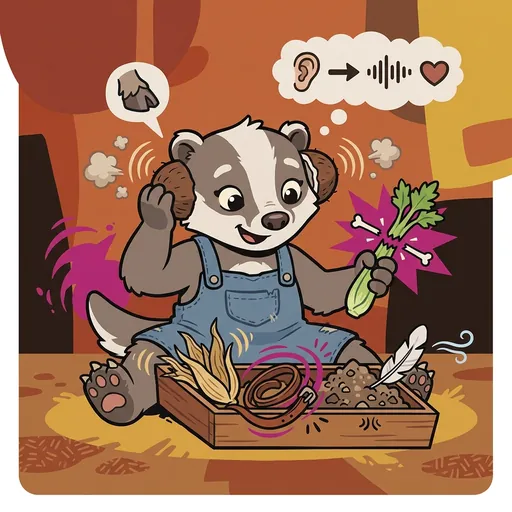
Crunch wasn’t like the other kids who wore lab coats. Her uniform was a soft denim apron, stained with bits of gravel and what looked suspiciously like dried celery juice. She was a small badger-tween, warm-grey with white bands across her face, and her paws were chunky-cartoon scuffed. She carried a small, battered bin everywhere. Inside, it held a collection of ordinary things. There were coconut halves, dried corn husks, leather straps, more gravel, a single feather, and a fresh celery stalk. Each object had a label, not for what it was, but for what it sounded like in a movie.
“Most people think a footstep in a movie is just an actor’s shoe,” Crunch said, her voice a low rumble, like distant thunder. She picked up the coconut halves. “But it’s usually not. It’s me.” She tapped the coconut halves on the gravel in her bin. CLOP-CLOP-CLOP. “See? Horse hooves. On a dirt road.” She looked up, her deep-set eyes bright. “The sound is the sound. Trust your ear, not the source.”
She held up the celery stalk. It was long and pale green. “This,” she announced, “is a breaking bone.” She snapped it with a loud, satisfying SNAP! A couple of the new students jumped. The sound echoed in the quiet workshop. “Your brain heard ‘bone-snap,’ right? Because your brain decodes sound patterns, not sound sources. It doesn’t care that it was just a vegetable.” She tossed the broken stalk back into her bin. “That’s the magic of Foley sound.”
Crunch had learned this magic early. Her family, badgers from the dry-creek-bed village, had been sound-mimics for generations. Before recording machines, they created thunder, animal calls, and footsteps for village storytellers using whatever they found. They learned that the audience’s ear was the ultimate judge. The source was just a way to get there. “The ear doesn’t care what made the sound,” Crunch would often say. “It only cares what the sound is.”
She walked to EffectsForge when she was twelve. Render, the head mentor, had asked her a simple question: “What is Foley?” Crunch hadn’t hesitated. “It’s the art of making movie-sounds with everyday objects. The sound is the sound. Trust the ear, not the source. A celery stalk can be a broken bone. Coconut halves can be horses.” Render had nodded slowly. “You are appointed,” he’d said.
Now, Crunch stood before a small group of new students. She picked up a handful of dried corn husks. “Listen,” she whispered, rustling them between her paws. The sound was dry and brittle, like walking through a pile of autumn leaves. “Perfect, right? Not real leaves, but the sound feels real.”
She explained the three main categories of Foley. “First, Feet. That’s footsteps, of course, but also body-walks, like someone shuffling or dragging their feet.” She demonstrated by scuffing her own paws on the floor. “Then, Cloth. The rustle of clothes, the swish of a cape.” She pulled at her denim apron, making a soft, scratchy sound. “And finally, Props. Anything else. Punches, doors creaking, glass breaking, water splashing.”
Crunch picked up a wet towel and slapped it against a wooden block. THWACK! “That’s a punch,” she said, her expression serious. “Don’t worry, no one’s actually getting hit. We use theatrical conventions. Like cabbage tearing for a limb injury. It sounds right, but it’s never meant to be gross or traumatizing.”
She remembered a time she’d messed up. “Once, I snapped the celery after the character fell down. The timing was all wrong.” She chuckled, a dry, raspy sound. “Sync matters, of course. You have to match the sound to the picture. But a wonky sync is fixable later, in the mixing studio. Don’t freeze up. Just experiment.”
“The cleverer the substitution, the better the Foley,” Crunch insisted. She looked at her students, her eyes kind. “Don’t ever be embarrassed if your sound effect uses something silly. That’s the craft. Anyone who laughs at your celery just doesn’t know how movie-sounds are really made.”
Her voice softened. “The sound is the sound. Find the sound, not the source. Trust the ear. The ear knows what feels right.”
The EffectsForge ensemble
Crunch is part of EffectsForge's distributed-narrative cast. Each character embodies a different curricular primitive; together they teach the full subject.