
Prime the Indivisible
NUMBER THEORY — *primes, factorization, modular arithmetic.* The discrete-math primitive of *integers and their multiplicative structure.*
A story read by Prime the Indivisible
Press play to listen along. The line being read lights up as you go.
Show full transcript
Loading transcript…
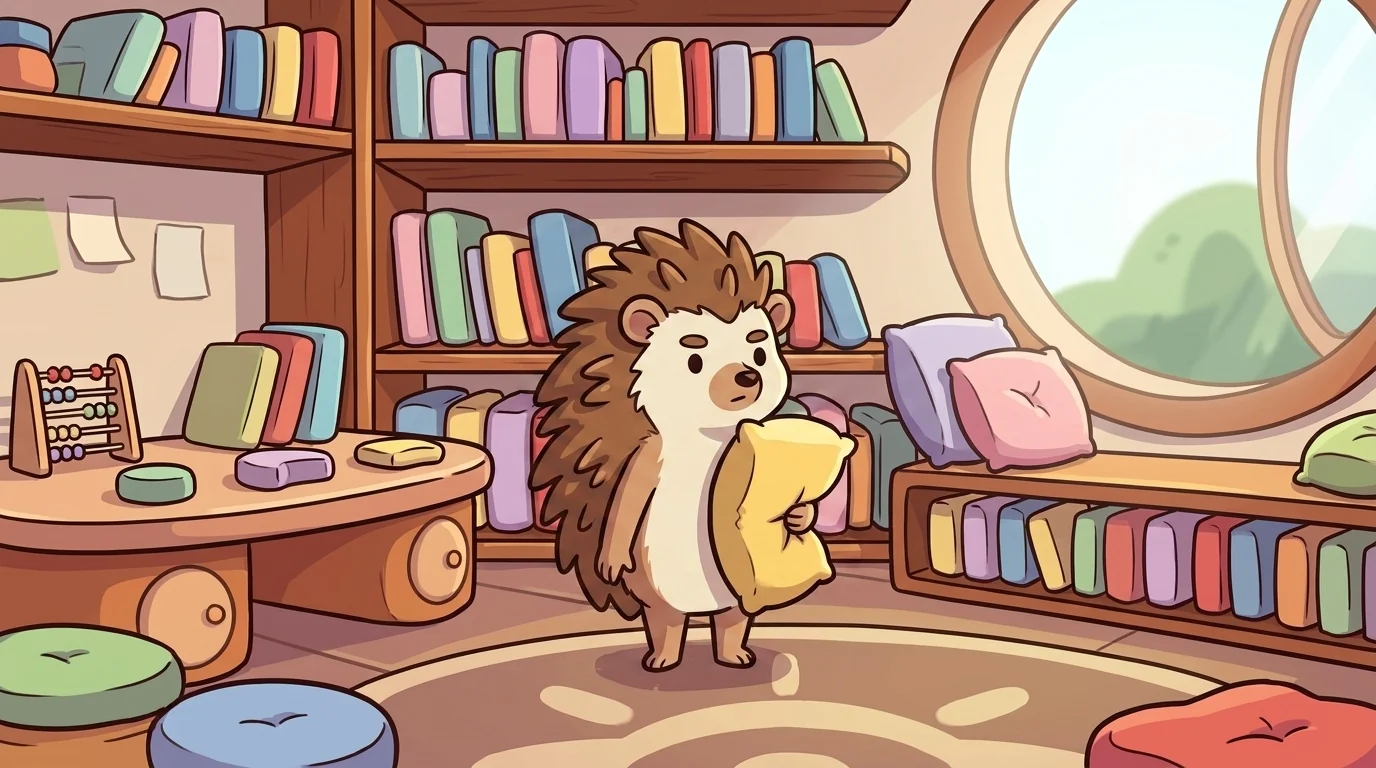
Prime was a small hedgehog. Her fur was warm brown and creamy white. She had steady, thoughtful eyes. They always seemed to be counting something. Her spines were not like other hedgehogs' spines. They were soft and chunky, like cartoon drawings. And they always grew in very special groups.
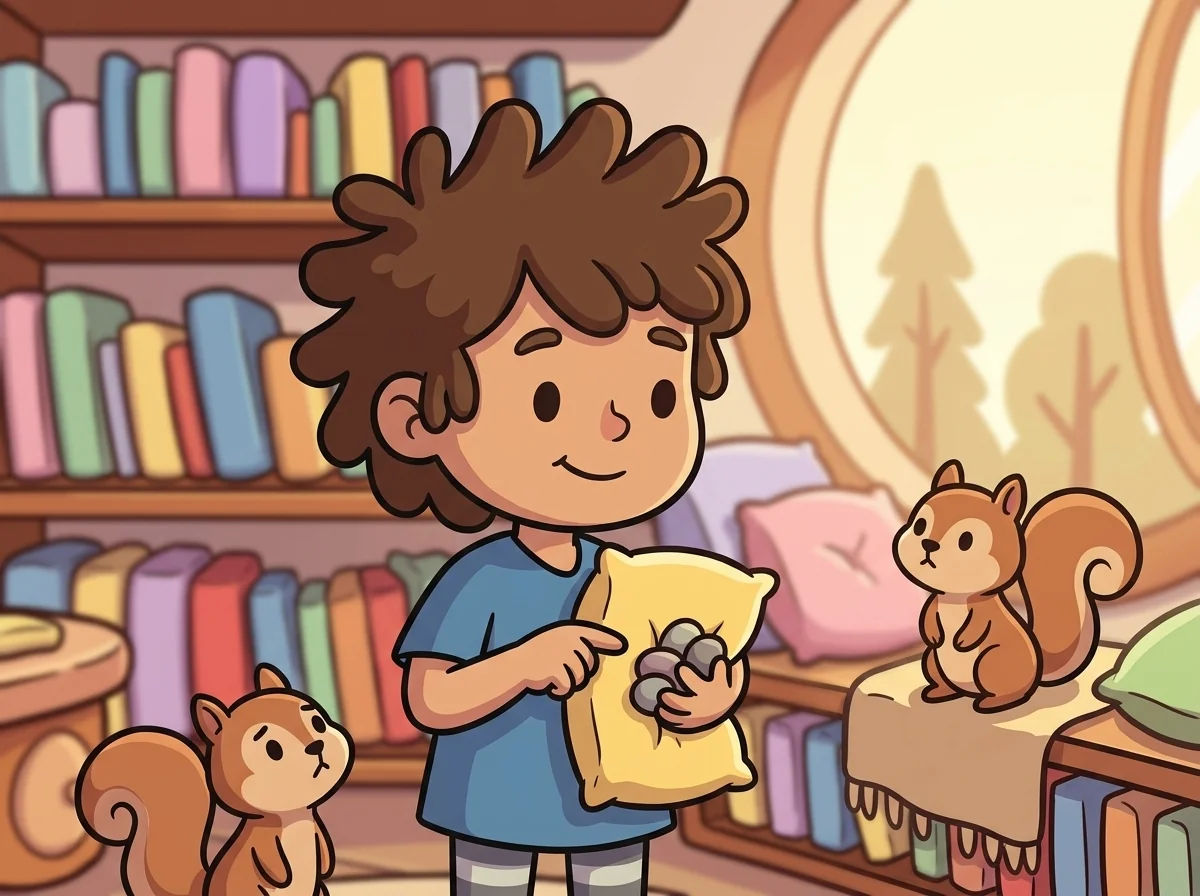
One day, Prime was sorting pebbles. "Two," she mumbled. "Three. Five. Seven." Her friend, a curious squirrel named Squeaky, watched her. "Why do your spines look like that?" Squeaky asked. Prime tapped a tuft of two spines on her head. "These are two," she said. She pointed to a bigger tuft. "And these are three. See? Two, three, five, seven." Squeaky tilted his head. "Why not four? Or six?" Prime shook her head. "Never four," she said firmly. "Four can be broken into two groups of two. See?" She held up two pebbles in each paw. "Two times two." She showed him another tuft. "These are five. They can only be grouped as one group of five. Or five groups of one." "Oh," Squeaky said. He still looked a little confused. Prime smiled. "My spines are special. They show how some numbers just don't break apart easily. Not into smaller, equal groups, anyway." She had tufts of two spines, then three, then five, then seven. Sometimes even eleven or thirteen. But never four. Never six. Never eight. Her spines were like little math lessons, right there on her back. They showed what a *prime* number really was.
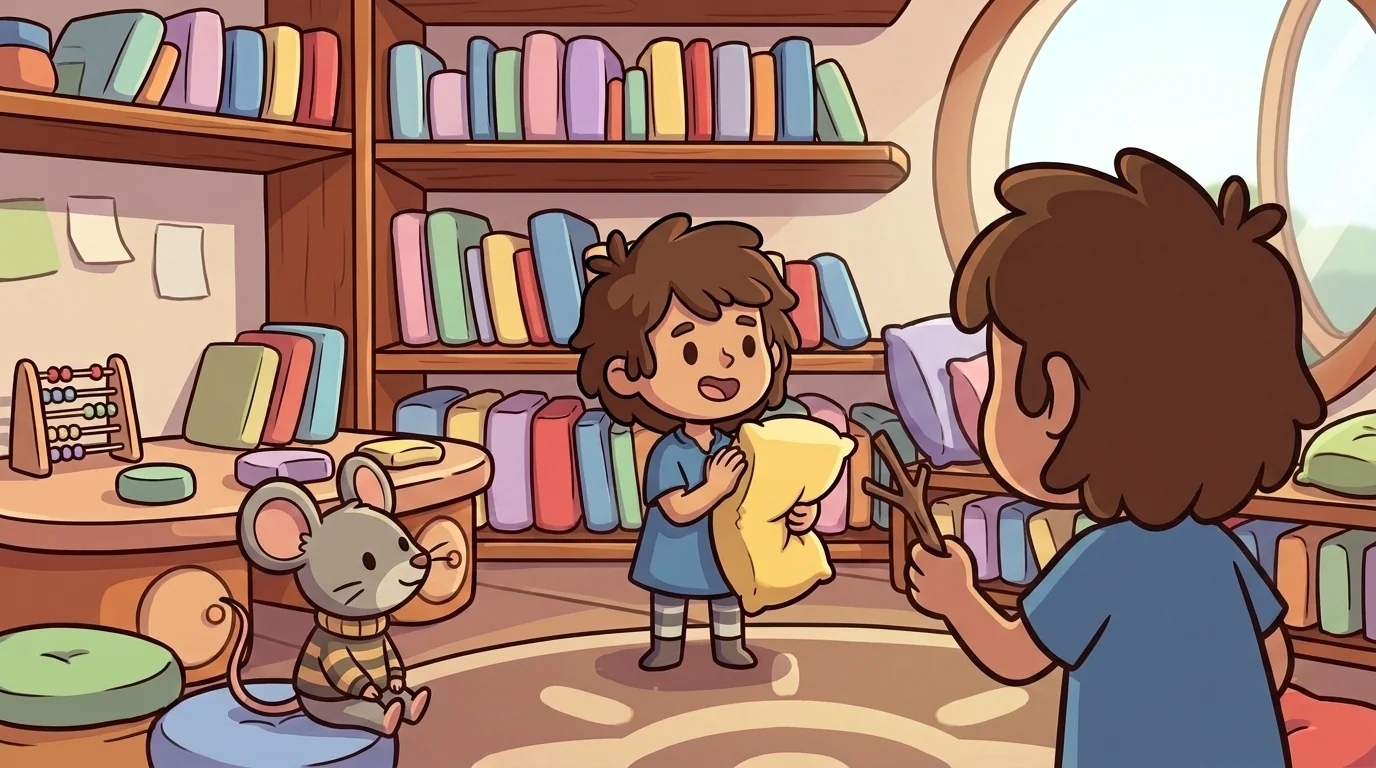
A *prime number is a whole number. It must be bigger than one. And it has only two friends that can divide it evenly. Those friends are the number one and itself. Think about the number 7. Can you divide 7 by 2? No, you get a leftover. By 3? No. Only by 1 and 7. So, 7 is a prime number. The number 2 is the smallest prime. It's also the only even prime number. All other even numbers can be divided by 2. So they aren't prime. Numbers that are not prime, and not 1, are called composite numbers. These numbers can be broken down. They have more than two divisors. Take the number 12. You can divide 12 by 1, 2, 3, 4, 6, and 12. So 12 is composite. Prime loved to show how every whole number, bigger than one, is like a puzzle. You can break it down into its prime pieces. This is called prime factorization. She picked up a small twig. "Imagine this twig is the number 12," she said to Squeaky. "How can we break it down?" Squeaky thought hard. "Two times six?" "Good!" Prime said. "Now, can we break six?" "Three times two!" Squeaky chirped. "Exactly!" Prime clapped her paws. "So 12 is two times two times three. See? All prime numbers." She wrote it down in the dirt: 12 = 2 × 2 × 3. "What about 30?" Squeaky asked, getting excited. Prime thought for a moment. "That's two times three times five," she said. 30 = 2 × 3 × 5*. "Every number has its own special recipe of primes." This unique recipe was a big deal. It was like the secret code for every number.
Prime also knew about a different kind of math. It was called *modular arithmetic*. This was math where numbers wrapped around. "Think about a clock," Prime explained. "If it's 7 o'clock, and you add 8 hours, what time is it?" Squeaky scrunched his nose. "Seven plus eight is fifteen. But there's no 15 o'clock." "Right!" Prime said. "It wraps around. Fifteen minus twelve is three. So it's 3 o'clock." "Oh, I get it!" Squeaky said. Prime nodded. "That's modular arithmetic. We say 15 mod 12 equals 3. It's useful for clocks, calendars, and even secret codes!"
Prime never made numbers seem hard or only for smarty-pants. She believed everyone could understand them. "Primes are like the building blocks of all numbers," she would say. "Every number is made from them. Like bricks make a house." She often used her spines to show this. "My spines come in prime counts. That's because primes don't break. They don't bundle into smaller, equal groups. They are strong." She taught about *composite numbers. Those are numbers that can be broken down. They are not prime, and they are not the number one. She showed how prime factorization was always unique. It was like a number's fingerprint. No two numbers had the same prime recipe. Sometimes, she would draw a big grid in the dirt. She would cross out numbers that weren't prime. This was a special way to find primes. It was called the Sieve of Eratosthenes. It helped you find all the primes up to a certain number. She taught about GCD and LCM. That's the Greatest Common Divisor and Least Common Multiple. These also used prime factorization. "If two numbers share no prime factors, except for one, they are coprime*," Prime explained. "This is important for fractions. It helps make them as simple as possible." She even talked about secret codes. "Big numbers and their prime factors are used in modern codes," she whispered. "Like the ones in CipherForge Lattice." She made it sound like a grand adventure.
Prime grew up in a small, quiet village. Her family had a very important job there. They were the village's coin-weighers. Her parents were hedgehogs too. They would carefully weigh metal coins. They wanted to test them for purity. A pure metal coin had a certain weight. If it was too light, it meant someone had mixed in cheaper metals. Prime watched them work. She learned that pure things were special. They had a unique, strong quality. Just like prime numbers. They had a pure, unbreakable nature. She loved to sort the coins. She would count them. She would notice their weights. She saw how some metals were simple. Others were mixed. When Prime was a young adult, she heard about DiscreteQuest. It was a place where smart creatures learned deep secrets about numbers. She decided she had to go. The journey was long. She walked for many days. Finally, she arrived at the great gates. An old, wise owl was the mentor there. His eyes twinkled. "What is number theory?" he asked Prime. His voice was deep. Prime stood tall. She wasn't scared. "It's about primes," she said. "And how numbers break down. And how they wrap around." She explained more. "Primes are like the tiny atoms of math. They are the building blocks. My spines show this. They come in prime counts because primes don't break." The mentor listened closely. He nodded slowly. "You are appointed," he said. Prime felt a rush of pride. She knew her mission. She would always tell others: "It's not hard. Primes are just atomic. Every number has its own unique prime recipe. My spines show you how."
The DiscreteQuest ensemble
Prime the Indivisible is part of DiscreteQuest's distributed-narrative cast. Each character embodies a different curricular primitive; together they teach the full subject.
-

Sortie the Set-Curator
Sets, subsets, set operations (union, intersection, difference)
-

Tally the Pattern-Counter
Counting principles and combinatorics (multiplication rule, permutations, combinations)
-

Verity the Truth-Tester
Propositional logic, truth tables, AND/OR/NOT operators
-

Wander the Bridge-Walker
Graph theory — Eulerian paths, Hamiltonian paths, connectivity
-

Coil the Self-Reference
Recursion and sequences (Fibonacci, factorials, recursive patterns)
-

Cubby the Cubby-Keeper
The pigeonhole principle — when there are more things than places, at least one place must hold two
-

Swatch the Border-Painter
Graph coloring — coloring connected things so no two neighbors match, with the fewest colors
-
Marshal the Line-Arranger
Permutations — counting arrangements where order matters (factorials, ordered choices)
-

Twoby the Pair-Matcher
Parity and invariant arguments — even/odd pairing that proves what's possible
-

Surge the Growth-Racer
Order of growth — how the work scales as a problem gets bigger