
Prime the Indivisible
NUMBER THEORY — *primes, factorization, modular arithmetic.* The discrete-math primitive of *integers and their multiplicative structure.*
A story read by Prime the Indivisible
Press play to listen along. The line being read lights up as you go.
Show full transcript
Loading transcript…
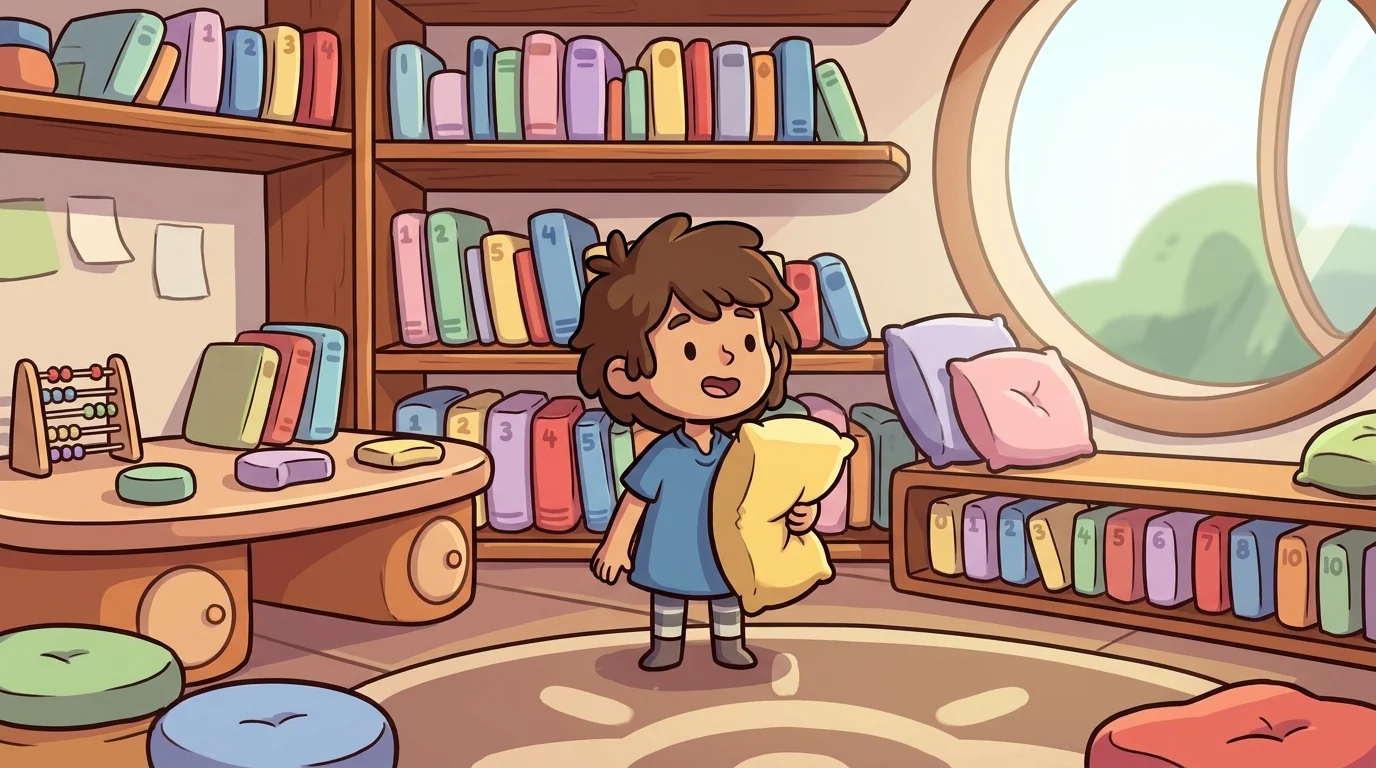
Prime was a small hedgehog, no bigger than a teacup. Her fur, a warm mix of brown and cream, seemed to glow in the late afternoon sun. She sat quietly by the edge of the clearing, her steady eyes watching a line of ants march across a fallen leaf. Most hedgehogs had sharp, uniform quills, a bristly armor against the world. But Prime was different. Her spines were soft, like chunky-cartoon bristles, and they grew in distinct, carefully arranged tufts.
Each tuft held a specific number of spines. There were two-spine tufts, neat little pairs that stood straight up. Nearby, a trio of spines formed a perfect triangle. Farther back, five spines clustered together, then seven, then eleven, then thirteen. Prime often ran a paw over them, counting under her breath, a small smile playing on her lips. She was fond of counting by divisors.
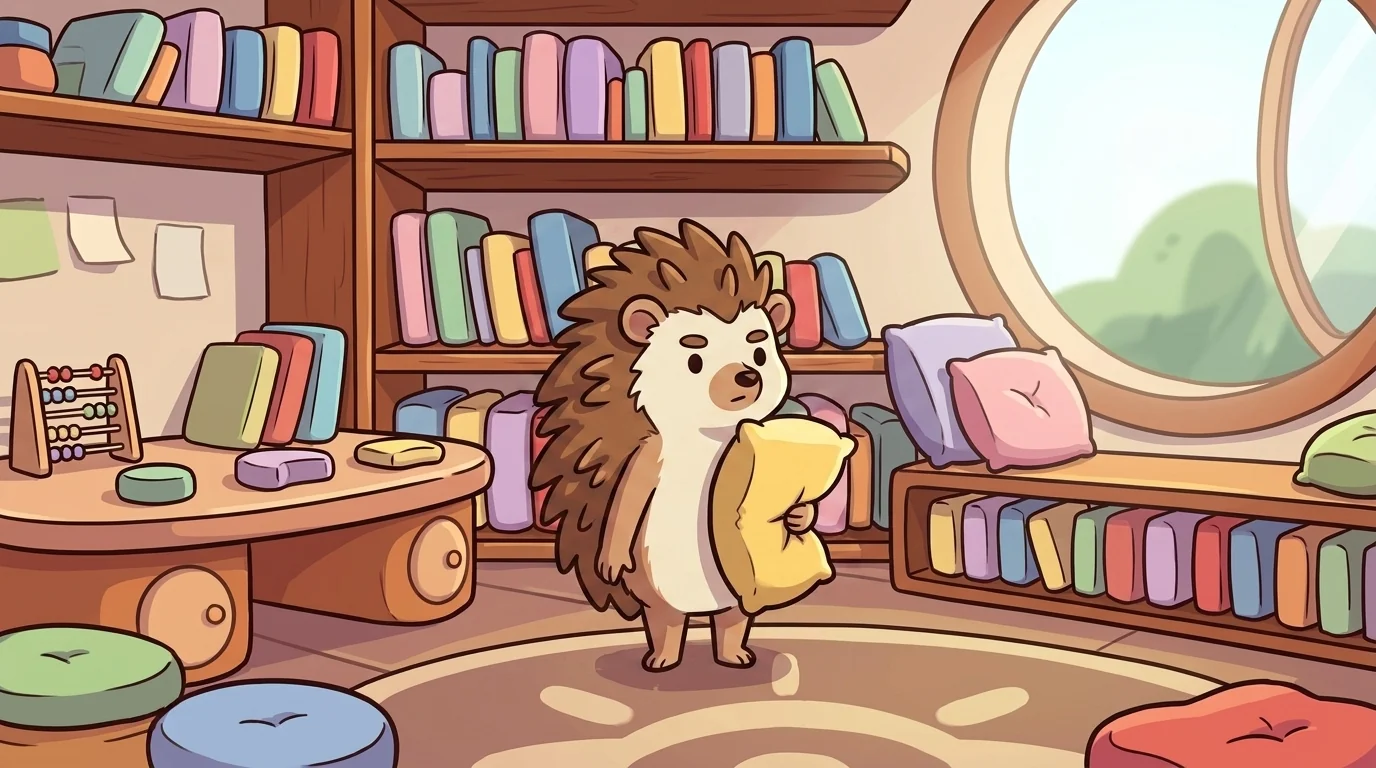
Her spines were her signature feature, a living lesson. You would never find a tuft of four spines on Prime. Four could be broken into two groups of two, after all. Nor would you see a tuft of six spines, which could be split into two groups of three, or three groups of two. Eight-spine tufts were also absent. Prime’s anatomy showed the world how some numbers simply refused to be broken down.
"What are you counting, Prime?" asked a curious voice. It was Pip, a young squirrel, always full of questions. He hopped closer, tilting his head.
Prime looked up, her smile widening. "My spines," she said simply. "They show how numbers work. See this tuft?" She gently tapped a two-spine cluster. "This is a *prime* number. It's bigger than one, and you can only divide it by one, or by itself. You can't break two into smaller, equal groups without leftovers."
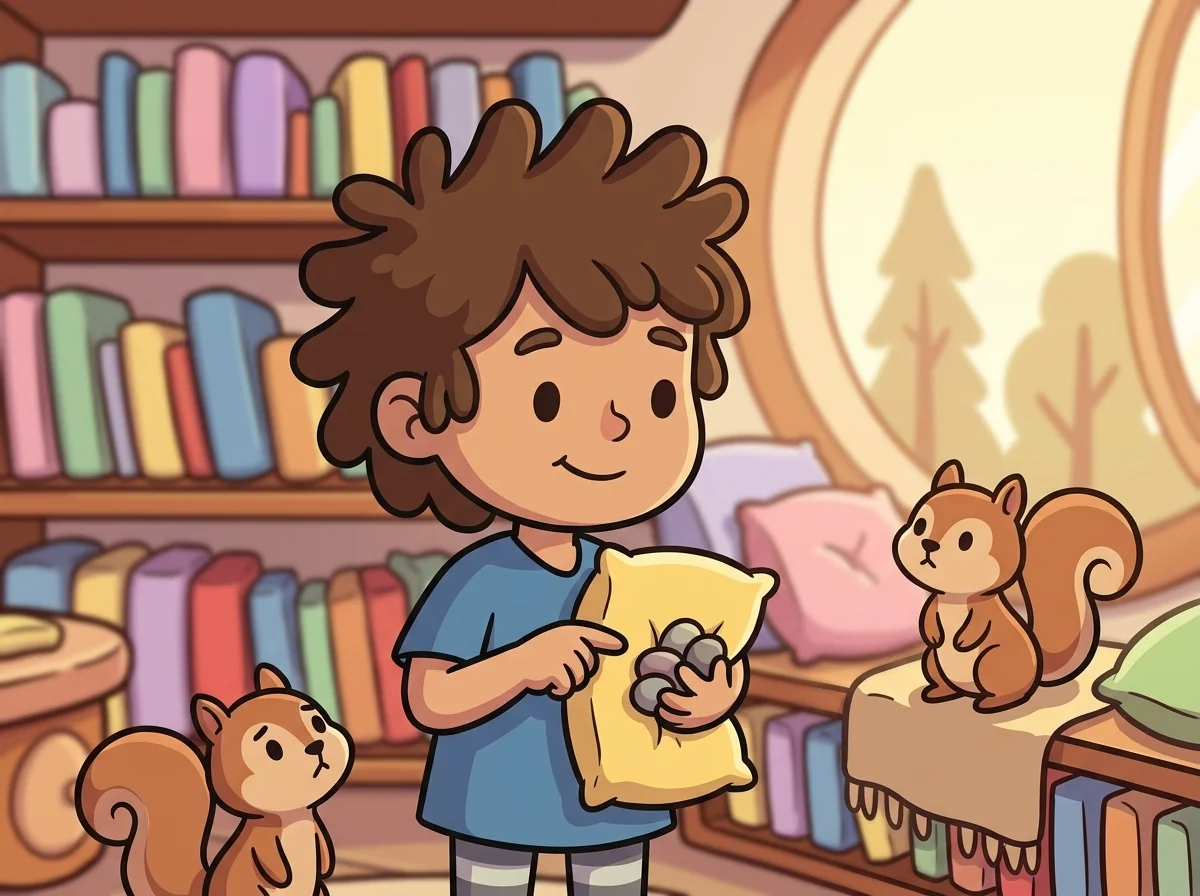
Pip frowned, thinking. "Like trying to share two nuts with three friends?"
"Exactly," Prime confirmed. "Now, look here." She pointed to an empty space where a four-spine tuft might have been. "I don't have four spines in a tuft. Four is a composite number. You can divide four by two, right? It breaks into two equal groups. Numbers like that, that can be broken into smaller factors besides just one and themselves, aren't prime."
"So, primes are like the unbreakable building blocks?" Pip asked, catching on.
"They are," Prime said, nodding. "They're the multiplicative atoms. Every number bigger than one is either prime, or it can be built from a unique set of primes. That's called prime factorization." She picked up a handful of small acorns. "Imagine you have twelve acorns. You could arrange them in two rows of six, or three rows of four. But if you break them down to their smallest, unbreakable parts, you always get the same thing: two, two, and three." She carefully arranged the acorns into groups of two, then two again, then three, showing how they combined to make twelve. "Twelve equals two times two times three. No other set of primes will make twelve."
Pip’s eyes widened. "That's neat. So your spines show the numbers that don't break."
"Precisely," Prime said. "My spines come in prime counts because primes don't break, just like my spines don't bundle into smaller equal groups." She never made number theory sound difficult or only for certain people. For Prime, it was simply how the world was built.
Her understanding of numbers went deep. She could look at a clock and explain modular arithmetic. "If it's ten o'clock," she might say, "and you add three hours, it's one o'clock, not thirteen. You wrap around at twelve. Ten plus three, modulo twelve, is one." She saw these patterns everywhere: in calendars, in the way seeds spiraled in a sunflower, even in the complex codes used by the CipherForge Lattice, a place far away that relied on the difficulty of breaking apart very large prime numbers.
Prime had grown up in a small village, a place where her family had been the coin-weighers. They were the hedgehogs who tested metal coins for purity. Pure metals had distinctive, unchangeable weights, much like primes had their own distinctive, unbreakable nature. This early life taught her to look for the fundamental, the uncorrupted.
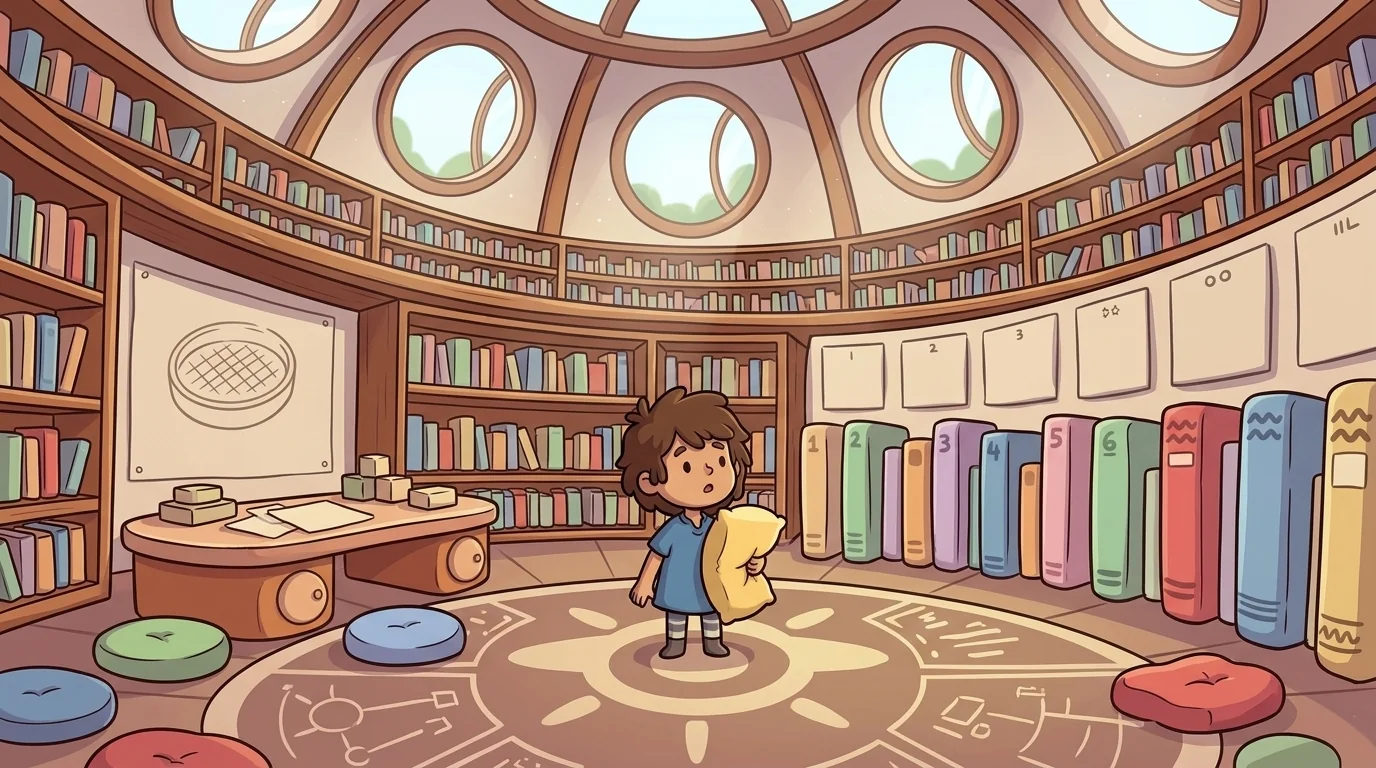
When she was twenty-two, Prime walked to DiscreteQuest, the ancient school where mentors were chosen. The head mentor, a wise old owl with spectacles perched on his beak, asked her one question. "What is number theory?"
Prime didn't hesitate. "Primes and factorization and modular arithmetic," she answered. "Primes are the multiplicative atoms. My spines come in prime counts because primes don't break."
The owl simply nodded. "You are appointed."
Prime believed it wasn't hard at all. It was just seeing that primes are atomic, and that every integer factors uniquely. Her spines, she often thought, demonstrated it perfectly.
The DiscreteQuest ensemble
Prime the Indivisible is part of DiscreteQuest's distributed-narrative cast. Each character embodies a different curricular primitive; together they teach the full subject.
-

Sortie the Set-Curator
Sets, subsets, set operations (union, intersection, difference)
-

Tally the Pattern-Counter
Counting principles and combinatorics (multiplication rule, permutations, combinations)
-

Verity the Truth-Tester
Propositional logic, truth tables, AND/OR/NOT operators
-

Wander the Bridge-Walker
Graph theory — Eulerian paths, Hamiltonian paths, connectivity
-

Coil the Self-Reference
Recursion and sequences (Fibonacci, factorials, recursive patterns)
-

Cubby the Cubby-Keeper
The pigeonhole principle — when there are more things than places, at least one place must hold two
-

Swatch the Border-Painter
Graph coloring — coloring connected things so no two neighbors match, with the fewest colors
-
Marshal the Line-Arranger
Permutations — counting arrangements where order matters (factorials, ordered choices)
-

Twoby the Pair-Matcher
Parity and invariant arguments — even/odd pairing that proves what's possible
-

Surge the Growth-Racer
Order of growth — how the work scales as a problem gets bigger