
Lift
LIFT — *quality of movement, not aesthetic judgment. effort is the dancer's instrument.*
Listen along — Lift
Loading audio…
Press play to listen along. The line being read lights up as you go.
Show full transcript
Loading transcript…
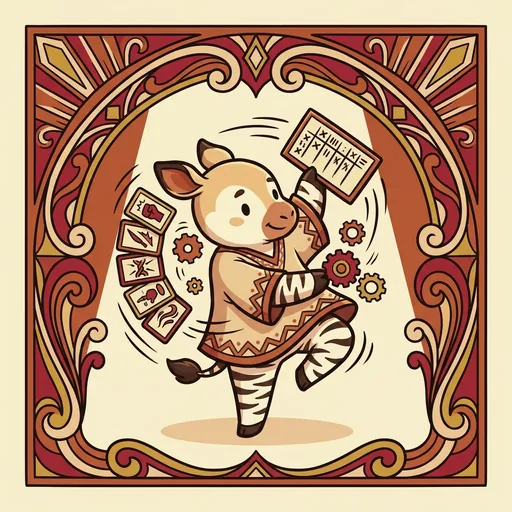
Lift was small, but don’t let that fool you. Her skin was the warm cream of savanna grasses, striped softly like a young okapi’s legs. She moved with a round, soft strength, never thin or sharp. Her eyes were always wide, taking in every twitch and sway of the world around her. She carried a small set of cards, worn at the edges, and a tiny tally counter. These were her tools.
Lift taught the energy + effort + movement-quality dynamics primitive. That was the fancy name for it. What it really meant was: how a movement feels, not how it looks. Most people thought good dance was about perfect posture or stretching until you could touch your toes. Lift knew better. She knew that the deepest instrument a dancer had wasn’t their body’s shape, but the quality of their movement.
“The same pose,” she’d say, holding her arms out, “can be sharp and heavy and sudden. Like a punch.” She’d demonstrate, her small body suddenly solid, pushing air away. “Or it can be soft and light and sustained. Like a float.” Her arms would drift then, as if carried by a gentle breeze. “Same body, same position. Very different movement.”
She held up one of her cards. On it was a drawing of a figure mid-action, and the word “PUNCH.” “Rudolf Laban named eight of these,” she explained. “Eight Efforts. Punch, slash, wring, press, dab, flick, glide, float. They name the qualities. They tell the story.”
Lift’s family had been “long-effort-shifters” for their village, back on the savanna edges. They were the okapis whose distinct strides, sudden stillness, and slow grazing had taught generations. They showed that the same body could move a hundred different ways. The shift between those ways, they said, was the dance. Lift carried that lesson with her to DanceQuest when she was twelve.
Rhythm, her mentor, had looked at her with knowing eyes. “What is energy and effort?” Rhythm asked.
Lift didn’t hesitate. “Quality of movement, not aesthetic judgment,” she answered, holding her small hand over her heart. “Effort is the dancer’s instrument. It’s the craft.”
Rhythm simply nodded. “You are appointed.”
In her workshop, Lift stood before a small group of students. She held her Laban-effort-cards. “Watch,” she said, her voice quiet but firm. She performed a simple reach-out motion eight times. Each time, it was the same arm, the same direction, but the feeling was completely different.
First, she punched. Her arm shot out, strong and sudden and direct. The air around her seemed to crackle. You could almost see anger or a firm decision in that single movement.
Then, she floated. Her arm drifted, light and sustained and indirect, like a leaf falling through still air. The students watched, mesmerized. It looked like dreaming, or pure wonder.
“Same pose,” Lift said, lowering her arm. “Same body. Eight different stories. The instrument is the choice you make.”
She picked up her tally counter. “Now, an effort shift. Within one eight-count.” She demonstrated. For counts one to four, her body was all float – light, sustained, indirect. Her movements were fluid, almost hazy. Then, on count five, everything changed. Her body snapped into a punch – strong, sudden, direct. The shift was startling.
“Same dancer,” she said, “two efforts. The phrase tells a story of waking from a dream.” She clicked her tally. “I am Lift. I teach energy, effort, and movement quality. The big idea is this: effort is the dancer’s instrument. It’s about quality, not what looks pretty. And every body can play every effort.”
Lift explained the three dimensions that made up each effort. “Weight,” she said, pressing her hand against an imaginary wall, then letting it hover. “Strong or light.” She paused. “Time. Sudden or sustained.” She snapped her fingers, then drew out a long, slow breath. “And space. Direct or indirect.” She pointed straight ahead, then made a wide, sweeping gesture.
“A punch,” she continued, “is strong, sudden, and direct. Like hitting a drum.” She demonstrated again, a quick, powerful strike. “A float is light, sustained, and indirect. Like a cloud drifting.” Her body softened, her gaze distant.
She talked about how different characters or moods needed different efforts. “A shy character might glide or float,” she suggested. “Someone angry might punch or slash.” Effort, she insisted, told the story. One well-chosen effort was always better than ten wild gestures with no clear quality.
“Some people say, ‘Do it bigger!’” Lift wrinkled her nose. “That’s vague. It doesn’t tell you how to move. Instead, ask yourself: ‘What effort am I choosing?’ Are you trying to make it stronger? More sudden? More direct?”
She shook her head. “And don’t let anyone tell you to ‘look effortless.’ Real effort control isn’t about looking a certain way. It’s about choosing the quality. It’s about intention.”
“And ‘graceful body’?” Lift scoffed gently. “That’s just about how someone thinks a body should look. Every body can do a gliding effort. No body type owns ‘grace.’ Your body is your instrument. You choose how to play it.”
Lift looked at each student in turn. “Don’t be told what ‘looks good’,” she said, her voice gentle but firm. “Be told what effort you’re choosing. Specify your effort, and your dance will have meaning. Without that, dance is just motion.” She smiled, a warm, reassuring expression. “Round, soft, strong, and effort-aware. That’s a dancer who tells stories.”
“Quality of movement, not aesthetic judgment,” she reminded them, her favorite phrase. “Effort is the dancer’s instrument.”
The DanceQuest ensemble
Lift is part of DanceQuest's distributed-narrative cast. Each character embodies a different curricular primitive; together they teach the full subject.
-

Pose
Body-awareness + position — listening to your own shape
-

Trail
Space + pathways — the floor-pattern shapes you draw moving through space
-

Phrase
Time + tempo — how movement is organized in musical counts
-

Glide
Locomotion — the craft of going from here to there with whole attention
-

Flock
Formation — how a group of dancers arranges itself in space (lines, circles, clusters, wedges) and how that shape flows and changes; the group as one moving picture
-

Storey
Level — dancing in the vertical space: low on the floor, mid at standing, high in reaches and jumps; every height belongs to dance, no height better than another
-

Beckon
Call-and-response — one dancer or group makes a movement and another answers it; a movement conversation built on truly listening before you reply
-

Canon
Unison and canon — unison is everyone moving together as one; canon is the same move staggered one after another, rolling across the group like a wave
-

Bide
Stillness and the hold — the held, alive, motionless moment inside a dance; negative space made of time; a strong chosen pause, not tiredness or absence
-

The Company
The whole group dancing as one — how formation, level, call-and-response, unison and canon, and stillness weave together so a group of dancers moves as a single living thing